
Growth requires the right mix of outlook, strategy, and capabilities. Top leaders achieve their goals by turning five mindsets into action.
Picture a venerable industrial conglomerate steeped in history, where tradition has calcified into stagnation, causing the company’s stock price to languish for decades.
Enter a dynamic leader with the vision to shake things up—not just to dream of growth but to ignite it. This new CEO doesn’t just bring fresh ideas. She brings a new mindset, refusing to accept silos and inefficiencies or to defer to the status quo. She leverages technology and analytics to uncover missed opportunities and new business adjacencies, acting swiftly to drive both growth and cost reduction. The result? An explosion of new energy across the company and a stock price nearly doubling in two years.
For CEOs and top executives everywhere, growing profitably is the ultimate fitness goal. It’s a long-term athletic pursuit that drives significant value, with high-growth companies experiencing 50 percent higher TSR than their peers. Profitable growers reap even greater rewards.
That said, achieving and sustaining growth is tough work. Previous McKinsey research found that only one in ten companies maintained above-GDP growth and remained in the S&P 500 over 30 years. Growth demands courage, dedication, and discipline.
About the research
Our McKinsey Growth Leaders Mindset Survey, conducted from June 7 to July 18, 2024, queried more than 500 leaders, including CEOs, presidents, other C-suite executives, senior vice presidents, and executive vice presidents. Respondents included leaders from all regions of the world
from publicly listed companies generating $1 billion or more in annual revenue and representing a wide range of industries, including consumer goods, energy and materials, financial services, healthcare, industrial, technology and media, and travel and leisure. Thirty-six percent of our
respondents are executives of companies we consider to be “growth outperformers.” To determine which companies were outperformers, we looked at more than 4,000 of the largest companies globally from 2017 to 2022 and identified those companies exceeding their subsector peers on revenue growth and profitability.
We asked each executive 50 questions about behaviors, mindsets, and practices related
to growth strategies and initiatives. These questions covered how executive teams set and track growth goals, allocate resources, monitor progress, and communicate growth to key stakeholders. The survey also explored
the leaders’ underlying growth mindsets and practices. Many of the mindsets remain consistent with previous McKinsey research, but we examine them in greater depth here.
Our findings reveal a disconnect between growth ambitions and actual actions. High-performing leaders, however, demonstrate mastery of certain mindsets that correlate with strong financial performance. This research builds on previous McKinsey articles, “Choosing to grow: The leader’s blueprint” and “Courageous growth: Six strategies for continuous growth outperformance,” and provides new insights for CEOs and senior executives pursuing growth.
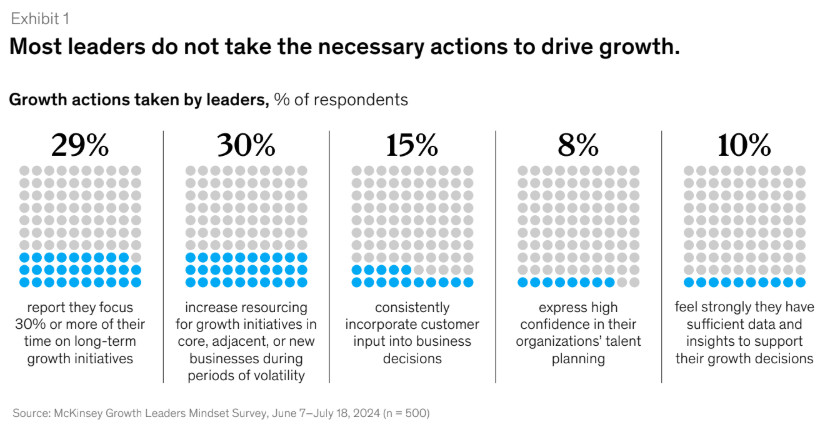
Our new survey research has found that while many leaders believe they’ve adopted and implemented productive mindsets for growth, these attitudes and ambitions don’t always translate into the behaviors and actions necessary to drive growth, as shown in Exhibit (see sidebar “About the research”).
Leaders of outperforming companies unlock sustained growth by aligning their behaviors with five critical mindsets: prioritizing growth, acting boldly, maintaining a customer-centric approach, attracting and nurturing talent, and executing with rigor. Growth outperformers—companies exceeding their subsector peers on revenue growth and profitability—do things differently. They set themselves apart by closing the gap between knowing and doing, turning their growth aspirations into reality.
The journey to growth is a marathon, not a sprint: it often requires more than 18 months to see results. To get there, leaders need more than just ambition and business savvy; they need a holistic approach with courage and resilience at the core. Getting fit for growth means converting mindsets into actions to drive toward targets. Leaders should be intentional in making decisions that reflect five critical growth mindsets.
1. Invest in growth, even in turbulent times
Investing in growth starts with thinking about, then acting upon, an organization’s long-term growth goals. Most leaders believe they make growth a top priority, with 72 percent of our survey respondents setting above-market targets compared with their peers in the same industry. They think they unite their businesses around ambitious targets, confidently adjusting and reallocating resources and talent as needed across both short-and long-term initiatives.
However, our survey results reveal gaps between executives’ growth ambitions and their ability to translate them into practices and results. Through-cycle outperformers—leaders who outperform through the ups and downs of an economic cycle by prioritizing long-term growth over short-term initiatives—tend to produce higher revenue growth than their peers. Yet, on average, respondents say that only 22 percent of their time is spent on long-term growth initiatives, with the remainder of their time dedicated to short-and medium-term projects (Exhibit 2).
How can leaders tactically invest in and prioritize growth? To become outperformers, leaders should align their behaviors to reflect a long-term vision and commitment to growth (see sidebar “From glassware to gen AI: Corning’s new growth trajectory”). Leaders’ focus areas should include the following:
- Spending more time on long-term growth initiatives. Leaders often underestimate the time and focus required for growth initiatives. To truly drive sustainable success, they should prioritize long-term growth and resist the temptation to get sidetracked by shorter-term tasks.
- Allocating resources to long-term growth initiatives. Businesses should continually survey the landscape for growth opportunities and take calculated risks in shifting resources to promising new areas, even when budgets are tight. Our survey results show that outperformers are 10 percent more likely than others to engage in monthly or quarterly debates with their teams about whether to accelerate, modify, or halt growth initiatives and to track progress against goals.
From glassware to gen AI: Corning’s new growth trajectory
Over the past few years, the stock price of 173-year-old specialty glassmaker Corning has undergone several swings. The COVID-19 pandemic initially spurred demand for fiber-optic cables and electronic devices needed to help a global population work remotely, as well as medical glassware critical for disease testing and vaccine delivery. Corning saw double-digit growth, with its stock price nearly tripling in just 12 months. However, as the pandemic waned, customers reduced their inventory, while consumers shifted spending from lockdown necessities to experiences and services in a reopened economy. By October 2023, Corning’s stock price hit a three-year low, with sales declining 11 percent from the previous year.
Facing this pivotal moment, CEO Wendell Weeks redefined the company’s growth trajectory. He recognized that the pandemic had temporarily depressed demand but was confident that a smart long-term strategy could lead to a rebound. “If you understand innovation deeply, you understand that getting the timing right is almost impossible. You’ve got to be able to instead go to work on stuff that matters early,” Weeks said to Fortune magazine in 2024. And that’s exactly what Corning has been doing for the last few years—quietly driving innovations to fuel explosive growth in areas like generative AI (Gen AI), while remaining ready to support a rebound in longer-term areas like broadband
expansion. Where some CEOs shy away from specific commitments and frequent accountability, Weeks has rallied internal stakeholders and announced his aspirations externally. He publicly outlined a concrete plan in 2024 to drive growth across business units, ambitiously aiming to deliver more than $3 billion in annualized sales over the next three years through existing and emerging product areas. He also promised to report quarterly about how the company was faring against its goals, a rarity among CEOs today.
Since announcing this growth plan, Corning accelerated product development in its optical business to support anticipated demand from the gen AI boom, all while managing costs and invested capital to maintain strong margins. Weeks’s ambitious mindset has already begun to pay off. In its 2024 third-quarter earnings call, Corning reported an 8 percent increase in revenue year over year, delivering growth above guidance. Adoption
of its new connectivity products for gen AI drove 55 percent of the year-over-year growth in the enterprise portion of Corning’s optical-communications segment. Weeks continues to provide public updates on key milestones, demonstrating his commitment to growth,
accountability, and momentum.
- Communicating externally and internally that growth is a North Star. Leaders should explicitly state ambitious growth goals to the board and executive team to generate buy-in and accountability. Outperformers are 80 percent more likely than others to communicate their achievements through town halls, investor updates, and performance reviews to help their teams hit ambitious long-term targets, according to our survey.

2. Be audacious on growth
Acting audaciously means thinking creatively, taking risks, and mobilizing resources quickly across a portfolio of growth bets and pathways. This includes a willingness to explore unconventional avenues with potential for growth (see sidebar “From Brazil to Saudi Arabia: Expanding cancer care across continents”). Eighty-three percent of outperformers in our survey indicate that they encourage their teams to test new ideas, fail quickly and affordably, and learn from the results. Furthermore, 79 percent of all survey respondents say they prioritize speed over perfection when it comes to their growth-related practices (Exhibit 3).
However, when it comes to committing resources to bold actions, the reality looks different. During periods of volatility, 30 percent of respondents say they choose to increase resourcing for growth initiatives—whether in core, adjacent, or new markets—indicating a reluctance to commit to courageous growth strategies when it matters most. Moreover, 47 percent of respondents tend to focus on tactics, such as pricing and automation, rather than making bold moves, such as investing in innovation or focusing on a new, unfamiliar market with high potential.
Leaders of outperforming companies set themselves apart in the following ways:
- Experimenting with bold risks to support innovative ideas. Amazon founder and executive Jeff Bezos has said that experimental failure can be beneficial. (He differentiates this from operational failure, where execution is poor.) Leaders who are willing to try new ideas, even when they may not pan out, can learn, innovate, and grow from the experience. According to a 2023 McKinsey digital strategy survey, top performers were 63 percent more likely than peers who were not outperformers to allocate resources to innovate in the development of a new product or to enter a new market, and 44 percent more likely to do so in “breakout” opportunities outside of their current industry or ecosystems.
- Favoring speedy action over perfection. Outperformers create a clear path to action that allows teams to execute on initiatives proactively or react rapidly to unpredictable shifts in the market. Sixty-four percent of outperformers act with speed when faced with market shocks or internal changes, allowing them to capture a first-mover advantage..
From Brazil to Saudi Arabia: Expanding cancer care across continents
Dr. Bruno Ferrari is no stranger to bold moves. The CEO of Oncoclinicas, which operates leading-class outpatient cancer care centers in Brazil, founded the company in 2010 with a single clinic in Belo Horizonte, Brazil, and expanded to more than 140 clinics in less than a decade. In a country where most healthcare is centralized, Ferrari built the Oncoclinicas network by building smaller clinics outside of the major hospital systems to meet patients where they were and where they most needed care.
Keen to expand the impact of Oncoclinicas, Ferrari went far afield. After learning that there was no specialized oncology provider to serve the 37 million people there, he sensed an opportunity. “We saw that there were key similarities between Brazil and Saudia Arabia in the challenges that people have in getting
cancer care,” he told us. “We decided to make a move and expand to the Middle East. Now we can help the people there by providing more accessible treatment with reduced wait times.”
In August 2024, Oncoclinicas announced a partnership with a local multisector conglomerate, Al-Faisaliah, to open its first cancer care clinic in Riyadh, with an eye toward future expansion across Saudi Arabia. The ability to have broad impact in an area with limited cancer care facilities, coupled with strong government support for the healthcare sector, made this unconventional strategy appealing to Ferrari. The joint venture is expected to open five new clinics, expand to other countries in the region, and generate $550 million in annual revenue (50 percent of Oncoclinicas’ current revenue) within five years.

3. Listen to your customers—for real
Improving customer experience creates stacked wins for higher returns, faster growth, and lower costs. As previously described in McKinsey’s work on experience-led growth, companies that put customer experience at the center achieve twice the revenue growth of those that fall behind in this area. Sixty-three percent of survey respondents cite customer feedback as a top source for generating growth ideas (second only to internal R&D, at 64 percent). Yet despite significant evidence showing that customer-centricity is important, only 15 percent of respondents say that they consistently incorporate customer input into their decisions, and just 23 percent say they regularly engage with customers to ensure their offerings deliver real value (Exhibit 4). This reveals a disconnect between the intent to prioritize customer needs and the reality of executing on that commitment.

Leaders of outperforming companies put the customer at the center by achieving the following:
- Figuring out what customers want next. Growth outperformers use predictive analytics to not only learn but actually predict needs. They look at the edges of their own industry and beyond to identify broader shifts. This allows them to truly understand their customers’ core desires, then create products and adjust services accordingly. To do this, leaders leverage AI and use technology beyond survey-based systems to identify customer experience issues and opportunities in real time. Forty-five percent of outperformers in our survey indicate that they use technology to better understand customer needs.
- Deploying gen AI to respond to customers. To deliver on brand promise and expectations, outperformers personalize responses to inquiries and quickly respond to customers in their moments of need. For example, autonomous gen AI agents augment human–customer interactions to improve service levels, customize interactions, and automate complex tasks.
- Ensuring customer insights are consistently translated into new growth initiatives. Outperformers ensure that once customer feedback is systemically captured and analyzed at scale, it is turned into innovations in products, services, or strategies that reflect that feedback and provide a superior customer experience (see sidebar “The beauty aficionados at the center of Sephora’s success”).
The beauty aficionados at the center of Sephora’s success
Despite intense competition from both established players and emerging brands, global beauty retailer Sephora has continued to experience significant organic growth across business units (LVMH’s selective retail business which houses the brand grew 25 percent in 2023). According to global president and CEO Guillaume Motte, the main ingredient to Sephora’s fast-growth success has been a relentless focus on customers. Sephora’s key initiatives in 2024 included enhancing the in-store experience with interactive displays and personalized consultations, convening more “SEPHORiA” experiences (a Fashion Week–like customer event), and building a skin analysis service based on feedback from customers.
Additionally, Sephora has cultivated a thriving community of over 40 million “Beauty Insiders.” This loyalty program rewards members with special events such as the Rouge Celebration, which leverages Sephora’s relationship with brands to provide special giveaways, discounts, and demonstrations to top customers. Sephora’s focus on customer engagement has paid off: Beauty Insider members account for a majority of Sephora’s annual transactions.
4. Rally a dream team for growth
Talent is essential for growth. Engaged employees fuel innovation, productivity, success of functional capabilities, and customer loyalty. By focusing on talent, companies can achieve a competitive advantage and cultivate an organization with a growth mindset.
Despite the important role talent plays in an organization’s ability to grow, 69 percent of respondents believe there is a significant human capital or capability gap within their organizations (Exhibit 5). Moreover, fewer than 8 percent of respondents express high confidence in their end-to-end talent strategy (that is, recruiting, integrating, upskilling) to deliver the workforce needed to drive future growth, casting doubt on their companies’ ability to fill talent gaps organically. These shortcomings highlight a critical disconnect between recognizing the importance of talent and taking credible steps to secure it.
Leaders of growth outperformers take a different approach to talent planning (see sidebar “Banking on tech talent for growth”). They center their organizations’ development on growth and nurture team relationships to foster cultural health, which in turn unlocks growth. These leaders focus on talent to fuel growth by making the following moves:
- Elevating and redeploying top performers. Many companies reward people based on the size of the business unit they oversee or how many people they manage. That means top performers often end up running more mature parts of an organization, rather than growth areas. Outperformers, however, invest in and offer incentives to high-performing talent by putting outstanding employees in more visible roles to further their development and continue to spark growth. Thirty-six percent of outperformers say they have an agile organizational talent model that allows easy movement of the best people through their companies.
- Rewarding failure when done fast and cheaply. Outperformers encourage taking calculated risks by creating a culture of psychological safety that supports iterative development and knowledge sharing, with the appropriate guardrails to derisk initiatives. Leaders who act on this mindset lead with optimism, not just pragmatism, to communicate a positive outlook clearly and encourage bold thinking.
- Pursuing unconventional sources for talent. High-growth leaders explore hiring from adjacent or different industries to bring a fresh level of thinking that pushes growth and spurs new and sometimes even uncomfortable conversations. They ensure that teams have the right combination of both big-picture visionaries and detail-oriented thinkers. Outperformers are 50 percent more likely than peers to proactively close talent gaps through external hiring. They do so not only in the C-suite but at each level of the organization.

Banking on tech talent for growth
Development Bank of Singapore (DBS), one of Southeast Asia’s largest banks, is focusing on nurturing top talent. The DBS executive team committed to hiring new talent and upskilling and reskilling tens of thousands of staff members, with a focus on fostering tech skills. Sameer Gupta, DBS’s chief analytics officer, recently shared with McKinsey the bank’s strategic approach, which focuses on building an enterprise-level data science talent pipeline through a targeted curriculum for data scientists and data analysts. Under his leadership, DBS has created a comprehensive training curriculum on AI and data for its employees across skill levels and fostered an environment that encourages learning for its employees across operations.
By investing in its technology talent (the bank has roughly twice as many technologists as bankers), DBS has successfully captured value from its early adoption of AI and machine learning. DBS employees have used gen AI to generate hundreds of ideas, including hyperpersonalized financial guidance for customers, deeper insights to enhance customer engagement, and customized career pathways to foster long-term employee growth. In 2023 alone, the bank’s AI and machine learning use cases generated approximately $270 million of incremental economic value, either through revenue growth or expenses saved.
5. Derisk growth by executing with excellence
Executives need a robust operating rhythm—one that clearly manages growth activities, communicates growth strategies, and ensures accountability—to succeed against their growth goals (see sidebar “Monday morning jolts: How one executive sparked growth through accountability”).
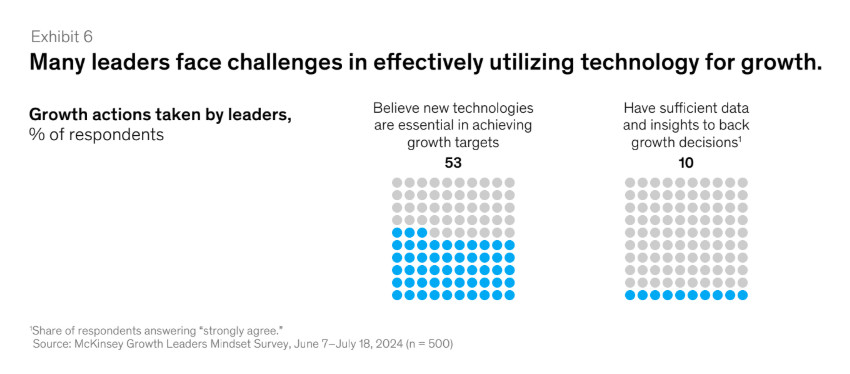
Derisking growth also requires executives to harness the right technology from the early planning stages all the way through to execution. The potential of AI and gen AI is, by now, widely viewed by executives as an important growth enabler. However, only 10 percent of executives in our survey believe they have sufficient data and insights to back their growth initiatives (Exhibit 6). Most leaders regularly check in on the performance of their initiatives but face significant challenges in effectively utilizing new technologies to drive growth.
As our recent research shows, successful growth transformers take the following actions:
Monday morning jolts: How one executive sparked growth through accountability
- They recognize risks and challenges and course-correct with agility. Outperformers establish processes such as using evaluation tools or conducting regular check-ins to identify, assess, and debate risks. They also ensure KPIs are as rigorously measured and monitored on growth initiatives as they would be on cost initiatives. More than 40 percent of respondents course-correct their growth initiatives based on measured progress against growth goals. They move first but minimize risk by closely monitoring growth initiatives and changing course if moves are proving unsuccessful.
- They remove roadblocks. Outperforming leaders don’t just check in with their teams. They also clear obstacles to unleash their full potential to drive growth, ensuring that every- one can focus on what they do best without getting bogged down by unnecessary hurdles.
- They enable decision-making and assign real accountability. These leading companies assign real influence and accountability at the initiative-owner level. Charging a broad slate of owners with specific remits and incentives to collaborate encourages an atmosphere of empowerment and trust.
When a new executive was tasked with growing a business unit at an iconic North American services company, she started by instituting weekly check-ins. But these were no ordinary check-ins with a readout and a few questions. Instead, she started the week with early Monday morning stand-up meetings, which included head-to-head matchups between teams, a growth leaderboard, and frequent uncomfortable challenges to those lagging behind on their targets.
The somewhat oppositional Monday morning check-ins worked. The initial discomfort across the team gave way to increased accountability and an entrepreneurial spark, which led to a nearly 25 percent increase in the division’s book of business year over year from 2023 to 2024 as the team hungrily chased growth against the odds.
Growth dreams alone don’t get you in shape. Doing real work, day in and day out, does. High-performing leaders don’t just hope for progress; they work up a sweat to make it happen. They translate aspirations into concrete plans and drive them forward with decisive leadership.
To do this, executives can start by asking and answering these fundamental questions:
- What funding have I recently reallocated toward growth? In any resource-constrained environment, there will always be ideas and initiatives that gain traction and those that wither away. Executives who can prioritize growth initiatives—even if it means making painful or conflict-ridden decisions—outperform their peers.
- Am I acting boldly, or just operating in my comfort zone? If growth decisions don’t lead to at least a little discomfort, they may not be bold enough. If your team is not able to call shots quickly (and change direction with agility, if needed), then there hasn’t been sufficient effort to derisk a bold growth move.
- What have I done lately to better integrate customer needs? Most companies generate customer insights of some kind. Gen AI agents and other tools create an opportunity to gather much more accurate customer insights rapidly. The executives who find success with growth are using the latest technology to better understand their customers and then act on those insights.
- Have I reconstituted my team to focus on growth? Fostering the best talent requires not only a strategy but also a willingness to make difficult decisions to put the right team in place. A group of people with the right experience isn’t enough. Leaders of outperforming companies also make it a point to have teams with the right balance of personalities to ensure high-quality discussions and collaboration.
- What targeted interventions have I made recently? Growth requires more than a strategy. It requires rigorous execution and mechanisms to track and support it. Executives should determine the best operating rhythms for themselves and their teams and implement necessary changes to ensure a consistent focus on growth.
It’s time to shift from “wanting” to “achieving.” Growth happens when leaders roll up their sleeves and get to work, mixing pragmatism with optimism to propel forward in sometimes-uncharted waters. Only then can leaders ensure their organizations are fit and ready for the growth journey ahead.