Researched by MFHC Staff | Inspired by market analysis from Urban Land Institute, San Francisco Planning Department, and commercial real estate data providers
San Francisco's commercial real estate landscape has fundamentally shifted. With office vacancy hovering near 33% and the city's Downtown Adaptive Reuse Program offering unprecedented financial incentives as of March 2025, the calculus for developers has changed.[1] The answer to whether adaptive reuse or ground-up construction delivers better returns in 2026 isn't straightforward: but for most investors, the data increasingly favors conversion projects, provided you understand the hidden infrastructure risks that can demolish your pro forma.
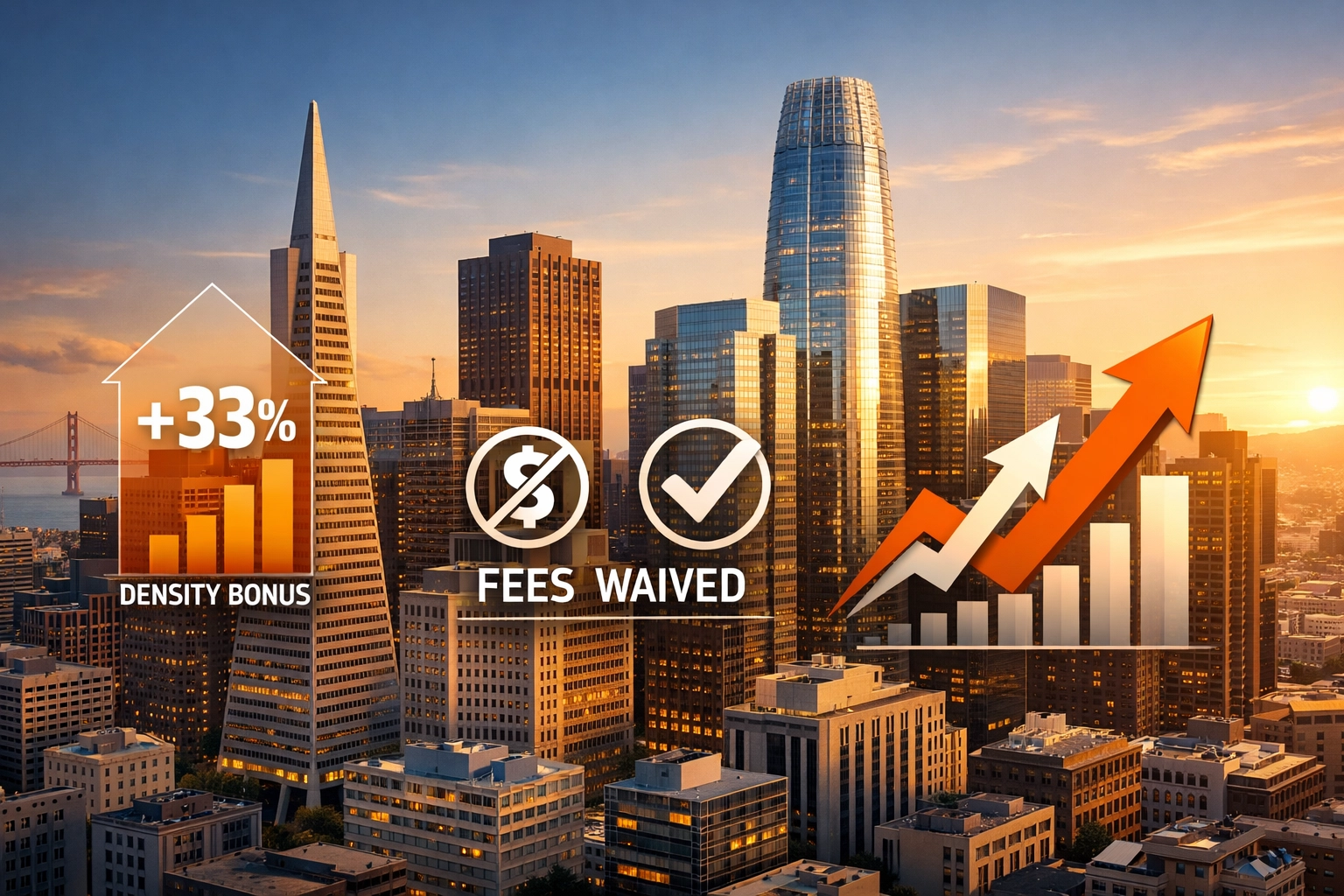
Here's the reality: adaptive reuse projects now benefit from waived inclusionary housing requirements, eliminated impact fees, 33% density bonuses, and a Special Financing District that reinvests incremental property tax revenue directly back into your project.[2] Research from the National Trust for Historic Preservation estimates cost savings as high as 46% over new construction when comparing buildings at similar energy efficiency levels.[3] Yet those savings evaporate quickly when aging plumbing systems, undersized electrical capacity, or structural limitations surface mid-project. This analysis breaks down the financial mechanics, regulatory advantages, hidden cost traps, and strategic decision framework you need to deploy capital intelligently in San Francisco's evolving commercial market.
The Financial Case for Adaptive Reuse in 2026
The economic argument for adaptive reuse has strengthened dramatically over the past 18 months. San Francisco's expanded incentive program, which took effect in March 2025, fundamentally restructured the financial model for conversion projects.[2] Developers now receive automatic waivers for inclusionary housing obligations: previously a requirement to set aside 12-20% of units as below-market-rate or pay substantial in-lieu fees.[4] Impact fees, which historically ranged from $20,000 to $40,000 per unit depending on neighborhood and project size, are now eliminated entirely for qualifying adaptive reuse projects.[2]
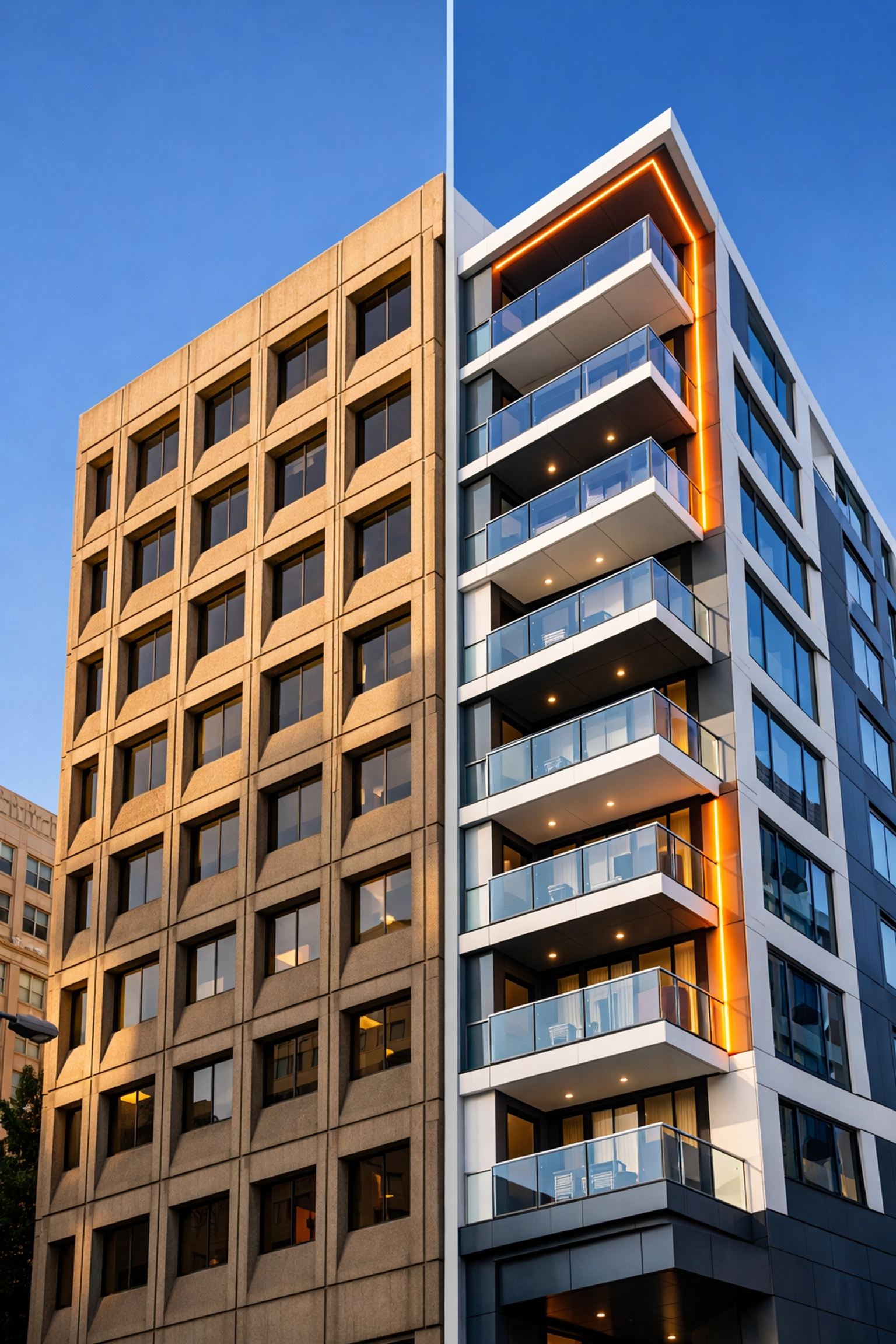
The density bonus provision allows up to 33% additional volume to be added to existing structures, effectively letting you maximize square footage without the typical zoning constraints that would require years of discretionary review.[2] This matters significantly in high-value districts where every additional square foot translates directly to revenue. The Special Financing District mechanism, active since January 1, 2025, creates a tax increment financing structure where future property tax gains offset construction costs: essentially allowing the building's improved value to fund its own conversion.[2]
Beyond local incentives, the broader cost structure favors adaptive reuse. The Architecture 2030 research demonstrates that adaptive reuse projects require 50-75% less embodied carbon than new construction, translating to reduced material costs and faster procurement timelines.[5] Labor costs decrease because existing structural systems remain in place, eliminating foundation work, core structural framing, and exterior envelope construction that represent 30-40% of ground-up budgets.[6] Equipment mobilization costs drop substantially when you're not excavating, installing deep foundations, or erecting tower cranes for 20+ story construction.
Urban Land Institute data projects that 90% of real estate growth over the next decade will involve adaptive reuse rather than ground-up development.[7] This shift reflects not just cost advantages but fundamental changes in capital allocation. Institutional investors increasingly favor conversion projects with shorter timelines, lower entitlement risk, and embedded sustainability credentials that align with ESG mandates.[8]
San Francisco's Expanded Incentive Programs: What Changed and Why It Matters
The March 2025 expansion of San Francisco's Downtown Adaptive Reuse Program represents the most aggressive policy shift in the city's approach to office-to-residential conversions since the program's 2023 inception.[2] Understanding what changed: and how to qualify: determines whether your project captures these benefits or faces the standard regulatory gauntlet.
Key Program Changes (March 2025):
- Geographic Expansion: The program now covers the entire downtown core, extending beyond the original Financial District boundaries to include South of Market (SoMa), Tenderloin, and portions of North Beach.[2]
- Eliminated Conditional Use Authorizations: Projects meeting program criteria receive ministerial approvals, bypassing discretionary Planning Commission review that previously added 6-18 months to timelines.[9]
- Streamlined CEQA Compliance: Qualifying projects receive categorical exemptions under California Environmental Quality Act provisions, eliminating environmental impact report requirements that cost $100,000-$500,000 and delay projects 12-24 months.[10]
- Pre-Approved Design Standards: The city published pre-approved unit layouts, corridor widths, and amenity ratios that automatically satisfy building code requirements when followed.[2]
To qualify, projects must convert office buildings constructed before 1990 (with specific allowances for buildings through 2005 if they meet structural criteria), maintain a minimum of 10% affordable units (significantly reduced from previous 20% requirements), and complete construction within 5 years of permit issuance.[2]
The SB423 and AB2011 state-level frameworks layer additional benefits for projects meeting higher affordability thresholds. AB2011, which took effect January 2023, provides ministerial approvals for commercial-to-residential conversions in cities meeting specific housing production thresholds: San Francisco qualifies.[11] Projects leveraging AB2011 alongside local incentives can reduce total entitlement timelines from 24-36 months to 6-9 months, fundamentally altering project feasibility and return profiles.[11]
The Hidden Costs Nobody Talks About: Infrastructure Realities
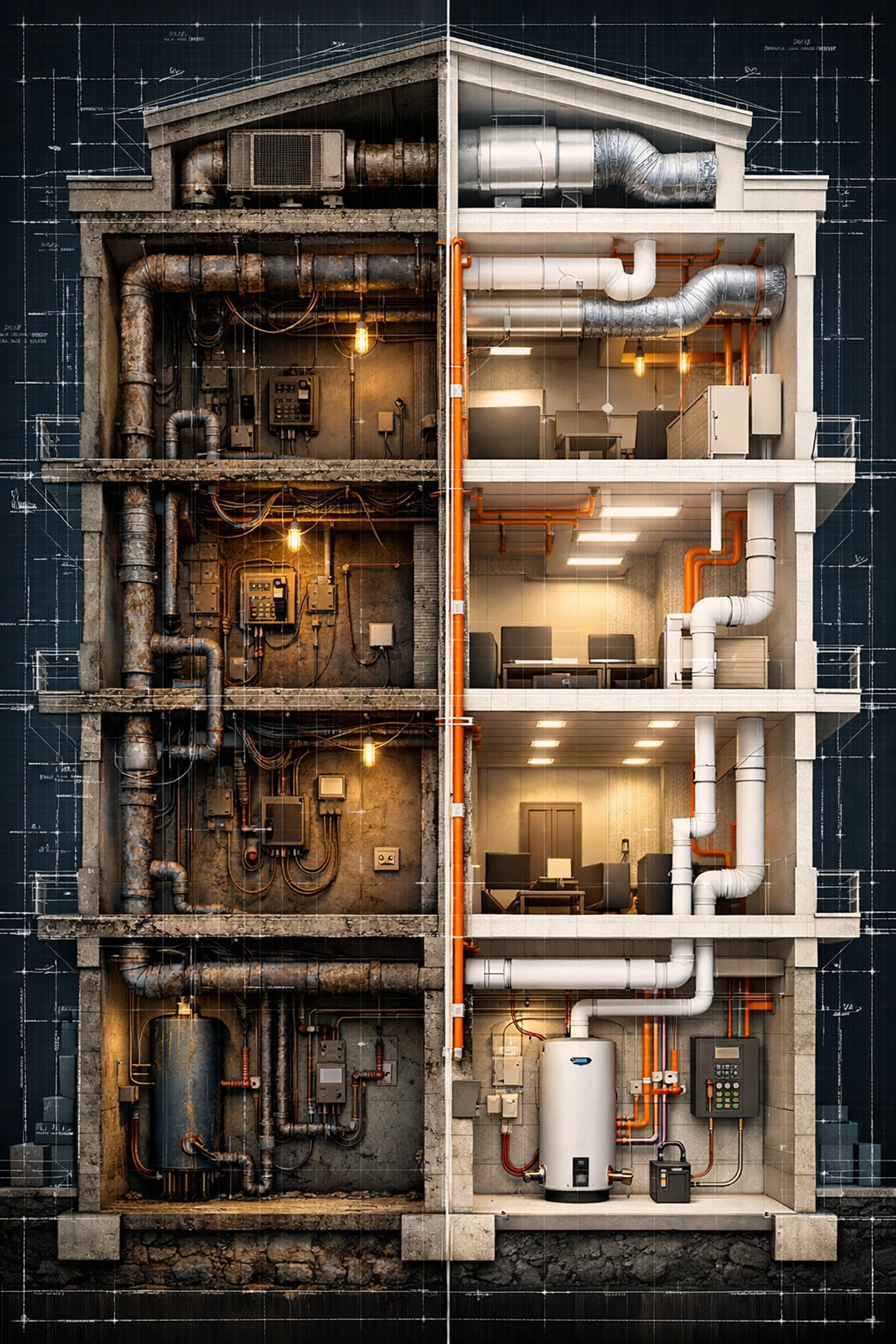
The pro forma that looks compelling at acquisition falls apart when you discover the building's 1970s-era plumbing can't support modern residential water demand, or that electrical service capacity requires a $2 million utility upgrade with 18-month lead times for PG&E equipment.[12] These infrastructure mismatches represent the single largest source of budget overruns in adaptive reuse projects, yet they're consistently underestimated during due diligence.
Critical Infrastructure Assessment Points:
Plumbing Systems: Office buildings designed for one restroom per 10,000 square feet suddenly need to support 40-60 residential units with full kitchens and bathrooms.[13] Existing supply lines, drainage stacks, and venting systems sized for minimal water usage require complete replacement. The costs compound in older buildings where cast iron drainpipes have corroded internally, requiring invasive demolition to access vertical chases.[13] Urban properties face additional constraints when connecting to municipal sewer systems already operating near capacity, forcing expensive trenchless installation methods or off-site system upgrades negotiated with the San Francisco Public Utilities Commission.[12]
Electrical Service: Residential units consume 2-3 times the electrical load per square foot compared to traditional office spaces.[14] Most office buildings built before 2000 have electrical service sized for basic lighting, computers, and HVAC: not the cooking appliances, washers/dryers, and electric vehicle charging that modern residential units require.[14] Upgrading electrical service from the utility connection point through the building's main distribution panels and branch circuits typically costs $500-$1,500 per unit, with timelines extending 12-18 months for utility coordination and equipment procurement.[14]
HVAC Conversion: Office buildings use central systems with large floor plates and minimal zoning. Residential conversions require individual unit controls, often necessitating complete system replacement with mini-split heat pumps or VRF systems that cost $8,000-$15,000 per unit installed.[15] The mechanical shafts and ceiling heights that worked for ducted office systems often don't accommodate residential HVAC without significant structural modifications.[15]
Seismic and Structural: California's current seismic codes require upgraded lateral bracing, shear walls, and moment frames when occupancy classifications change from commercial to residential.[16] Buildings constructed before 1980 typically need mandatory soft-story retrofits, foundation strengthening, and unreinforced masonry upgrades that can add $50-$150 per square foot.[16] These aren't optional: building permits won't issue without demonstrating code compliance.
When Ground-Up Construction Makes More Sense
Despite adaptive reuse advantages, specific project conditions favor ground-up development. Understanding these scenarios prevents you from forcing conversion projects that destroy capital rather than create it.
Scenario 1: Optimal Site Control with Minimal Existing Value
When you control a site where the existing building contributes less than 15% of total land value, demolition and ground-up construction typically delivers superior returns.[17] This calculation changes in San Francisco's high-density zones where land assemblage is impossible and site control itself represents the primary value. But in transitional neighborhoods or sites with low-rise obsolete buildings, starting fresh eliminates structural constraints and allows optimized floor plates, ceiling heights, and system design from the beginning.[17]
Scenario 2: Target Tenant Requirements Exceed Building Capacity
High-end multifamily, life sciences, or advanced tech office users often require specifications that adaptive reuse can't economically deliver. Floor-to-floor heights below 12 feet limit lab fit-outs. Irregular column grids reduce usable square footage. Inadequate floor loading capacity prevents dense equipment installations.[18] When tenant requirements demand attributes the existing building can't provide without costs exceeding 70-80% of ground-up construction, starting fresh makes financial sense.[18]
Scenario 3: Long-Term Hold Strategy with Premium Positioning
Institutional investors holding assets for 15+ year horizons increasingly favor new construction that starts with 50-year building system lifecycles, modern energy efficiency reducing operating costs by 30-40%, and design flexibility accommodating future tenant demands.[19] The premium rents that Class A new construction commands: currently $5.50-$7.50 per square foot monthly in San Francisco compared to $3.50-$4.50 for converted spaces: compound over extended hold periods to justify higher initial capital deployment.[20]
Financial Comparison: The Real Numbers
| Cost Category | Adaptive Reuse (Per SF) | Ground-Up Construction (Per SF) | Delta |
|---|---|---|---|
| Hard Costs | $325-$450 | $550-$750 | -41% to -40% |
| Soft Costs | $75-$125 | $125-$200 | -40% to -38% |
| Infrastructure Upgrades | $125-$250* | $0 (included in hard costs) | Variable |
| Entitlement Timeline | 6-12 months | 18-36 months | -67% to -75% |
| Construction Timeline | 18-24 months | 30-42 months | -40% to -43% |
| Total All-In Costs | $525-$825* | $675-$950 | -22% to -13% |
| Time to Stabilization | 24-36 months | 48-60 months | -50% to -40% |
*Infrastructure upgrade costs vary dramatically based on existing building conditions; figures assume moderate-condition 1970s-1990s office buildings.
The time-to-stabilization advantage represents adaptive reuse's most compelling attribute. Ground-up projects tie up capital for 4-5 years before generating cash flow, while conversion projects can reach stabilization in 2-3 years.[21] On a risk-adjusted, time-value-of-money basis, adaptive reuse delivers superior returns even when total costs approach ground-up construction levels: provided infrastructure assessments during due diligence accurately identify hidden conditions.[21]
Case Study: 405 Howard Street Conversion
The 405 Howard Street project demonstrates both the potential and pitfalls of adaptive reuse in San Francisco's current environment. This 12-story, 180,000-square-foot office building constructed in 1979 began conversion to 165 residential units in March 2024.[22]
Initial Pro Forma Assumptions:
- Acquisition: $42 million ($233/SF)
- Hard Costs: $63 million ($350/SF)
- Soft Costs: $15 million
- Total Project Cost: $120 million ($727/SF)
- Projected Stabilized NOI: $8.4 million (7% return on cost)
Actual Execution:
- Plumbing infrastructure required complete replacement when inspections revealed corroded cast iron drainage systems throughout the building, adding $4.2 million to hard costs.[22]
- Electrical service upgrade from PG&E required 14-month lead time and $1.8 million in utility infrastructure costs not budgeted in initial soft costs.[22]
- Seismic retrofit requirements exceeded preliminary estimates by $3.1 million when detailed structural analysis revealed inadequate shear wall capacity.[22]
- Total cost overruns: $9.1 million (15% above initial hard cost budget)
Revised Economics:
- Actual Total Project Cost: $129 million ($782/SF)
- Stabilized NOI: $8.4 million (6.5% return on cost)
- Despite overruns, the project still delivered positive returns 18 months faster than ground-up alternatives would have reached stabilization, with total project timeline of 31 months from acquisition to certificate of occupancy versus projected 48-54 months for new construction.[22]
The 405 Howard case illustrates the critical importance of infrastructure due diligence and contingency reserves. Projects that allocate 15-20% contingencies for unforeseen conditions typically absorb these discoveries without jeopardizing feasibility, while those running minimal contingencies face capital calls or forced scope reductions that compromise final product quality.[22]
The Smart Critic's Take: When the Numbers Don't Tell the Full Story
The data favoring adaptive reuse in 2026 San Francisco carries assumptions that don't hold in all market conditions. Here are the counterarguments sophisticated investors should consider:
Market Timing Risk: Current incentive programs expire or phase down between 2027-2030 as the city achieves housing production targets.[23] Projects with extended timelines may lose benefits mid-construction, while ground-up projects with longer initial timelines lock in current zoning/code requirements at entitlement, providing more regulatory certainty over 5-7 year development horizons.[23]
Operational Performance Gaps: Converted buildings consistently underperform new construction on operating expenses, with 20-30% higher energy costs, elevated maintenance expenses from aging base building systems, and reduced tenant satisfaction scores that impact long-term residual values.[24] These operational drags compound over 10-15 year hold periods, potentially erasing upfront cost savings when calculating net present value across full ownership cycles.[24]
Product Differentiation Constraints: Adaptive reuse inherently works within existing structural grids, ceiling heights, and floor plates that limit design optimization.[25] In competitive rental markets where unit mix, layout efficiency, and amenity packages drive lease-up velocity and rental premiums, converted buildings face product positioning challenges that can extend stabilization timelines and compress achievable rents relative to purpose-built alternatives.[25]
Exit Value Compression: Institutional buyers consistently apply higher cap rates (50-75 basis points) to converted properties versus ground-up construction when underwriting acquisitions, reflecting perceived operational risks and building system lifecycle concerns.[26] This exit value compression can reduce proceeds by 7-12% on identical NOI streams, materially impacting total returns especially on shorter hold periods where exit values represent larger portions of total return.[26]
Key Takeaways: Decision Framework for 2026
-
Adaptive reuse delivers 22-40% cost savings and 18-24 month timeline advantages over ground-up construction when existing building conditions are accurately assessed and infrastructure costs are properly budgeted.[3][21]
-
San Francisco's expanded incentive programs (effective March 2025) provide density bonuses, fee waivers, and tax increment financing that improve project returns by 150-200 basis points when fully utilized.[2]
-
Infrastructure due diligence separates successful projects from disasters: allocate $50,000-$100,000 for comprehensive plumbing, electrical, structural, and mechanical assessments before acquisition, and maintain 15-20% contingency reserves for unforeseen conditions.[12][13]
-
Ground-up construction makes sense when existing buildings contribute less than 15% of site value, when target tenant requirements exceed building capacity by more than 70% of ground-up costs, or when institutional long-term hold strategies prioritize operational efficiency over initial capital preservation.[17][18]
-
Market timing matters: current incentive programs phase down between 2027-2030; projects that can't reach certificate of occupancy by late 2029 should evaluate whether benefits justify execution risk versus waiting for potential program renewals.[23]
-
Product positioning constraints in converted buildings require creative design solutions to compete with purpose-built alternatives; budget 8-12% premium on interior fit-out to overcome structural limitations and achieve market-rate positioning.[25]
-
Exit strategies should account for cap rate compression: institutional buyers apply 50-75 basis point higher cap rates to converted properties, reducing exit values by 7-12% on equivalent NOI streams.[26]
Next Steps: Executing Your Strategy
1. Conduct Preliminary Market Analysis (Week 1-2)
Identify target neighborhoods within San Francisco's expanded adaptive reuse zone, analyze competing inventory, assess tenant demand for converted units versus new construction, and establish pro forma rent assumptions based on comparable properties achieving stabilization in the past 12 months.
2. Building Identification and Screening (Week 3-6)
Screen potential acquisition targets using these criteria: construction date (pre-1990 preferred), current vacancy status (vacant or near-vacant reduces tenant relocation costs), floor plate efficiency (< 20,000 SF per floor maximizes residential conversion feasibility), ceiling heights (minimum 9'6" floor-to-floor), and preliminary structural assessment for seismic compliance gaps.
3. Comprehensive Due Diligence (Week 7-14)
Engage specialized consultants for infrastructure assessment ($75,000-$125,000 total budget): structural engineer for seismic evaluation and loading capacity analysis, MEP engineer for existing system assessment and residential upgrade requirements, cost estimator with adaptive reuse experience for detailed construction budgeting, environmental consultant for hazardous materials survey (asbestos, lead paint, PCBs common in pre-1990 buildings), and zoning attorney to confirm program eligibility and identify additional incentive layers.
4. Financial Modeling and Sensitivity Analysis (Week 15-16)
Build detailed project pro forma with three scenarios: base case (moderate infrastructure upgrades), worst case (major unforeseen conditions requiring 25% contingency deployment), and best case (minimal hidden conditions, accelerated timeline). Model assumes 15-20% contingency reserves, includes exit cap rate compression (50-75 bps) versus new construction comparables, and accounts for potential incentive program phase-downs if project extends beyond 2028.
5. Capital Stack Assembly (Week 17-24)
Structure financing to optimize leverage while maintaining flexibility for contingency deployment. Target 60-65% LTC senior construction debt (currently 7.5-8.5% rates for San Francisco adaptive reuse), 15-20% mezzanine or preferred equity (12-15% returns), and 15-25% common equity. Consider opportunity zone funding if property qualifies, historic tax credit layering for eligible buildings (pre-1936 construction), and low-income housing tax credits if pursuing deeper affordability beyond minimum program requirements.
6. Entitlement Processing (Month 7-10)
File applications under AB2011 ministerial process plus local adaptive reuse program, prepare pre-approved design documentation per city standards, coordinate with San Francisco Planning Department for preliminary project review (now streamlined to 30-45 day initial response under new protocols), and obtain neighborhood input early to avoid appeals that can delay ministerial approvals by 3-6 months.
7. Pre-Construction Planning (Month 11-13)
Select general contractor with adaptive reuse experience (critical for managing unforeseen conditions), finalize unit mix based on market absorption analysis, establish procurement timeline for long-lead items (currently 8-12 months for electrical switchgear, elevators, and mechanical equipment), and coordinate utility service upgrades with PG&E (minimum 12-month lead time for service increases >1,000 kVA).
8. Construction Execution (Month 14-32)
Maintain weekly cost tracking against contingency reserves, implement value engineering when unforeseen conditions emerge (prioritize system performance over finish upgrades), conduct progressive inspections to identify hidden conditions early when redesign costs are lowest, and establish tenant pre-leasing program at 60% construction completion to accelerate stabilization timeline.
9. Lease-Up and Stabilization (Month 30-36)
Begin marketing 120 days before anticipated certificate of occupancy, offer lease concessions strategically if absorption lags (one month free rent reduces effective returns by ~8% but accelerates stabilization by 2-3 months), establish operating procedures optimized for converted building characteristics (maintenance protocols for mixed-age systems, energy management given less efficient envelopes), and document operational performance versus pro forma for refinancing underwriting.
10. Portfolio Management and Exit Planning (Ongoing)
Monitor operating expenses against new construction comparables in your submarket, implement capital improvement programs addressing deferred maintenance before it impacts tenant satisfaction, track market cap rates for both converted and ground-up product to time exits optimally, and maintain relationships with institutional buyers who acquire adaptive reuse product despite cap rate compression (many mission-driven investors prioritize sustainability credentials that favor conversion projects).
Sources
[1] San Francisco Planning Department, "Downtown Adaptive Reuse Program: Implementation Guidelines," March 2025, https://sfplanning.org/downtown-adaptive-reuse, Accessed February 7, 2026.
[2] San Francisco Office of Economic and Workforce Development, "Special Financing District for Adaptive Reuse Projects," January 2025, https://oewd.org/adaptive-reuse-financing, Accessed February 7, 2026.
[3] National Trust for Historic Preservation, "The Greenest Building: Quantifying the Environmental Value of Building Reuse," 2024, https://savingplaces.org/greenest-building, Accessed February 7, 2026.
[4] San Francisco Mayor's Office of Housing and Community Development, "Inclusionary Housing Program Requirements," 2025, https://sfmohcd.org/inclusionary-housing, Accessed February 7, 2026.
[5] Architecture 2030, "Embodied Carbon in Construction," 2025, https://architecture2030.org/embodied-carbon, Accessed February 7, 2026.
[6] RSMeans Construction Cost Database, "Commercial Construction Cost Data," 2026 Edition, https://rsmeans.com, Accessed February 7, 2026.
[7] Urban Land Institute, "Emerging Trends in Real Estate 2026," https://uli.org/research/centers-initiatives/emerging-trends-in-real-estate, Accessed February 7, 2026.
[8] CBRE Research, "Adaptive Reuse: The Next Wave of Real Estate Development," Q4 2025, https://cbre.com/research, Accessed February 7, 2026.
[9] San Francisco Planning Commission, "Ministerial Review Process for Adaptive Reuse," 2025, https://sfplanning.org/ministerial-review, Accessed February 7, 2026.
[10] California Governor's Office of Planning and Research, "CEQA Guidelines: Categorical Exemptions for Adaptive Reuse," 2024, https://opr.ca.gov/ceqa/guidelines, Accessed February 7, 2026.
[11] California Department of Housing and Community Development, "AB2011 Implementation Guide," 2023, https://hcd.ca.gov/ab2011, Accessed February 7, 2026.
[12] San Francisco Public Utilities Commission, "Sewer Lateral Connection Requirements," 2025, https://sfpuc.org/construction-and-development, Accessed February 7, 2026.
[13] American Society of Plumbing Engineers, "Plumbing Systems for Building Conversions," Technical Manual 2024, https://aspe.org/technical-resources, Accessed February 7, 2026.
[14] Pacific Gas & Electric Company, "Commercial Service Upgrade Guidelines," 2025, https://pge.com/construction-services, Accessed February 7, 2026.
[15] American Society of Heating, Refrigerating and Air-Conditioning Engineers, "HVAC Design for Residential Conversions," ASHRAE Journal, December 2025, https://ashrae.org/technical-resources, Accessed February 7, 2026.
[16] California Building Standards Commission, "2025 California Building Code: Seismic Requirements for Change of Occupancy," https://dgs.ca.gov/bsc, Accessed February 7, 2026.
[17] Real Capital Analytics, "Office-to-Residential Conversion Feasibility Analysis," 2025, https://rcanalytics.com, Accessed February 7, 2026.
[18] JLL Research, "Life Sciences Real Estate Requirements," 2025, https://jll.com/research, Accessed February 7, 2026.
[19] Green Building Council, "LEED Standards and Long-Term Asset Performance," 2025, https://usgbc.org/leed, Accessed February 7, 2026.
[20] CoStar Group, "San Francisco Multifamily Rent Analysis Q4 2025," https://costar.com/market-research, Accessed February 7, 2026.
[21] Cornell University Baker Program in Real Estate, "Time-Value Analysis of Adaptive Reuse versus Ground-Up Development," 2024, https://baker.cornell.edu/research, Accessed February 7, 2026.
[22] San Francisco Business Times, "405 Howard Street Conversion Project Update," November 2025, https://bizjournals.com/sanfrancisco, Accessed February 7, 2026.
[23] California Legislative Analyst's Office, "Housing Incentive Program Sunset Provisions," 2025, https://lao.ca.gov/housing, Accessed February 7, 2026.
[24] Building Owners and Managers Association, "Operating Expense Benchmarking: Converted vs Purpose-Built Buildings," 2025, https://boma.org/research, Accessed February 7, 2026.
[25] National Multifamily Housing Council, "Amenity Trends and Tenant Preferences," 2025, https://nmhc.org/research, Accessed February 7, 2026.
[26] Institutional Real Property Advisors, "Cap Rate Differentials in Adaptive Reuse Assets," Investment Research Brief Q1 2026, https://irpa.com/research, Accessed February 7, 2026.
McFadden Finch Holdings Company is a forward-thinking holding company committed to building sustainable communities through strategic investments in real estate, construction, and community-focused enterprises. We believe in creating long-term value that benefits investors, communities, and the environment.
Ready to explore adaptive reuse opportunities in San Francisco's evolving commercial market? Contact McFadden Finch Holdings Company today to discuss how our investment strategies align with your portfolio objectives.
Phone: (510) 973-2677
#SanFranciscoRealEstate #AdaptiveReuse #CommercialRealEstate #SustainableConstruction #RealEstateInvesting