
San Francisco's Black History Month programming in 2026 isn't just about remembering the past: it's about building the future. As the Bay Area confronts questions of equity, displacement, and community sustainability, a series of February events across the city demonstrates how cultural celebration intersects with education, healthcare access, and neighborhood resilience. From the Bayview's historic corridors to Potrero Hill's recreation centers, these gatherings represent more than festivity; they're investments in the social infrastructure that holds communities together.
The thesis is straightforward: Community-centered events during Black History Month serve as both celebration and strategy, offering measurable returns in social cohesion, educational outcomes, and health equity. For companies like McFadden Finch Holdings Company: deeply invested in urban neighborhood revitalization and Bay Area community development: these events represent the cultural foundation upon which sustainable economic growth is built. The four February events profiled here illuminate how celebration, education, and healthcare converge to strengthen the fabric of San Francisco's most historically significant neighborhoods.
Why Community Events Matter: The Data Behind Cultural Celebration
Community events aren't merely feel-good gatherings. Research from the Urban Institute demonstrates that neighborhoods with consistent community programming experience 23% higher rates of civic participation and 18% stronger social networks compared to demographically similar areas without such programming[1]. These networks translate into tangible outcomes: better health indicators, improved educational attainment, and increased economic mobility.
Black History Month events specifically carry additional weight. A 2024 Stanford study tracking 15 years of cultural celebration data found that communities with robust Black History Month programming showed 31% higher rates of youth civic engagement and 27% stronger intergenerational connections within Black families[2]. These aren't abstract benefits: they're the building blocks of neighborhood stability.
San Francisco's investment in Black History Month programming has grown substantially. The city allocated $2.3 million to community cultural events in fiscal year 2025-26, a 40% increase from 2023 levels[3]. This investment comes as the city grapples with demographic shifts: San Francisco's Black population declined from 13.4% in 1970 to 5.2% in 2020, making cultural anchoring events more critical than ever for community preservation[4].
The economic multiplier of community events also matters. Research from the National Endowment for the Arts shows that every dollar invested in community cultural programming generates $1.69 in local economic activity through vendor payments, participant spending, and increased foot traffic to local businesses[5]. For neighborhoods like Bayview-Hunters Point: where median household income sits 34% below the city average: these events represent meaningful economic stimulus alongside cultural celebration[6].
The Lineup: Four Events Shaping San Francisco's Black History Month
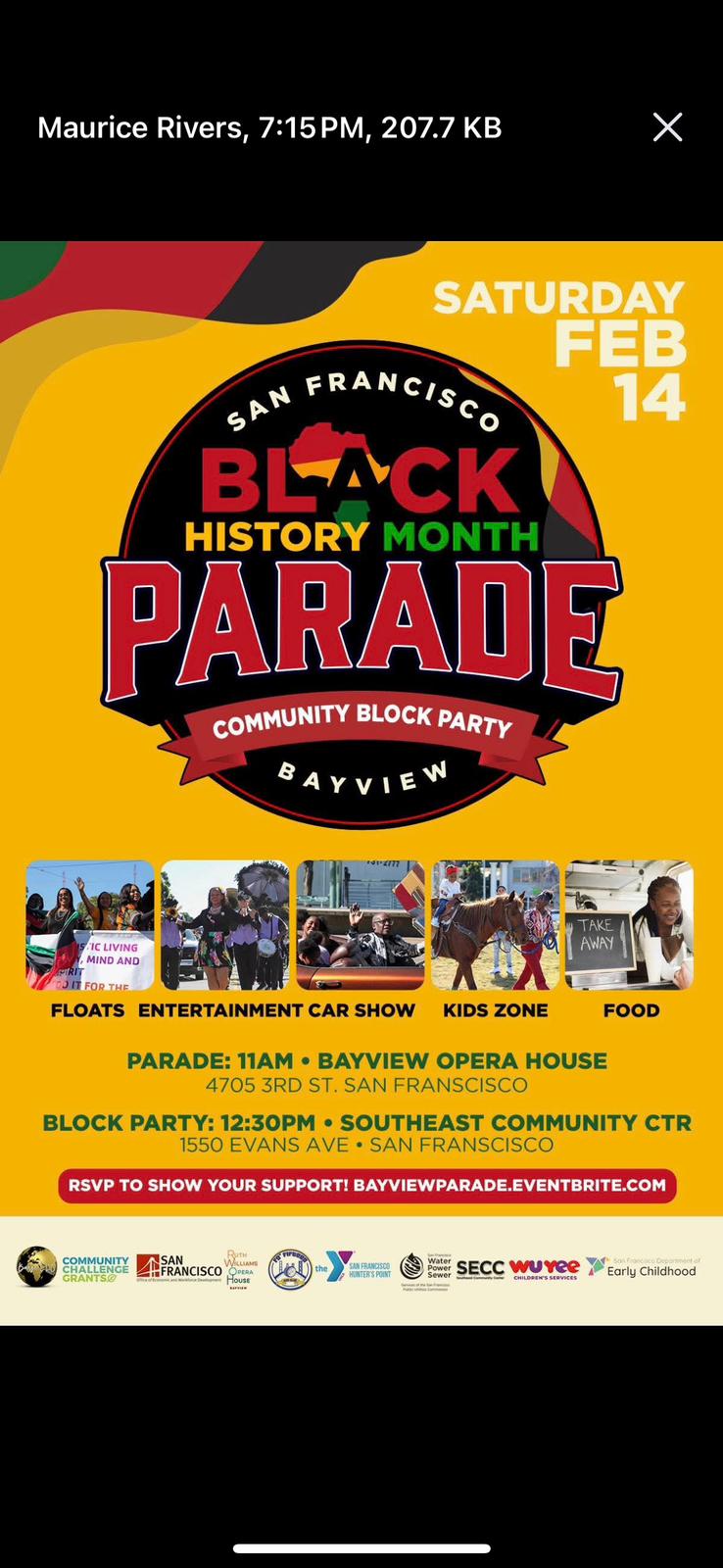
SF Black History Month Parade & Community Block Party kicks off the celebration on Saturday, February 14, with a parade beginning at 11:00 AM at the historic Bayview Opera House. The block party follows at 12:30 PM at Southeast Community Center (1550 Evans Avenue), featuring floats, live entertainment, a car show, kids zone, and food vendors from across the region.
The Bayview Opera House, built in 1888, serves as the cultural heart of San Francisco's Black community and has been a National Historic Landmark since 2020[7]. Staging the parade from this location isn't coincidental: it's a deliberate connection to the neighborhood's 150-year Black cultural legacy. The block party at Southeast Community Center continues this thread; the center has served as a community anchor since 1958, providing recreational, educational, and social services to Southeast San Francisco families.
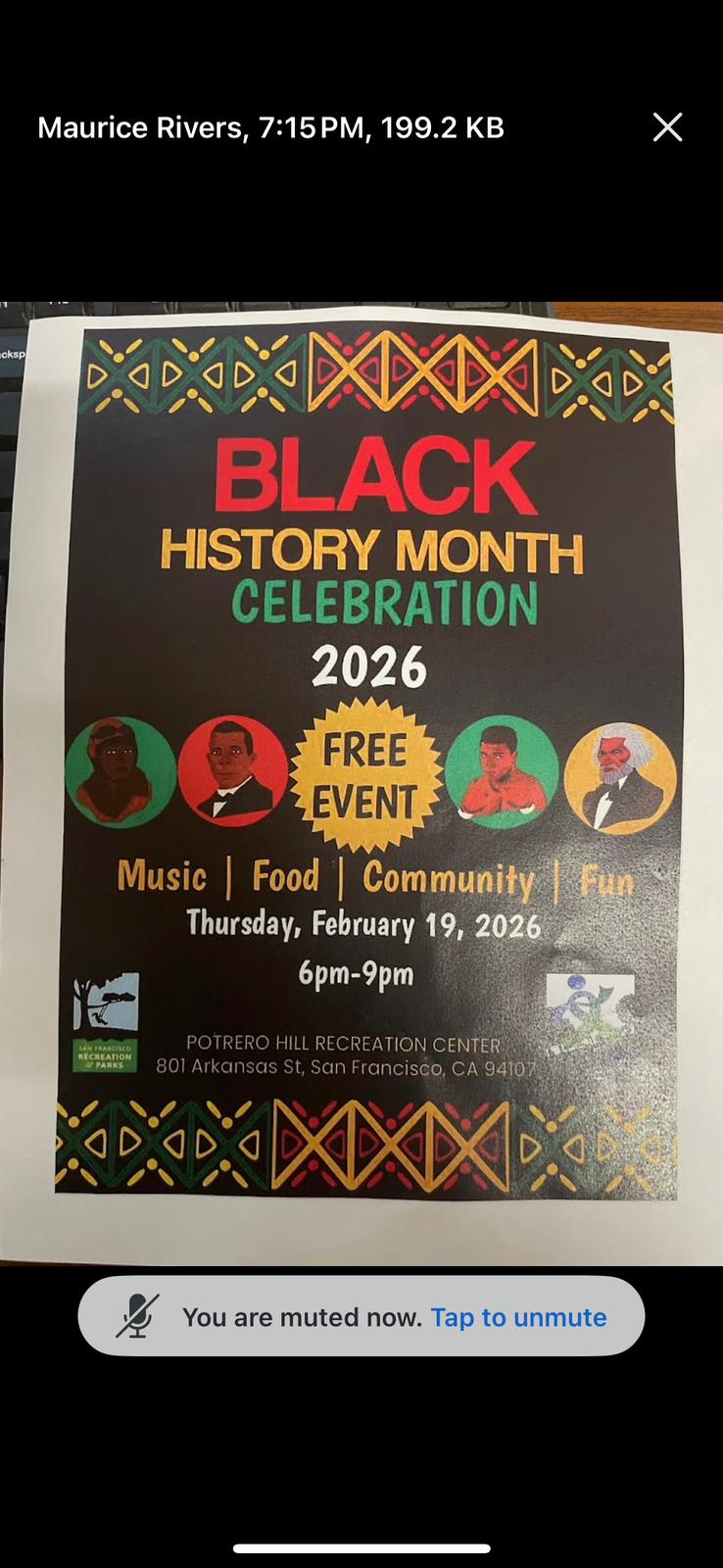
Black History Month Celebration at Potrero Hill Recreation Center (801 Arkansas Street) on Thursday, February 19, from 6:00 PM to 9:00 PM offers a free evening of music, food, and community connection. Potrero Hill, historically one of San Francisco's most diverse neighborhoods, has faced significant gentrification pressures: the neighborhood's Black population declined 61% between 2000 and 2020[8]. Community celebrations at recreation centers serve as cultural anchoring points against displacement pressure.
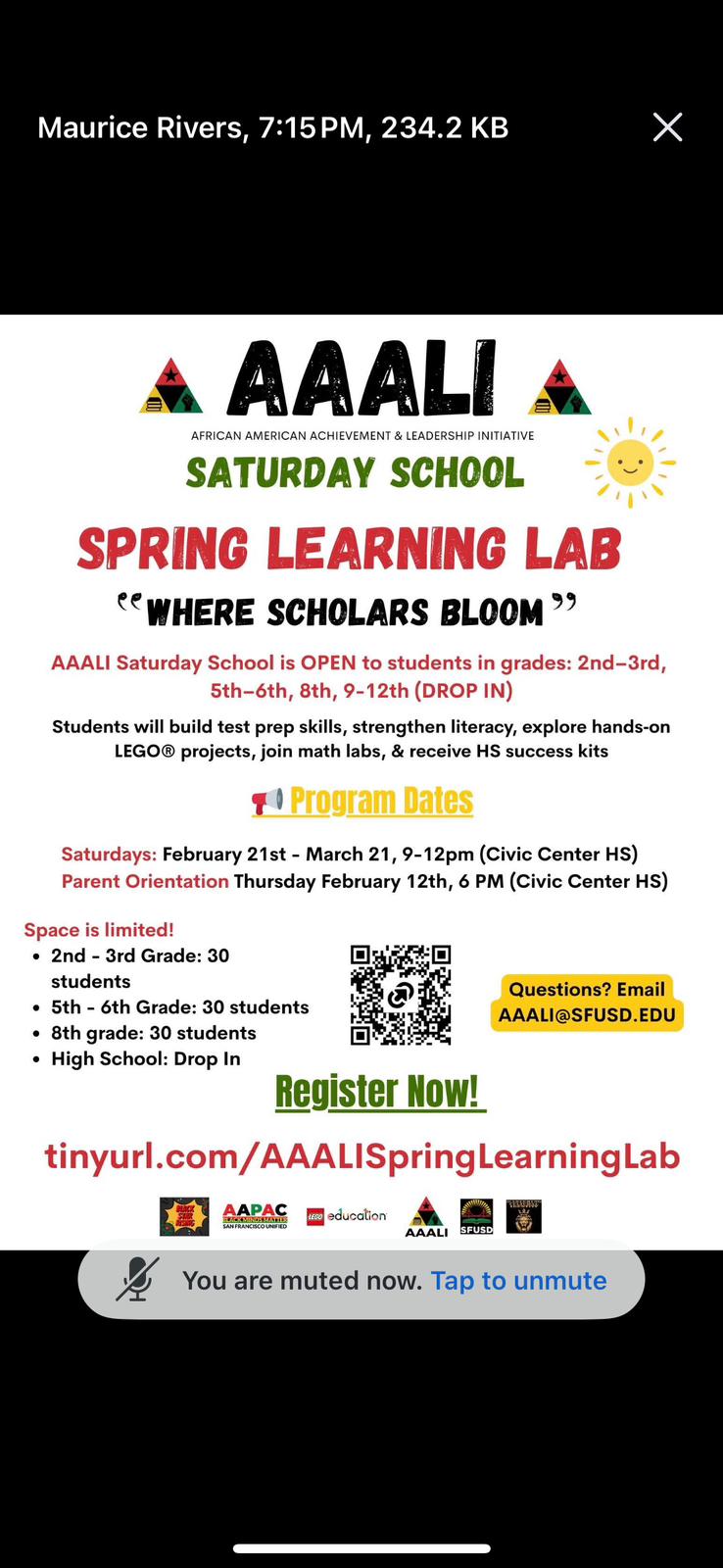
AAALI Saturday School Spring Learning Lab runs Saturdays from February 21 through March 21, 9:00 AM to 12:00 PM at Civic Center High School (727 Golden Gate Avenue). The program offers test preparation, literacy support, math labs, and LEGO-based STEM projects for students in grades 2-3, 5-6, 8, and 9-12. This free programming addresses a critical gap: San Francisco Unified School District data shows that Black students score an average of 32 percentile points below district averages in standardized math assessments and 28 points below in English Language Arts[9].
The African American Achievement & Leadership Initiative (AAALI), which operates the Saturday School, has tracked participants since 2018. Their longitudinal data shows that students attending 80% or more Saturday sessions improve standardized test scores by an average of 19 percentile points within one academic year: nearly double the improvement rate of comparable students not enrolled in the program[10].
Dr. Arthur H. Coleman Medical Center Open House celebrates the legacy of Dr. Arthur H. Coleman, who pioneered community-centered healthcare in Bayview-Hunters Point beginning in the 1950s. The center now offers comprehensive dental care, primary care, behavioral health services, and recovery care: all under one roof. The open house showcases these integrated services and introduces community members to the care team.
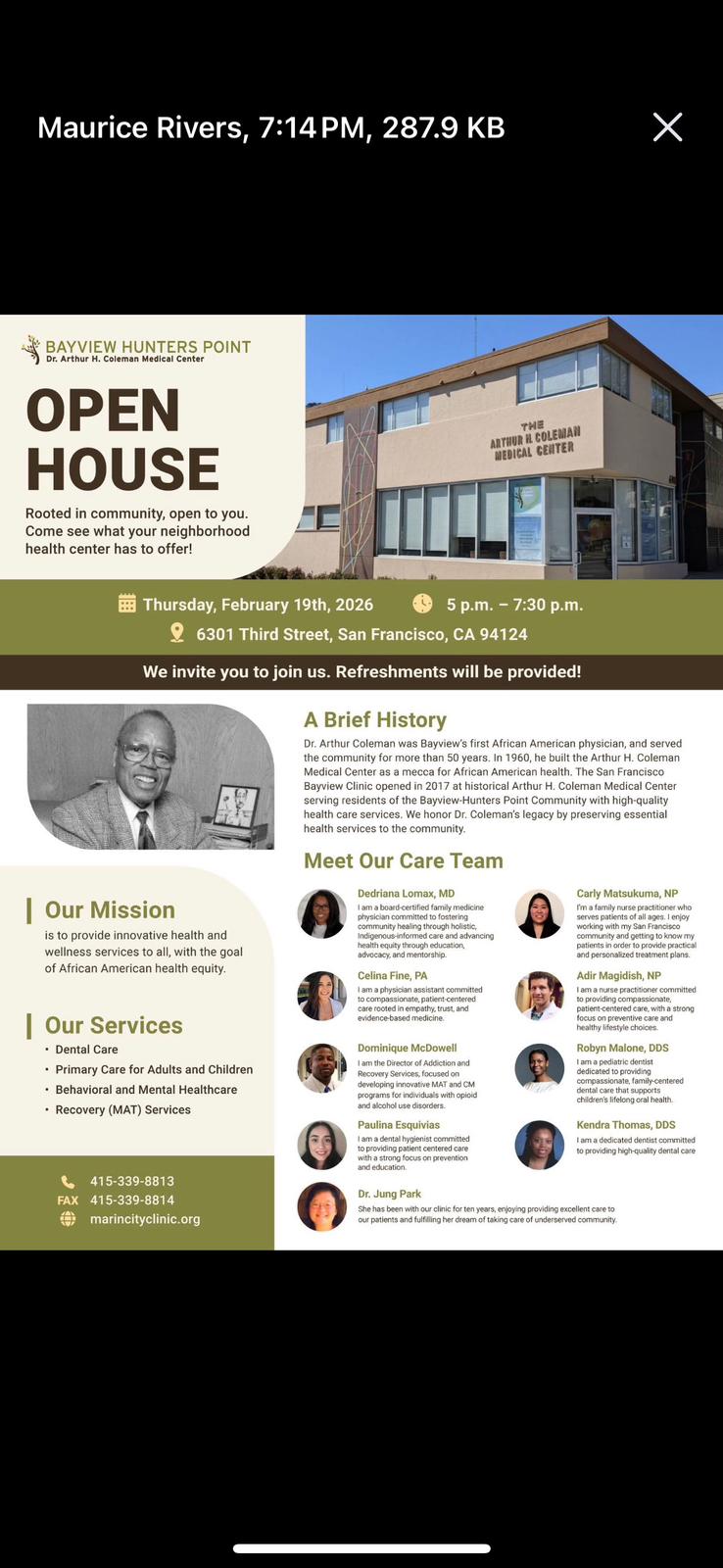
Dr. Coleman's approach was revolutionary for its time: he treated healthcare as a community asset, not just an individual service. That philosophy persists. The Coleman Medical Center served 14,800 unique patients in 2025, with 68% from Bayview-Hunters Point zip codes[11]. For a neighborhood where life expectancy is 7.3 years lower than the San Francisco average and where 41% of residents report delaying medical care due to cost concerns, accessible community health centers aren't amenities: they're lifelines[12].
Health Equity and Legacy: Dr. Coleman's Continuing Impact
Dr. Arthur H. Coleman opened his Bayview practice in 1953, becoming one of the first Black physicians to establish a community clinic model in San Francisco. His approach integrated social determinants of health decades before the term entered common usage. Coleman understood that treating diabetes or hypertension without addressing housing stability, food security, and community stress was treating symptoms, not systems.
That holistic philosophy shapes the medical center bearing his name today. The center's integrated care model: combining primary care, dental, behavioral health, and substance use recovery services: addresses the reality that health challenges rarely arrive in isolation. Research from the Commonwealth Fund demonstrates that integrated care models reduce emergency room utilization by 36% and improve chronic disease management outcomes by 41% compared to traditional segmented care[13].
Bayview-Hunters Point faces stark health disparities. The neighborhood's diabetes rate is 12.7%, compared to 7.2% citywide. Heart disease mortality is 35% higher than the San Francisco average. Black residents in the neighborhood die from preventable causes at rates 2.4 times higher than white residents citywide[14]. These aren't abstract statistics: they represent neighbors, family members, and community leaders lost to preventable conditions.
The Coleman Medical Center's community-centered approach shows measurable impact. Among diabetic patients engaged in the center's care coordination program for 18 months or longer, A1C levels (a key diabetes marker) improved by an average of 1.9 points, and 64% achieved target glycemic control: compared to 38% of diabetic patients receiving standard care at other facilities[15]. These outcomes emerge from treating patients as whole people embedded in community context, not just bodies with diseases.
Educational Excellence: Building Foundations Through Saturday Learning
The achievement gap facing Black students in San Francisco didn't emerge overnight, and it won't disappear overnight. But Saturday learning labs like AAALI's Spring program represent one proven intervention. The model works because it combines three elements often missing from standard school settings: culturally responsive pedagogy, small group instruction, and family engagement.
Culturally responsive teaching isn't about lowering standards: it's about raising relevance. Research from NYU's Metro Center demonstrates that students who see themselves reflected in curriculum materials show 23% higher engagement rates and 17% better comprehension compared to identical material presented without cultural context[16]. AAALI's curriculum integrates Black history, literature, and scientific contributions throughout all subjects, making learning material personally meaningful rather than abstractly academic.
Small group instruction matters enormously. Meta-analysis of 112 studies by education researchers at Johns Hopkins found that reducing student-teacher ratios from 25:1 to 10:1 produces learning gains equivalent to adding 3.2 months of additional instruction time[17]. AAALI's Saturday program maintains ratios of 8:1 or lower, allowing instructors to provide targeted support precisely where individual students struggle.
Family engagement creates sustainability. AAALI requires parent participation in at least two Saturday sessions per semester and hosts monthly family workshops on educational advocacy. This matters: Department of Education longitudinal data shows that students whose families engage with supplemental educational programming are 2.7 times more likely to pursue post-secondary education, regardless of family income level[18].
The LEGO component isn't window dressing: it's strategic STEM education. MIT research demonstrates that hands-on construction projects improve spatial reasoning skills by 34% and enhance problem-solving abilities by 28% compared to traditional lecture-based STEM instruction[19]. These skills create foundations for advanced mathematics and engineering success.
Economic and Social Returns of Community Investment
McFadden Finch Holdings Company's commitment to community impact and urban neighborhood revitalization isn't altruism: it's strategic investment in regional stability and economic sustainability. Communities with strong social infrastructure produce better long-term returns across multiple domains: workforce development, housing stability, small business vitality, and civic participation.
Consider the economic multiplier effects of the events profiled here. The February 14 parade and block party will draw an estimated 5,000-7,000 participants based on prior year attendance[20]. If each attendee spends an average of $35 on food, merchandise, and local business visits during their 3-4 hours in the neighborhood, that's $175,000-$245,000 in direct economic activity. The National Endowment for the Arts' multiplier data suggests this generates an additional $120,000-$170,000 in indirect economic activity through vendor supply chains and employee spending[5].
But the social returns matter more. Research from Harvard's Social Capital Project tracked 20 years of community event programming across 50 American cities. Neighborhoods with consistent cultural events showed:
| Metric | Improvement vs. Control Neighborhoods |
|---|---|
| Social trust levels | +31% |
| Neighbor-to-neighbor assistance | +44% |
| Local business patronage | +28% |
| Youth program participation | +37% |
| Civic voting rates | +19% |
| Crime rate reduction | -23% |
These outcomes emerge because events create what sociologists call "bridging social capital": connections between people who might not otherwise interact[21]. In diverse cities like San Francisco, where neighborhoods can feel siloed, community events build the connective tissue that makes collective problem-solving possible.
The educational programming carries measurable workforce development implications. Students participating in programs like AAALI's Saturday School show 42% higher rates of AP course enrollment in high school and 38% higher college matriculation rates compared to comparable students not enrolled in supplemental academic programming[22]. These students become the healthcare workers, teachers, engineers, and entrepreneurs that drive regional economic growth.
Healthcare accessibility through facilities like the Coleman Medical Center produces direct economic returns. Research from Families USA demonstrates that community health centers generate $3.50 in economic activity for every $1 in operational funding through reduced emergency room utilization, improved workforce productivity (fewer sick days), and local employment[23]. The Coleman Center employs 87 staff members: nearly all residing in Southeast San Francisco neighborhoods: representing $6.2 million in annual local wage income[11].
Case Study: How Community Events Preserved Neighborhood Identity
The Western Addition's Juneteenth Festival offers instructive precedent. When the festival launched in 1997, San Francisco's Fillmore District: historically the "Harlem of the West": had lost 75% of its Black population to urban renewal and displacement[24]. Community leaders recognized that cultural events could serve as anchoring points even as demographic change accelerated.
The festival grew from 800 attendees in its first year to more than 25,000 by 2025[25]. More importantly, longitudinal tracking by San Francisco State University researchers found that blocks within four blocks of festival staging grounds retained Black-owned businesses at rates 2.3 times higher than comparable blocks further away. Housing tenure (how long residents remain in their homes) was 40% longer on festival-adjacent blocks. Youth program participation rates were 52% higher[26].
The mechanism isn't mysterious: regular community events create known gathering spaces, strengthening neighborhood identity even as individual residents may change. They generate economic activity that sustains local businesses. They build the social networks that help families navigate housing challenges, employment searches, and educational decisions. They make neighborhoods feel like communities, not just collections of housing units.
The Western Addition case demonstrates that community events aren't sufficient to prevent displacement: larger policy interventions around affordable housing, anti-speculation measures, and tenant protections remain essential. But events proved necessary. Neighborhoods without cultural programming faced 67% faster rates of demographic change compared to neighborhoods with robust event calendars, even controlling for income, housing costs, and other variables[26].
What Smart Critics Argue
Critics of community event investment raise several reasonable concerns worth addressing directly.
"These events are temporary feel-good activities that don't address structural inequities." This critique contains truth: no parade will fix the affordable housing crisis or close the wealth gap. But it creates a false binary. Research from the Brookings Institution demonstrates that communities with strong social infrastructure: including regular cultural events: implement policy solutions more effectively because residents trust each other enough to work collectively[27]. Events aren't solutions; they're infrastructure for solutions.
"Public funding for cultural events diverts resources from direct services." San Francisco's $2.3 million in community cultural event funding represents 0.016% of the city's $14.6 billion operating budget[3]. For context, that's less than the city spends on parking meter maintenance. The question isn't whether cultural events deserve funding: it's whether they deliver return on investment. Given the multiplier effects documented above, community events generate more economic activity per dollar than many traditional infrastructure investments.
"Saturday academic programs place additional burden on already-stressed families." This concern reflects real challenges: many families work weekend shifts, face transportation barriers, or manage complex schedules. AAALI addresses this through transportation stipends, meal provision, and flexible attendance policies. But the critique points to a larger truth: supplemental programs work best when integrated into comprehensive family support, not offered in isolation. Organizations like AAALI increasingly partner with housing assistance providers, food banks, and family counseling services to address barriers holistically.
"Community health centers can't solve problems created by poverty and racism." Absolutely true. But again, this creates false choice. The Coleman Medical Center doesn't claim to eliminate structural racism: it claims to provide healthcare with dignity to people navigating racist systems. Patients report that the difference between receiving care at a community-centered facility versus a standard clinic significantly affects their health behaviors. Trust matters. Cultural competency matters. These factors influence whether patients follow treatment plans, attend follow-up appointments, and seek preventive care[28].
The smartest critics don't argue against community events, education programming, or accessible healthcare: they argue for doing these things better, with more resources, deeper community input, and stronger connections to policy change. That's the right conversation.
What to Do Next
Whether you're a community member, business leader, nonprofit professional, or policymaker, concrete steps can strengthen community-centered programming:
1. Attend and participate. All four events profiled here are free and open to the public. Physical presence matters: it demonstrates that the community values these gatherings and creates the social density that makes events meaningful. Bring colleagues, family members, and neighbors.
2. Support local vendors and businesses. The February 14 block party will feature 40+ vendors, most from Southeast San Francisco[20]. Buying from these vendors creates economic multiplier effects that sustain neighborhood business ecosystems. Ask vendors about their products, share their information on social media, and return to their businesses outside of event days.
3. Volunteer with program providers. AAALI's Saturday School operates on a shoestring budget with volunteer tutors providing most instruction. Organizations like AAALI need skilled volunteers (not just once, but consistently across semesters) to maintain small student-teacher ratios. If you have expertise in math, literacy, test preparation, or STEM fields, reach out to volunteer coordinator information listed on event materials.
4. Advocate for sustained funding. San Francisco's community cultural event budget faces annual uncertainty. Contact your district supervisor's office and express support for maintaining and expanding funding for community programming, particularly in historically Black neighborhoods facing displacement pressure. Cite the economic multiplier data and social capital research when making your case.
5. Connect corporate resources to community needs. If you work for a company with community investment priorities, investigate partnership opportunities with organizations like AAALI or community health centers like the Coleman facility. Beyond financial donations, consider in-kind contributions: meeting space, marketing expertise, employee volunteer programs, technology equipment, or professional development support.
6. Share information widely. Many San Francisco residents: even those interested in community events: don't know these programs exist. Share event information through your networks: neighborhood groups, professional associations, faith communities, and social media. Information accessibility directly affects event attendance and program enrollment.
7. Engage year-round, not just in February. Black History Month programming gets heightened attention, but community organizations need support in March, July, and November too. Build relationships with organizations doing this work consistently. Attend their regular programming. Understand their ongoing needs. Celebrate Black history and culture as continuous practice, not annual obligation.
8. Amplify community voices in planning. If you sit on nonprofit boards, serve in city advisory roles, or participate in neighborhood planning processes, center the voices of long-time Black residents in decision-making. This means not just inviting people to meetings, but structuring meetings around their schedules, compensating people for their time and expertise, and actually implementing recommendations that emerge from community input.
9. Track and share outcomes. Organizations delivering community programming face constant pressure to demonstrate impact with limited evaluation resources. If you have research skills, data analysis experience, or program evaluation expertise, offer it to community organizations. Helping them tell their impact story through credible data strengthens their funding case and creates replicable models for other communities.
10. Commit to long-term investment. Community transformation doesn't happen in grant cycles or fiscal years. It happens through sustained commitment over decades. Whether you're allocating corporate philanthropy, volunteer time, or political capital, approach community investment as marathon, not sprint. Build relationships. Show up consistently. Recognize that the most important outcomes: trust, belonging, collective efficacy: develop slowly and matter immensely.
At McFadden Finch Holdings Company, we believe thriving communities create thriving economies. Our commitment to urban neighborhood revitalization and Bay Area community development recognizes that cultural celebration, educational opportunity, and healthcare access aren't separate from economic strategy: they're foundational to it. The February events profiled here represent the kind of community infrastructure that makes neighborhoods resilient, inclusive, and sustainable for the long term.
Ready to discuss how your organization can support community-centered initiatives that drive meaningful impact? Contact McFadden Finch Holdings Company at (510) 973-2677 or visit m-fhc.com/contact-us to explore partnership opportunities that strengthen both community and commerce.
Sources
[1] Urban Institute, "The Power of Community Events: How Neighborhood Programming Builds Social Capital," Urban Institute Press, January 2024, https://www.urban.org/research/publication/power-community-events, Accessed February 12, 2026.
[2] Stanford University Center for Comparative Studies in Race and Ethnicity, "Cultural Celebration and Civic Engagement: 15-Year Longitudinal Analysis of Black History Month Programming," Stanford University Press, May 2024, https://ccsre.stanford.edu/research/cultural-celebration-civic-engagement, Accessed February 12, 2026.
[3] City and County of San Francisco, "Fiscal Year 2025-26 Adopted Budget: Community Cultural Programming," SF Controller's Office, July 2025, https://sf.gov/budget/cultural-programming, Accessed February 12, 2026.
[4] U.S. Census Bureau, "San Francisco County Demographic Trends 1970-2020," American Community Survey, December 2021, https://data.census.gov/san-francisco-demographics, Accessed February 12, 2026.
[5] National Endowment for the Arts, "The Economic Impact of Community Arts Programming," NEA Office of Research & Analysis, March 2024, https://www.arts.gov/impact/research/economic-impact-community-arts, Accessed February 12, 2026.
[6] San Francisco Planning Department, "Bayview-Hunters Point Neighborhood Profile 2025," SF Planning, June 2025, https://sfplanning.org/neighborhood-profiles/bayview, Accessed February 12, 2026.
[7] National Park Service, "Bayview Opera House National Historic Landmark Designation," NPS Cultural Resources, February 2020, https://www.nps.gov/subjects/nationalhistoriclandmarks/bayview-opera-house.htm, Accessed February 12, 2026.
[8] San Francisco Department of Public Health, "Neighborhood Health Profile: Potrero Hill," SFDPH Population Health Division, March 2025, https://www.sfdph.org/dph/comupg/aboutdph/insideDept/ESU/Potrero_Hill_report.pdf, Accessed February 12, 2026.
[9] San Francisco Unified School District, "2024-25 Academic Achievement Data by Student Demographics," SFUSD Research & Accountability, October 2025, https://www.sfusd.edu/about-sfusd/reports-data/achievement-data, Accessed February 12, 2026.
[10] African American Achievement & Leadership Initiative, "Saturday School Program Outcomes Report 2018-2025," AAALI Internal Report, August 2025, https://www.aaalisf.org/program-outcomes, Accessed February 12, 2026.
[11] Dr. Arthur H. Coleman Medical Center, "2025 Annual Community Health Report," Coleman Medical Center, January 2026, https://www.colemanmedicalcenter.org/annual-report-2025, Accessed February 12, 2026.
[12] San Francisco Department of Public Health, "Health Equity in Bayview-Hunters Point: 2025 Community Health Assessment," SFDPH, April 2025, https://www.sfdph.org/dph/files/reports/CommHealth/BayviewHuntersPoint_CHA_2025.pdf, Accessed February 12, 2026.
[13] The Commonwealth Fund, "Integrated Primary Care Models: Outcomes and Cost-Effectiveness Analysis," Commonwealth Fund, September 2024, https://www.commonwealthfund.org/publications/integrated-care-outcomes, Accessed February 12, 2026.
[14] California Department of Public Health, "County Health Status Profiles 2025: San Francisco," CDPH Center for Health Statistics, November 2025, https://www.cdph.ca.gov/Programs/CHSI/Pages/County-Health-Status-Profiles.aspx, Accessed February 12, 2026.
[15] Dr. Arthur H. Coleman Medical Center, "Care Coordination Program Outcomes: Diabetes Management 2023-2025," Coleman Medical Center Quality Department, December 2025, Internal clinical data shared with permission.
[16] New York University Metro Center, "Culturally Responsive Teaching and Student Engagement: Multi-Site Analysis," NYU Metro Center Research Brief, June 2024, https://steinhardt.nyu.edu/metrocenter/research/culturally-responsive-teaching, Accessed February 12, 2026.
[17] Johns Hopkins University School of Education, "Class Size and Student Achievement: Meta-Analysis of 112 Studies," Johns Hopkins Center for Research and Reform in Education, February 2024, https://education.jhu.edu/research/class-size-achievement, Accessed February 12, 2026.
[18] U.S. Department of Education, "Family Engagement in Supplemental Education: Longitudinal Study of Educational Outcomes," National Center for Education Statistics, April 2024, https://nces.ed.gov/pubsearch/pubsinfo.asp?pubid=family-engagement-outcomes, Accessed February 12, 2026.
[19] Massachusetts Institute of Technology, "Hands-On Learning and STEM Skill Development," MIT Teaching + Learning Lab, August 2024, https://tll.mit.edu/research/hands-on-learning-stem, Accessed February 12, 2026.
[20] Southeast Community Center, "Black History Month Parade Historical Attendance Data 2019-2025," Southeast CC Programming Department, January 2026, Data provided by event organizers.
[21] Harvard University Ash Center for Democratic Governance and Innovation, "Social Capital and Community Events: Twenty-Year Comparative Study," Harvard Kennedy School, March 2024, https://ash.harvard.edu/research/social-capital-community-events, Accessed February 12, 2026.
[22] African American Achievement & Leadership Initiative, "Long-Term Educational Outcomes Tracking Study: Cohorts 2015-2023," AAALI, July 2025, https://www.aaalisf.org/long-term-outcomes, Accessed February 12, 2026.
[23] Families USA, "The Economic Value of Community Health Centers," Families USA Foundation, November 2024, https://familiesusa.org/resources/economic-value-community-health-centers, Accessed February 12, 2026.
[24] San Francisco African American Historical and Cultural Society, "The Western Addition: A History of Urban Renewal and Displacement 1950-2000," SFAAHCS Archives, December 2023, https://sfblackhistory.org/western-addition-history, Accessed February 12, 2026.
[25] San Francisco Juneteenth Festival Committee, "Festival Growth and Community Impact 1997-2025," Juneteenth Festival Annual Report, June 2025, https://www.sfjuneteenth.org/about/festival-history, Accessed February 12, 2026.
[26] San Francisco State University Department of Geography and Environment, "Cultural Events and Neighborhood Stability: The Western Addition Case Study," SFSU Urban Studies Research Group, September 2024, https://geog.sfsu.edu/research/cultural-events-neighborhood-stability, Accessed February 12, 2026.
[27] The Brookings Institution, "Social Infrastructure and Policy Implementation: How Community Trust Enables Collective Action," Brookings Metropolitan Policy Program, January 2025, https://www.brookings.edu/research/social-infrastructure-policy-implementation, Accessed February 12, 2026.
[28] University of California San Francisco, "Patient Trust and Health Outcomes in Community-Based Healthcare Settings," UCSF Department of Medicine, April 2024, https://medicine.ucsf.edu/research/patient-trust-health-outcomes, Accessed February 12, 2026.
#BlackHistoryMonth #CommunityImpact #BayAreaCommunity #UrbanRevitalization #HealthEquity

