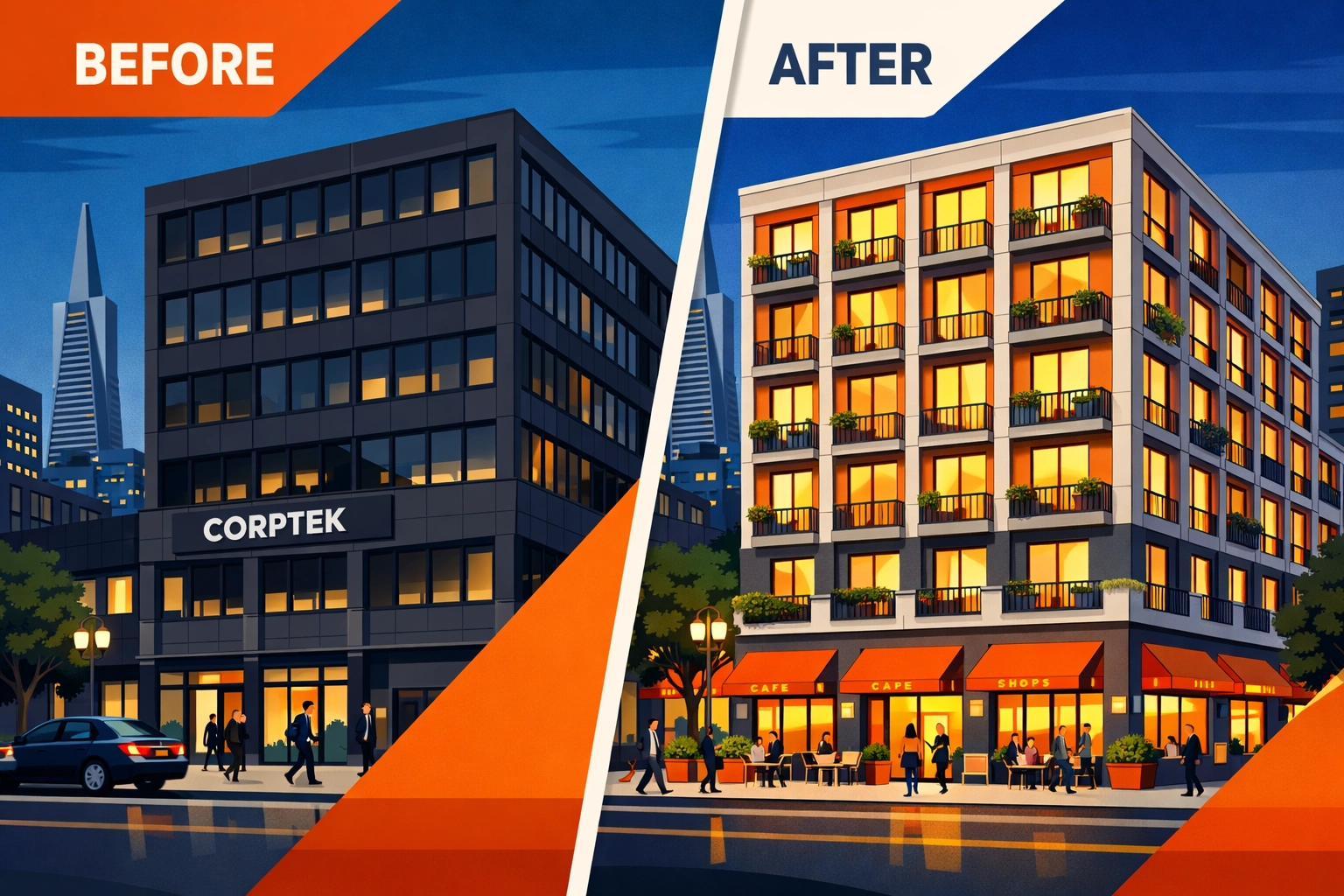
San Francisco's office-to-residential conversion market has reached a critical inflection point. With vacancy rates in the Financial District hovering near 35% and the city facing a mandate to deliver 82,000 new residential units by 2031, the conditions for adaptive reuse have never been more favorable.[1] The question is no longer whether conversions make financial sense: it's whether developers can navigate the intersection of new incentives, streamlined regulations, and persistent execution challenges fast enough to capitalize on this narrow window.
The 2026 landscape offers something unprecedented: a fully aligned policy framework designed to eliminate the traditional barriers that killed conversion projects in the past. Fee waivers now save developers $70,000 to $90,000 per unit.[1] Transfer tax exemptions under Measure C can eliminate seven-figure closing costs. Building code flexibility through the Department of Building Inspection's September 2024 guidelines has removed seismic and ventilation roadblocks that previously made conversions economically impossible.[7] Yet despite these tailwinds, most developers are still watching from the sidelines: waiting for proof of concept, worried about hidden costs, or paralyzed by the complexity of executing the first deal. This post cuts through the noise to deliver the strategic roadmap McFadden Finch Holdings Company and our Atlas Premier division are using to help clients navigate SF office to residential conversion 2026 opportunities with confidence and speed.
The '30×30' Initiative: San Francisco's Conversion Imperative
Mayor Daniel Lurie's administration has formalized the city's commitment to adaptive reuse through the 30×30 initiative: a target to convert 30% of underutilized office space to residential use by 2030.[4] This isn't aspirational marketing. It's a data-driven response to dual crises: a gutted downtown tax base and a Housing Element mandate requiring 82,000 new residential units by 2031.[1]
The math is straightforward. San Francisco has approximately 7 million square feet of eligible conversion space under current incentive programs.[3][5] If even half of that space converts at a conservative rate of 1,000 square feet per unit, the city adds 3,500 new residential units to its inventory: more than 4% of its total housing target, achieved through repurposing rather than ground-up construction.
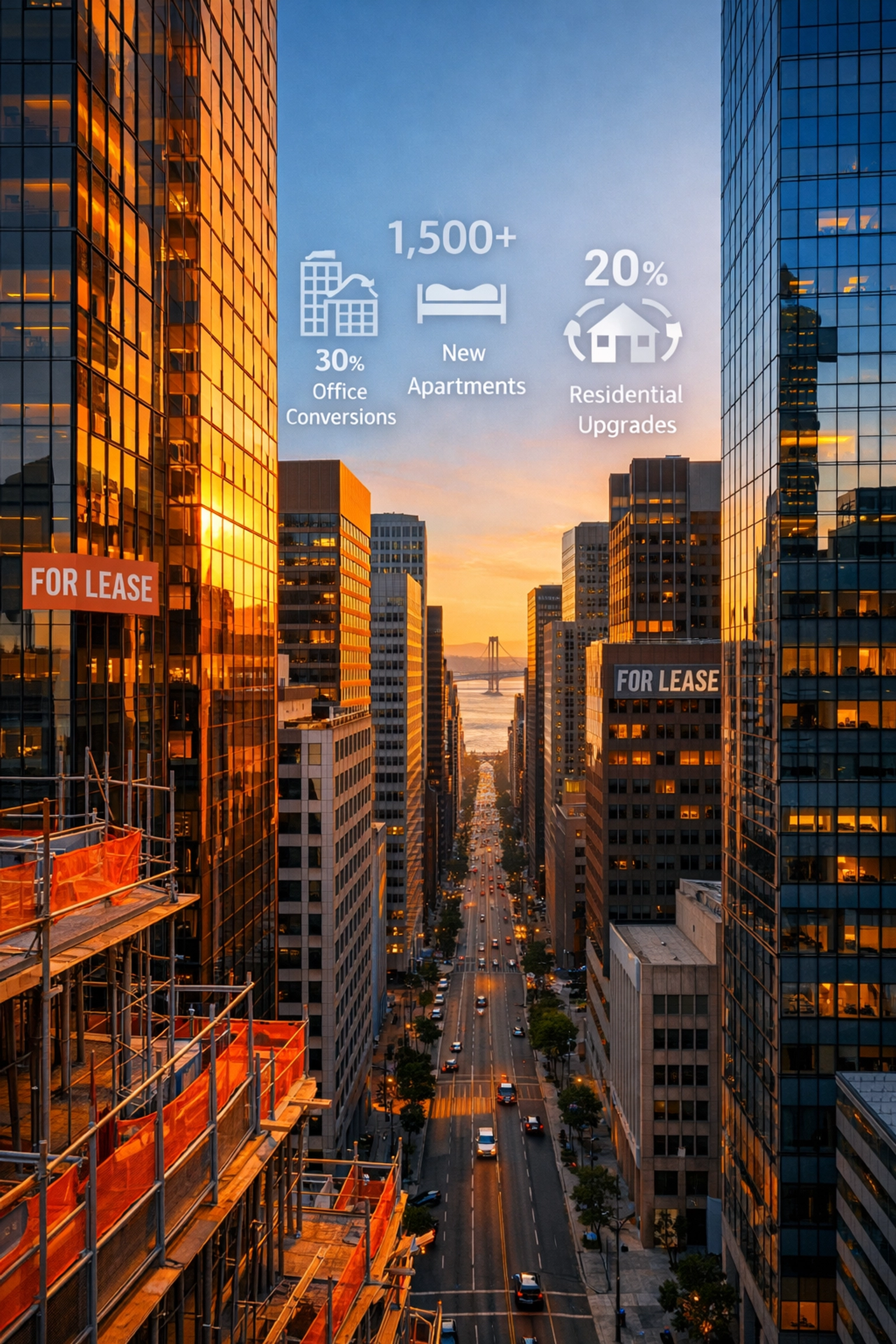
The initiative isn't just about units. It's about reclaiming downtown vitality. Office conversions deliver 24/7 residential populations that support ground-floor retail, increase transit ridership, and create the conditions for neighborhood-level economic recovery. The city's policy team understands this, which is why every major incentive program introduced since 2024 has been designed to remove friction from the conversion process.
Key 30×30 Drivers:
- 7 million square feet of gross floor area eligible for fee waivers and expedited approvals[3][5]
- January 1, 2030 deadline for Measure C transfer tax waiver eligibility[3]
- 82,000 unit mandate driving city-level urgency for all residential production pathways[1]
- No application deadline for the Commercial-to-Residential Adaptive Reuse Program: developers can enter at any time[1][3]
The initiative creates market certainty. Developers no longer need to guess whether the city will support conversion projects or whether incentives will evaporate mid-cycle. The policy framework is locked in, with clear eligibility criteria and multi-year horizons.
The Lurie Legislation: Revitalization Financing Districts
Mayor Lurie's administration has championed the establishment of downtown revitalization financing districts as a mechanism to fund infrastructure improvements that make conversion projects viable. These districts function as geographically targeted investment zones where property tax increments generated by new development are captured and reinvested into public improvements: upgraded streetscapes, pedestrian infrastructure, utility modernization, and public safety enhancements.
For conversion developers, this framework solves a persistent problem: how to de-risk investment in neighborhoods where existing infrastructure is degraded or insufficient to support increased residential density. Revitalization financing districts allow the city to front-load infrastructure improvements without requiring developers to shoulder the full burden through exactions or impact fees.
The strategic value is timing. Instead of waiting for neighborhood-level improvements to occur organically over decades, financing districts compress that timeline into 3–5 years: fast enough to align with conversion project schedules and create the amenity base that residential buyers and renters demand.
Financing District Mechanics:
- Property tax increments from new development are earmarked for district improvements
- Improvements include streetscape upgrades, utility modernization, and public safety infrastructure
- Districts compress infrastructure timelines from decades to 3–5 years
- Developers benefit from reduced impact fee burdens and improved neighborhood amenities
These districts are particularly critical for conversions in the eastern C-3 zoning areas: historically underinvested corridors where office buildings have strong conversion potential but weak surrounding infrastructure. By pairing financial incentives with place-based public investment, the Lurie administration is signaling that downtown revitalization is a coordinated, multi-dimensional strategy rather than a developer-only gamble.
Measure C and the Transfer Tax Waiver
Proposition C, passed by San Francisco voters, offers real estate transfer tax waivers for first-time transfers of non-residential properties converted to residential use, provided projects receive entitlement approvals before January 1, 2030.[3] For high-value downtown office buildings, this waiver can eliminate $1 million or more in transaction costs: a meaningful subsidy that directly improves project IRR.
Transfer taxes in San Francisco operate on a tiered structure, with rates increasing as transaction values rise. For commercial properties valued above $25 million, the combined city and county transfer tax can reach 6% of the sale price. On a $30 million office building acquisition, that's $1.8 million in transfer tax: capital that could otherwise fund construction, design upgrades, or contingency reserves.
Measure C eliminates that friction for qualifying conversions. The waiver applies to the first transfer of a property after conversion entitlements are approved, meaning sellers can market buildings to conversion-focused buyers with the explicit benefit of tax-free transfer. This lowers the all-in acquisition cost and makes previously marginal deals pencil.
Measure C Transfer Tax Waiver: Key Details
| Criteria | Requirement |
|---|---|
| Property Type | Non-residential properties (excludes hotels) |
| Conversion Type | Office, retail, or industrial to residential |
| Entitlement Deadline | Approvals received before January 1, 2030 |
| Transfer Eligibility | First-time transfer post-entitlement |
| Estimated Savings | $70,000–$1.8 million depending on property value |
The waiver is time-limited, creating urgency for both sellers and buyers. Properties that miss the January 1, 2030 entitlement deadline lose access to the benefit, which means developers need to move through predevelopment and entitlement processes with speed. For Atlas Premier clients, we're structuring acquisition timelines to hit entitlement milestones 12–18 months ahead of the deadline, ensuring Measure C benefits are locked in even if construction schedules slip.
Navigating the DBI Guidelines: Seismic and Window Flexibility
The Department of Building Inspection published detailed guidelines in September 2024 that clarify building and fire code requirements for office-to-residential conversions and introduce alternative methods of compliance.[7] These guidelines represent the most significant regulatory simplification in the conversion process, particularly around seismic upgrades, ventilation, and accessibility provisions.
Seismic Flexibility: Historic office buildings in San Francisco often require seismic retrofits to meet current residential building codes. Under the new DBI guidelines, conversions can use performance-based seismic design rather than prescriptive code compliance, allowing engineers to demonstrate that buildings meet life-safety standards through modeling and alternative structural strategies. This reduces retrofit costs by 20–40% in many cases and allows developers to preserve architectural features that would otherwise be demolished for code compliance.
Window and Ventilation Standards: Traditional office buildings have deeper floor plates and fewer operable windows than residential code requires. The DBI guidelines introduce natural ventilation credits, mechanical ventilation trade-offs, and reduced window-to-floor-area ratios for units that can demonstrate adequate air quality through HVAC systems. This is critical for conversions of 1960s–1980s office towers with large, windowless interior cores: buildings that were previously unconvertible under strict residential ventilation codes.
Accessibility Trade-offs: Conversions are now allowed to phase accessibility improvements and use alternative compliance paths for elevator capacity, accessible unit distribution, and common area design. This prevents situations where a single code requirement: like adding a second elevator shaft: kills an otherwise viable project.
Key DBI Guideline Benefits:
- Performance-based seismic design reduces retrofit costs by 20–40%
- Natural ventilation credits and mechanical trade-offs allow deeper floor plates
- Phased accessibility improvements prevent single-issue project failures
- Alternative methods of compliance documented and pre-approved by DBI
These guidelines remove the guesswork from code compliance. Developers and design teams now have a clear playbook for navigating the building code process, which reduces predevelopment timelines and eliminates the risk of late-stage code surprises that blow budgets or delay schedules.
Why Developers Are Still Hesitant (and the Atlas Premier Solution)
Despite comprehensive incentives and streamlined regulations, most developers remain cautious about SF office to residential conversion 2026 opportunities. The hesitation is rooted in three persistent challenges: execution complexity, market absorption risk, and financing gaps.
Execution Complexity: Conversions require coordination across architecture, structural engineering, MEP design, permitting, and construction: all while navigating a building type (adaptive reuse) that most Bay Area contractors have limited experience with. Mistakes in sequencing, code interpretation, or material selection can cascade into six-figure cost overruns. Developers who lack in-house adaptive reuse expertise are unwilling to bet $30–$50 million on their first project without external support.
Market Absorption Risk: San Francisco's residential market is improving, but it's not fully recovered. Developers worry that by the time a 2026 conversion project delivers in 2028, demand may have softened or competing supply may have flooded the market. This is particularly acute for larger conversions that deliver 100+ units: projects that require sustained absorption over 12–24 months to achieve pro forma returns.
Financing Gaps: Even with fee waivers and transfer tax exemptions, conversions require significant upfront capital for acquisition, design, and predevelopment. Traditional construction lenders remain skittish about adaptive reuse, which means developers often need to self-fund early stages or secure equity from family offices and private investors who understand the asset class. For smaller developers, this creates a capital access problem that no amount of regulatory streamlining can solve.

This is where Atlas Premier adds value. We provide turnkey project management for office-to-residential conversions, handling everything from feasibility analysis and entitlement coordination to contractor procurement and construction oversight. Our team has executed adaptive reuse projects across the Bay Area, which means we've already navigated the code complexities, contractor learning curves, and market timing challenges that paralyze first-time conversion developers.
Atlas Premier Conversion Support:
- Feasibility analysis and pro forma modeling
- Entitlement coordination with Planning and DBI
- Architect and engineer team assembly
- Contractor procurement and construction oversight
- Market timing and absorption strategy
- Post-construction lease-up or sales support
For developers who recognize the opportunity but lack the internal bandwidth or expertise to execute, Atlas Premier functions as an extension of their team: bringing specialized knowledge, vendor relationships, and project management discipline that de-risks the conversion process and accelerates timelines.
The Smart Critic: Why Some Experts Remain Skeptical
Not everyone is convinced that SF office to residential conversion 2026 incentives will produce the volume of new housing the city needs. Skeptics point to three structural concerns:
1. Limited Building Stock Suitable for Conversion: Only a fraction of San Francisco's office inventory is economically convertible. Buildings with floor plates wider than 60 feet, limited natural light penetration, or structural systems incompatible with residential layouts require prohibitively expensive redesigns. Critics argue that the city's 7 million square feet of eligible space may only yield 2,000–3,000 actual units: far short of what's needed to meet housing targets.
2. Affordability Mismatch: Most conversion projects will deliver market-rate units priced at $800,000+ for condos or $4,000+ per month for rentals. While the city's inclusionary housing waivers reduce developer costs, they also eliminate the below-market-rate units that conversions would otherwise produce. Critics worry that conversions will gentrify downtown without addressing the city's deeper affordability crisis.
3. Execution Risk Still High: Despite streamlined regulations, conversions remain complex. Projects require 18–36 months from entitlement to delivery, during which market conditions, construction costs, and financing availability can shift dramatically. For every successful conversion, skeptics predict two or three that will stall, pivot, or abandon mid-cycle: outcomes that waste developer capital and city resources without producing housing.
These critiques aren't without merit. Conversions are not a silver bullet for San Francisco's housing shortage, and the city will need ground-up construction, ADU production, and inclusionary mandates to hit its 82,000-unit target. But dismissing conversions as marginal misses the point. Even 3,000 units of downtown residential production creates momentum, market proof-of-concept, and neighborhood-level economic recovery that supports future housing development. The goal isn't to replace all housing production pathways: it's to activate an underutilized pathway that's been dormant for decades.
Next Steps: How to Capitalize on the 2026 Conversion Window
If you're a developer, investor, or property owner evaluating SF office to residential conversion 2026 opportunities, here's the strategic roadmap:
-
Run Preliminary Feasibility: Identify buildings in eligible C-3 or eastern C-2 zoning districts. Analyze floor plate dimensions, natural light penetration, structural systems, and parking availability. Partner with an architect experienced in adaptive reuse to generate preliminary unit layouts and construction cost estimates.
-
Model Fee Savings and Tax Waivers: Quantify the financial impact of development fee waivers ($70,000–$90,000 per unit) and Measure C transfer tax exemptions. Update your pro forma to reflect these savings and assess whether the project achieves your target IRR.[1][3]
-
Engage DBI Early: Schedule a pre-application meeting with the Department of Building Inspection to review code compliance strategies, seismic upgrade requirements, and alternative methods of compliance. Lock in agreement on performance-based design approaches before investing in full architectural drawings.[7]
-
Secure Entitlements Before January 1, 2030: Structure your predevelopment timeline to receive Planning and DBI approvals before the Measure C deadline. This ensures transfer tax waiver eligibility and avoids a last-minute scramble that could jeopardize the benefit.[3]
-
Assess Market Timing and Absorption: Work with a residential broker or market analyst to model absorption rates, pricing sensitivity, and competitive supply. Determine whether your project is better positioned as condos, rentals, or a phased hybrid approach.
-
Line Up Financing Early: Start conversations with lenders who have adaptive reuse experience. Expect higher equity requirements (30–40% of total project cost) and longer underwriting timelines than ground-up construction. Consider private equity or family office capital if traditional construction debt is unavailable.
-
Hire Specialized Project Management: If you lack in-house adaptive reuse expertise, bring in a firm like Atlas Premier to manage entitlements, contractor procurement, and construction oversight. The cost of external project management is a fraction of what you'll lose to execution mistakes or schedule delays.
-
Lock in Long-Lead Contractors: Conversions require specialized trades: seismic retrofit contractors, window replacement specialists, MEP engineers with adaptive reuse experience. Identify and pre-qualify these contractors during predevelopment to avoid delays during construction.
-
Monitor Policy Extensions: Stay current on city legislation related to conversion incentives. If the 30×30 initiative gains momentum, additional fee waivers, financing mechanisms, or regulatory simplifications may be introduced. Position your project to take advantage of future benefits.
-
Track Competitive Projects: Monitor conversion projects already in the pipeline. Study their unit mixes, pricing strategies, and lease-up or sales performance. Use this data to refine your own product positioning and marketing approach.
The SF office to residential conversion 2026 window is open, but it won't stay open indefinitely. Developers who move decisively: leveraging the full stack of financial incentives, regulatory simplifications, and execution support: will capture outsized returns and help reshape downtown San Francisco for the next generation.
At McFadden Finch Holdings Company, we invest in people, places, and businesses that create lasting value. From real estate development and restaurant operations to senior care and philanthropic impact, our portfolio companies are built on a foundation of strategic execution and community impact. Whether you're exploring an office-to-residential conversion opportunity or seeking partnership on a complex development project, we bring the capital, expertise, and long-term perspective to make it succeed.
Ready to navigate the 2026 conversion wave? Contact McFadden Finch Holdings Company or reach out to our Atlas Premier division at (510) 973-2677 to discuss how we can support your next project.
Sources
[1] San Francisco Planning Department, "Commercial-to-Residential Adaptive Reuse Program," City and County of San Francisco, January 2026, https://sfplanning.org/commercial-residential-adaptive-reuse, Accessed February 5, 2026.
[2] San Francisco Planning Department, "Family Zoning Plan Implementation Update," City and County of San Francisco, January 2026, https://sfplanning.org/family-zoning-plan, Accessed February 5, 2026.
[3] San Francisco Office of Economic and Workforce Development, "Proposition C: Transfer Tax Waiver for Conversions," City and County of San Francisco, 2025, https://oewd.org/proposition-c-transfer-tax-waiver, Accessed February 5, 2026.
[4] SPUR (San Francisco Bay Area Planning and Urban Research Association), "The 30×30 Initiative: Converting Office Space to Housing," SPUR, December 2025, https://spur.org/30×30-initiative, Accessed February 5, 2026.
[5] San Francisco Planning Department, "Development Fee Waiver Program for Office Conversions," City and County of San Francisco, 2025, https://sfplanning.org/development-fee-waivers, Accessed February 5, 2026.
[6] San Francisco Planning Commission, "Housing Element 2023-2031," City and County of San Francisco, adopted January 2023, https://sfplanning.org/housing-element, Accessed February 5, 2026.
[7] San Francisco Department of Building Inspection, "Office-to-Residential Conversion Guidelines," City and County of San Francisco, September 2024, https://sfdbi.org/conversion-guidelines, Accessed February 5, 2026.
#SFRealEstate #OfficeConversion #SanFranciscoDevelopment #AdaptiveReuse #DowntownRevitalization