Based on reporting by Zak Owens – Digital Editor, Louisville Business First (Feb 4, 2026). Deep-dive analysis compiled by McFadden Finch Holdings Company.
In early 2026, Yum! Brands confirmed plans to close roughly 250 underperforming Pizza Hut units in the U.S. in the first half of the year.[1] The update arrived alongside an ongoing Pizza Hut strategic review advised by Goldman Sachs and Barclays.[2] That pairing matters. In isolation, closures are often framed as "clean-up." In context, they read more like a corporate signal: a brand with immense awareness is trying to re-earn relevance by changing how it operates, not just where it operates.[1][7]
The closure of ~250 units is best understood as a strategic pivot toward an asset-light, digital-first operating model designed to restore Pizza Hut's competitive position, improve franchise unit economics, and let the brand compete on speed, convenience, and digital engagement, areas where QSR winners are increasingly decided.[1][4][5] In other words, Hut Forward is less about shrinking the brand and more about rebuilding the machine that delivers it.[1][5]
The Closures That Aren't "Just Closures"
Pizza Hut is one of those brands that feels permanent, part nostalgia, part national footprint, part Friday-night muscle memory. But restaurant permanence is an illusion when the underlying economics change. Over the last decade, the category has moved steadily off-premises: ordering shifts from phone to app, from dining room to doorstep, and from "where is the restaurant?" to "how fast does it arrive and how easy was it to order?" The National Restaurant Association's research shows off-premises is no longer a side channel; it's a dominant traffic driver across much of the industry.[4][6]
That reality creates a harsh math problem for legacy dine-in boxes: too much square footage, too much labor complexity, and not enough margin left after delivery friction, third-party fees, and higher operating costs. If your best customers mostly meet you through a screen, the dining room becomes a cost center unless it's truly differentiated.
So when Yum! Brands says "250 closures," it's not automatically a retreat. It can also be a portfolio decision: exit the wrong assets, modernize the operating system, and redirect capital and attention to the formats and tech that better match the way people actually buy pizza in 2026.[1][5][4]
The Core Move: Portfolio Pruning as a Strategic Operating Redesign
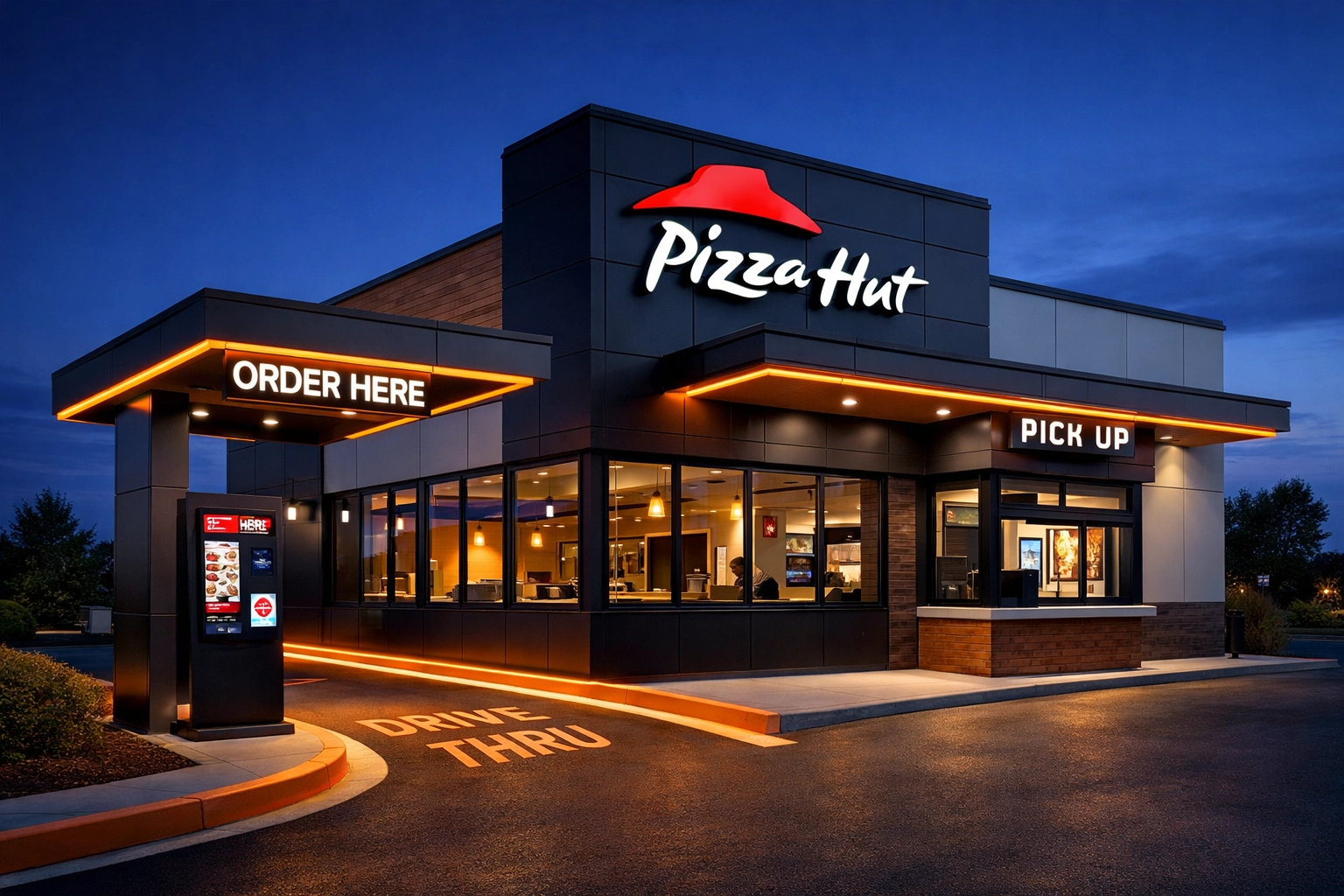
Yum! Brands has described the closures as targeted, a key word that implies the decision is being made at the unit economics level rather than via blunt cost cutting.[1] Targeted closures typically correlate with one or more of the following: structurally impaired trade areas, boxes designed for dine-in that can't win in delivery/carryout, lease terms that don't fit the new model, or franchise operators whose cost structure can't keep up with modern labor and marketing demands.[1][4][5]
From an operator's lens, closures can be a way to:
- Reduce fixed-cost drag (large dining rooms, maintenance-heavy legacy layouts).[4][5]
- Concentrate demand into stronger nearby locations (improving throughput and staffing efficiency).[1][5]
- Free capital for the parts of the system that now act like the storefront: app, website, loyalty, and delivery logistics.[1][3]
This is where the thesis becomes testable: if Pizza Hut were simply shrinking, you'd expect a vague narrative and scattered closures. If it's pivoting, you'd expect a coherent program (Hut Forward), technology milestones, and franchise/format redesign, all of which are in play.
Hut Forward Program: The "Bridge" Toward a Smaller-Box, Off-Premises Core
"Hut Forward" has been framed as a bridge strategy, language Yum! uses to suggest a transition from an older operating model to a more competitive one.[1] In practical terms, Hut Forward aligns with the category's operational direction: fewer dine-in-heavy formats, more carryout/delivery throughput, and improved digital conversion.[1][3]
What Hut Forward is trying to solve
- Format mismatch: legacy dine-in boxes are expensive to run when off-premises dominates.[6]
- Friction in ordering: the "storefront" is now UX and reliability as much as it is signage.[5]
- Speed/accuracy pressures: off-premises customers are less forgiving; errors travel farther and cost more to fix.[4][5]
What Hut Forward looks like on the ground (operator translation)
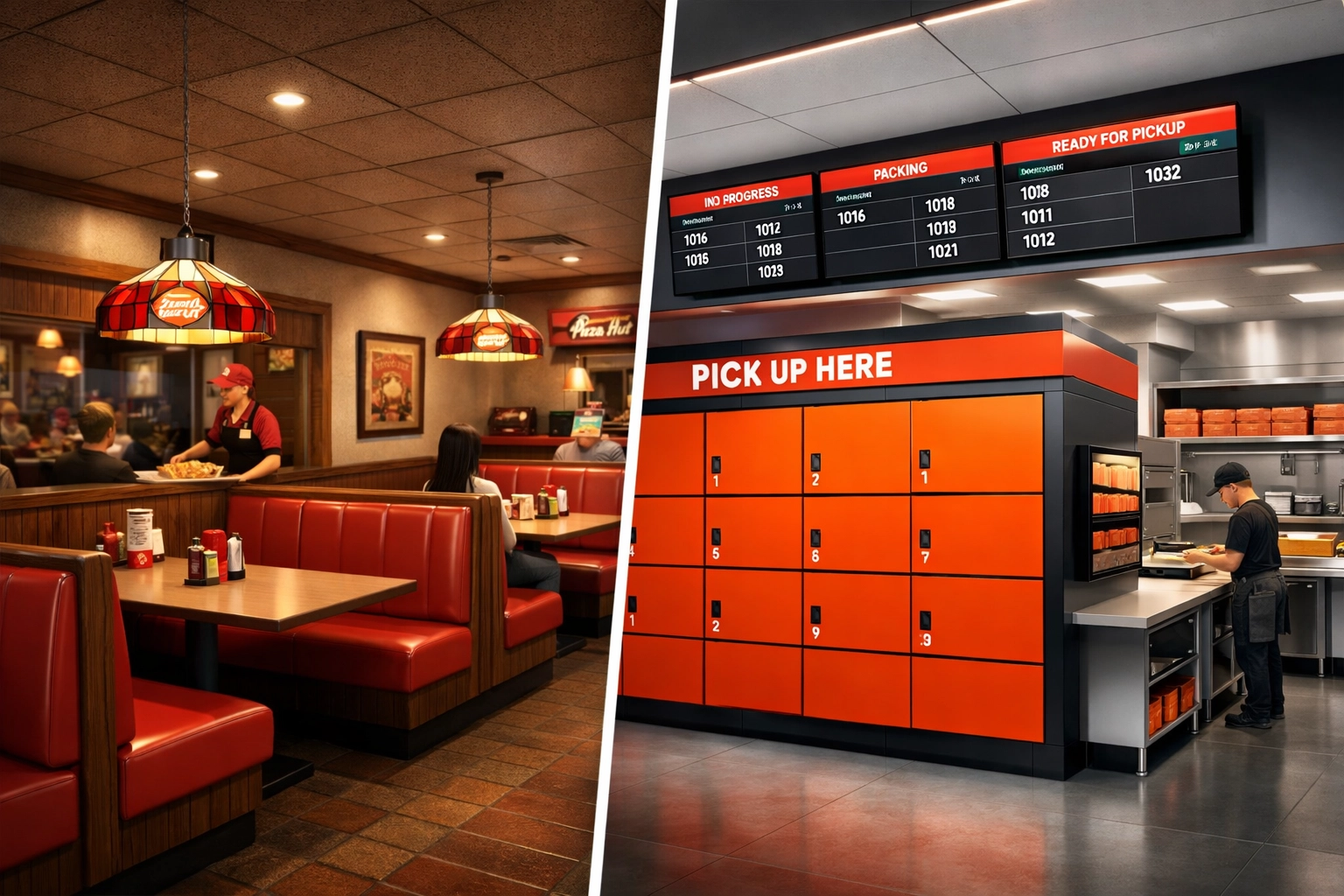
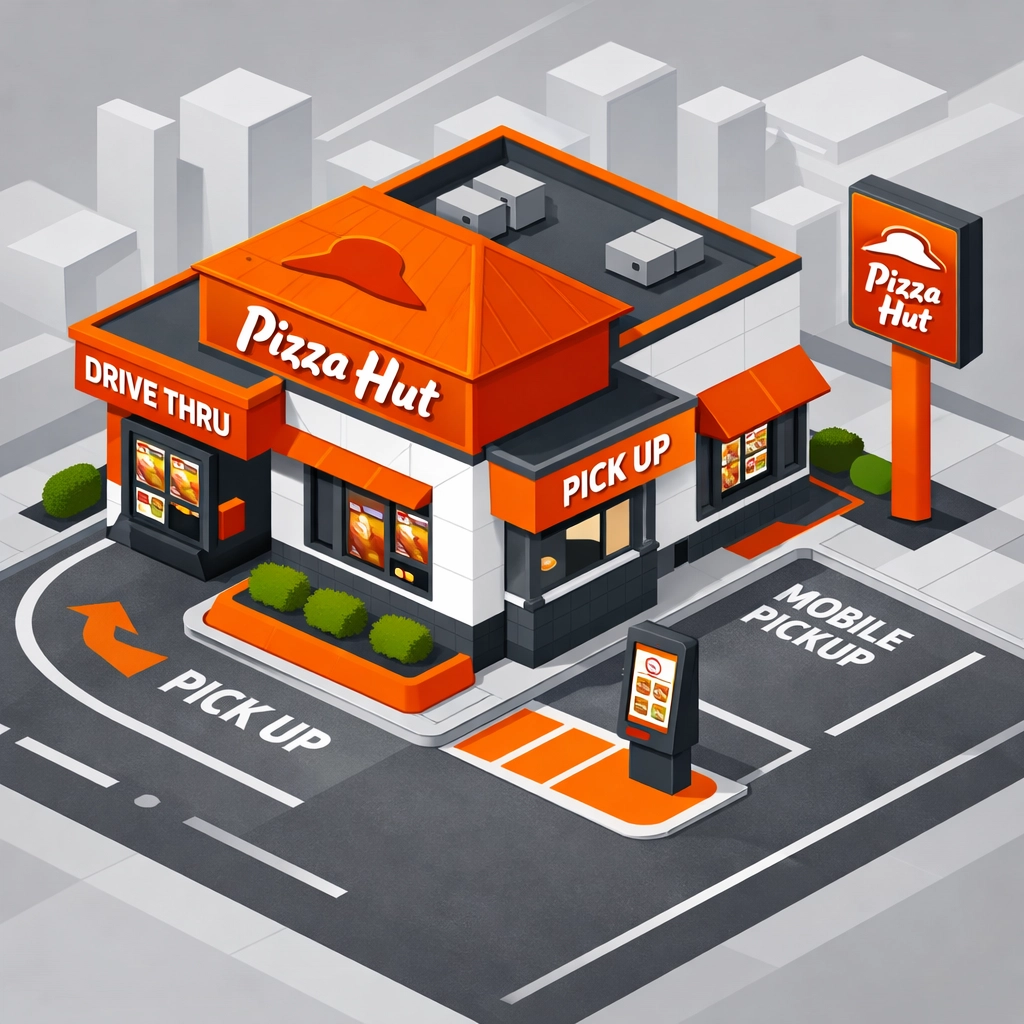
- Smaller, more efficient footprints designed around make-lines, staging, and pickup.
- Dedicated pickup flows (counters/windows/shelves) that reduce lobby congestion.
- Kitchen process simplification to raise consistency and reduce training time.[5]
The takeaway: Hut Forward isn't a slogan. It's a blueprint for how a legacy chain tries to operate like a modern QSR without losing brand equity.
The $30B Digital Milestone: Why "Digital" Is the New Real Estate
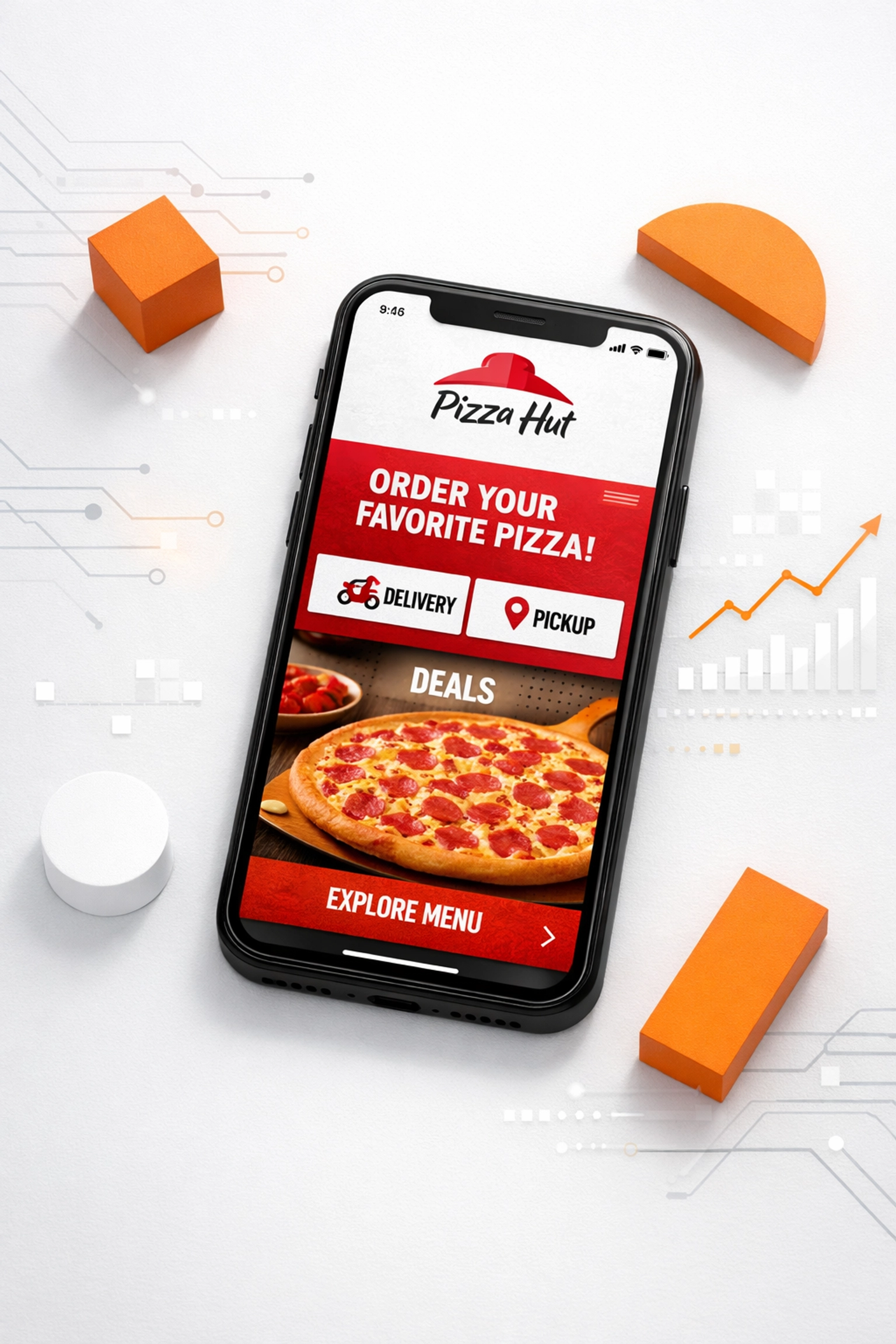
Yum! Brands has repeatedly emphasized digital as a growth engine, reporting multi‑billion-dollar digital sales and positioning digital mix as a core performance lever.[1][3] Even when the specific headline number fluctuates by year and definition (digital sales dollars vs. mix; system vs. company), the strategic direction is consistent: digital is treated as infrastructure.[1][3]
For Pizza Hut, the implications are immediate:
- The brand's "best" locations aren't always on a busy corner; they're often top tiles in a mobile app and strong placements in a delivery marketplace.
- Marketing efficiency increasingly depends on first-party data and loyalty engagement rather than mass discounting.
- The operating system must support a high share of orders that arrive prepaid, batched, timed, and tracked.[5][6]
Why this ties directly to closing 250 units
Digital-first economics reward throughput and reliability, not dining room capacity. So closing the wrong boxes is how you stop funding yesterday's model with tomorrow's margin.
Strategic Review (Goldman/Barclays): Why Yum Might Sell, Even While Investing
Yum! Brands initiated a strategic review of Pizza Hut with Goldman Sachs and Barclays as advisers, with the stated aim of exploring options to maximize long-term value.[2][3] Strategic reviews can lead to multiple outcomes:
- Sale to a buyer that specializes in brand turnarounds or refranchising acceleration.
- A restructured relationship with franchisees and suppliers.
- Continued ownership but with clearer capital allocation guardrails.
Why run a strategic review during Hut Forward?
Because the work required to "modernize" Pizza Hut, format changes, tech investment, franchise economics updates, can be a multi-year commitment.[2][3] Yum! may be assessing whether Pizza Hut's next chapter is better executed under a different ownership structure, even as it makes the system healthier in the near term.[2][3]
Corporate Footprint: PNC Tower as a Signal of Governance, Not Just Geography
While Pizza Hut restructures, Yum! Brands has also signaled a longer-term commitment to Louisville through its headquarters move to PNC Tower and a reported $12 million renovation to accommodate roughly 550 employees under a 10‑year lease, with a move timeline targeting late 2026.[7][8]
Why include this in a Pizza Hut strategy piece? Because corporate footprint decisions often reflect:
- Commitment to centralized governance and shared services.
- A longer planning horizon than a single brand's quarterly volatility.
- Confidence that the enterprise can absorb brand-level restructuring while continuing to invest in talent and operating systems.
It doesn't "solve" Pizza Hut. But it does suggest Yum! is managing Pizza Hut as part of a broader portfolio, where stability at the parent can create room for experimentation and reset.[1][7]
Consumer Trends: Solo Dining, Convenience, and the Shrinking "Occasion"
Pizza Hut's classic dine-in experience was built for groups. But consumer behavior is fragmenting into smaller occasions, snacks, solo meals, flexible schedules, and convenience-first decisions.[4][6] The NRA's State of the Restaurant Industry 2025 and Off-Premises Restaurant Trends 2025 both reinforce that off-premises behavior is entrenched, especially among younger cohorts, and that speed and user-friendly technology are major drivers of satisfaction.[4][6]
Solo dining and "meal-for-one" behaviors don't mean people never gather, just that a greater share of transactions are driven by individual convenience. For operators, that pushes strategy toward:
- Smaller ticket flexibility (personal portions, bundles that travel well).
- Packaging and quality control designed for delivery durability.[6]
- Frictionless digital reordering (favorites, subscriptions, loyalty).[5][9]
Hut Forward is, in effect, a bet that Pizza Hut can win more of these everyday transactions, without relying on the dining room to justify the box.
Comparison Table: Pizza Hut vs. Peers (Digital vs. Dine-In Reality Check)
Below is a directional comparison of how the operating emphasis tends to differ across peers, using publicly discussed strategic positioning and category norms, meant to illustrate model design, not provide identical accounting definitions.[1][10]
| Brand | Core premise (2026) | Digital ordering role | Dine-in role | Format bias |
|---|---|---|---|---|
| Pizza Hut | Rebuilding unit economics via Hut Forward + closures | Increasingly central to growth and retention (first-party + marketplaces) | De-emphasized in many U.S. markets; legacy dine-in is being rationalized | Shift toward smaller, off-premises optimized boxes |
| Domino's | Delivery/carryout machine first | Core competency and brand identity; digital is the operating backbone | Minimal; dine-in is not the model | Highly standardized, off-premises dominant stores |
| Taco Bell (Yum!) | Convenience + menu innovation + throughput | Major driver (app, loyalty, personalization) | Secondary to drive-thru/fast service | Drive-thru and high-throughput formats |
Case Study: NPC International Bankruptcy and the "Legacy Box" Problem
A useful historical parallel is NPC International, once the largest Pizza Hut franchisee in the U.S. NPC filed for Chapter 11 bankruptcy in 2020, citing heavy debt and operational pressure that worsened as consumer demand shifted and the pandemic disrupted dine-in traffic.[11] Reporting at the time highlighted that a meaningful portion of planned closures centered on underperforming dine-in units, reinforcing the idea that certain legacy footprints were structurally out of step with the direction of the category.[11][12]
As the process unfolded, NPC moved toward selling a large portion of its portfolio.[11][12] A bankruptcy court later approved the sale of major assets, with Flynn Restaurant Group among the acquirers in transactions reported around $800M total consideration, enabling stores to continue under new ownership groups better positioned (and capitalized) to reinvest and rationalize footprints.[12][13]
The lesson for today's Hut Forward moment: closures can be the visible symptom, but the deeper issue is box/occasion mismatch, when a brand's physical footprint is optimized for an era that no longer drives the majority of transactions.
What Smart Critics Argue (and why they might be right)
Thoughtful critics of the Hut Forward strategy raise points worth taking seriously:
-
"Closures are a lagging indicator." If stores are closing now, the competitive gap may have been widening for years, making the turnaround harder and more expensive.[5]
-
"Asset-light can mean brand-light." If Pizza Hut reduces dine-in visibility too far, it risks losing emotional connection and brand distinctiveness, especially in suburban markets where the dining room was part of the memory.[4]
-
"Digital-first isn't automatically profitable." Delivery can introduce margin pressure (fees, refunds, remake costs). Winning digitally requires operational excellence, not just an app.[6][9]
-
"Strategic review creates uncertainty." Franchisees and team members may hesitate to invest if ownership direction is unclear.[2]
These critiques don't invalidate the thesis, they sharpen it. If the pivot is to reclaim leadership, execution must be unusually disciplined: better unit economics, better speed, better quality control, better digital conversion.
What To Do Next: Action Steps for Portfolio Management
For investors, operators, and portfolio managers evaluating restaurant operation strategy in 2026, Pizza Hut's moment offers a practical playbook:
-
Segment the fleet by "model fit," not nostalgia. Identify boxes that will never work as off-premises hubs (layout, parking, lease) and treat them as exit candidates.[6]
-
Build an asset-light scorecard. Track occupancy cost %, labor hours per order, delivery remake rate, and order staging time, then compare to peer benchmarks.[5]
-
Prioritize first-party digital conversion. Improve app/web funnel metrics (search-to-cart, cart-to-pay, reorder rate) before adding more units.[5]
-
Redesign pickup to protect throughput. Dedicated pickup zones reduce labor friction and improve order accuracy, especially at peak.[6]
-
Treat packaging as part of product. Off-premises quality is packaging + timing; invest in it like you invest in ingredients.[6]
-
Align franchise economics with the new reality. If the brand asks franchisees to invest in tech and remodels, the margin model must support it.[1]
-
Use closures to strengthen remaining units. Shift demand, staffing, and marketing into the best trade areas; don't let closures create "ghost markets."
-
Scenario-plan the strategic review outcome. If ownership changes, pre-map transition risks: supplier terms, tech stack continuity, franchise agreement harmonization.[2]
-
Watch consumer micro-trends (solo dining/daypart). Test bundles and portion strategies that win smaller, frequent occasions.[4]
-
Set a 90-day operating cadence. Review unit economics, digital KPIs, and customer feedback monthly; treat "digital-first" as a continuous ops system, not a one-time project.[9]
Key Takeaways
- The ~250 closures read less like retreat and more like portfolio triage to fund a new operating model.[1][3]
- Hut Forward is the mechanism: simplify formats, improve off-premises throughput, modernize tech, and reset unit economics.[1]
- The competitive battleground is increasingly digital experience + operational reliability, not dining room capacity.[6][5]
- Yum!'s strategic review (Goldman/Barclays) signals that ownership structure is on the table, even while transformation work continues.[2]
- Yum!'s planned PNC Tower HQ buildout suggests parent-company stability while brand-level restructuring plays out.[7][8]
- The NPC International bankruptcy is a cautionary case: debt + legacy dine-in boxes can become brittle when demand shifts off-premises.[11][12]
- Smart critics are right that digital-first is not automatically profitable, execution is everything.[6][9]
FAQs (Operator + Investor Lens)
Is Pizza Hut "going away"?
No. The signals point to rationalization and redesign, not disappearance: though specific markets may see fewer dine-in footprints.[1]
Does asset-light mean no restaurants?
Asset-light typically means fewer capital-heavy boxes and more standardized, efficient units; plus heavy reliance on digital and delivery/carryout economics.[6][5]
What should franchisees watch most closely in 2026?
Unit economics (labor + occupancy), order accuracy, digital conversion, and clarity on the strategic review timeline.[2][6]
Institutional Contact (McFadden Finch Holdings Company)
For partnership inquiries related to restaurant operation strategy, portfolio optimization, or turnaround planning:
McFadden Finch Holdings Company : www.m-fhc.com
Contact: https://www.m-fhc.com/contact-us
Sources
[1] Yum! Brands, "Investor Relations / SEC filings (8-K exhibits, earnings releases)," February 2026, https://investors.yum.com/, Accessed February 5, 2026.
[2] Yum! Brands, "Strategic review announcement (SEC exhibit/earnings release context)," November 2025, https://www.sec.gov/Archives/edgar/data/1041061/000104106125000091/a8kex9911142025.htm, Accessed February 5, 2026.
[3] Yum! Brands, "Annual Report (FY2025 Annual Report PDF on SEC)," February 2026, https://www.sec.gov/Archives/edgar/data/0001702744/000110465925121944/tm2532956d2_ars.pdf, Accessed February 5, 2026.
[4] National Restaurant Association, "State of the Restaurant Industry 2025 (PDF)," January 2025, https://go.restaurant.org/rs/078-ZLA-461/images/SOI-2025-Report.pdf?version=0, Accessed February 5, 2026.
[5] Bank of America, "Restaurant Industry Digital Transformation (analysis page)," 2025, https://business.bofa.com/en-us/content/sara-senatore-analysis-restaurants-digital-transformation.html, Accessed February 5, 2026.
[6] National Restaurant Association, "Off-Premises Restaurant Trends 2025," 2025, https://restaurant.org/research-and-media/research/research-reports/off-premises-restaurant-trends-2025/, Accessed February 5, 2026.
[7] Louisville Business First, "Yum HQ/PNC Tower coverage," October 30, 2025, https://www.bizjournals.com/louisville/news/2025/10/30/yum-brands-picks-new-louisville-headquarters.html, Accessed February 5, 2026.
[8] WDRB, "Yum Brands will move headquarters 550 employees to downtown tower," October 2025, https://www.wdrb.com/news/business/louisville-based-yum-brands-will-move-headquarters-550-employees-to-downtown-tower/article_a730665d-56a1-4b9a-b703-002ac5b23e16.html, Accessed February 5, 2026.
[9] Bank of America, "Restaurant tech & satisfaction," 2025, https://business.bankofamerica.com/en/resources/how-to-improve-customer-satisfaction-with-restaurant-technology, Accessed February 5, 2026.
[10] Bank of America, "State of the Restaurant Industry 2025 (data hub)," 2025, https://business.bofa.com/en-us/content/restaurant-industry-report.html, Accessed February 5, 2026.
[11] Nation's Restaurant News, "NPC International Chapter 11 / restructuring coverage," July 2020, https://www.nrn.com/quick-service/pizza-hut-and-wendy-s-franchisee-npc-international-inc-files-for-chapter-11-bankruptcy-protection, Accessed February 5, 2026.
[12] Restaurant Business, "Bankruptcy court approves sale of NPC International," January 21, 2021, https://restaurantbusinessonline.com/financing/bankruptcy-court-approves-801m-sale-npc-international, Accessed February 5, 2026.
[13] Nation's Restaurant News, "Sale/approval reporting (NPC assets; ~ $800M context)," 2021, https://www.nrn.com/quick-service/bankruptcy-court-approves-sale-of-npc-international-s-pizza-hut-and-wendy-s-restaurants-to-wendy-s-parent-and-flynn-restaurant-group-for-around-800-million, Accessed February 5, 2026.
#PizzaHutStrategicReview #HutForwardProgram #RestaurantOperationStrategy #QSRDigitalSales #YumBrandsEarnings2026