Based on reporting by Gabriel Clark-Clough, February 10, 2026
After years of delays, false starts, and community skepticism, BART closed off a portion of the West Oakland station parking lot this week for preliminary soil testing: the first tangible sign that the massive Mandela Station transit-oriented development is finally moving from renderings to reality.[1] This isn't just another Bay Area housing announcement destined for the graveyard of abandoned proposals. Site remediation and construction are scheduled to begin later this year on a project that will deliver 762 residential units, 300,000 square feet of office space, and 53,000 square feet of retail to a neighborhood that has waited decades for reinvestment.[1][2]
: Well-executed transit-oriented development represents the most effective tool cities have for addressing housing affordability, reducing car dependency, and revitalizing historically marginalized neighborhoods: but only when projects move from approval to construction. The Mandela Station development offers a case study in how public-private partnerships can overcome bureaucratic inertia, remediate contaminated sites, and deliver mixed-income housing at transit hubs. For real estate development firms, construction project management teams, and investors focused on sustainable growth, this project demonstrates how urban neighborhood revitalization creates long-term value while addressing community needs. The West Oakland project matters because it's one of the few large-scale TOD projects in the Bay Area moving forward during a period when many developments remain stalled by financing challenges and regulatory complexity.[3]
The stakes extend beyond housing numbers. West Oakland's story: from prosperous Victorian-era neighborhood to economically devastated corridor scarred by freeway construction: mirrors the experience of Black communities across urban America.[4] The Cypress Freeway, built in the 1950s through the heart of West Oakland's business district, accelerated the area's decline by physically severing neighborhoods and channeling economic activity elsewhere.[4] After the structure's collapse in the 1989 Loma Prieta earthquake, the land remained underutilized for decades, including the parcels surrounding the BART station.[1][4] Rebuilding these spaces isn't just construction project management: it's an exercise in correcting historic planning mistakes and restoring economic vitality to a community that deserves better.
Why This Project Sat Dormant Since 2019
The Mandela Station development received full scope approval in 2019, but the project stalled for years despite community support and obvious need.[1] Understanding why reveals critical lessons about affordable housing development support and the challenges facing even well-designed transit-oriented projects.
Financing complexity topped the list of obstacles. Mixed-income developments require layering multiple funding sources: market-rate construction loans, Low-Income Housing Tax Credits (LIHTC), state and local subsidies, and often federal grants: each with different timelines, compliance requirements, and approval processes.[5] The affordable housing component (T3, with 240 units) particularly required securing competitive state funding that took multiple application cycles to obtain.[2] MacFarlane Partners, the lead developer, has extensive experience with complex capital stacks, but even experienced teams face delays when coordinating public and private financing.[6]
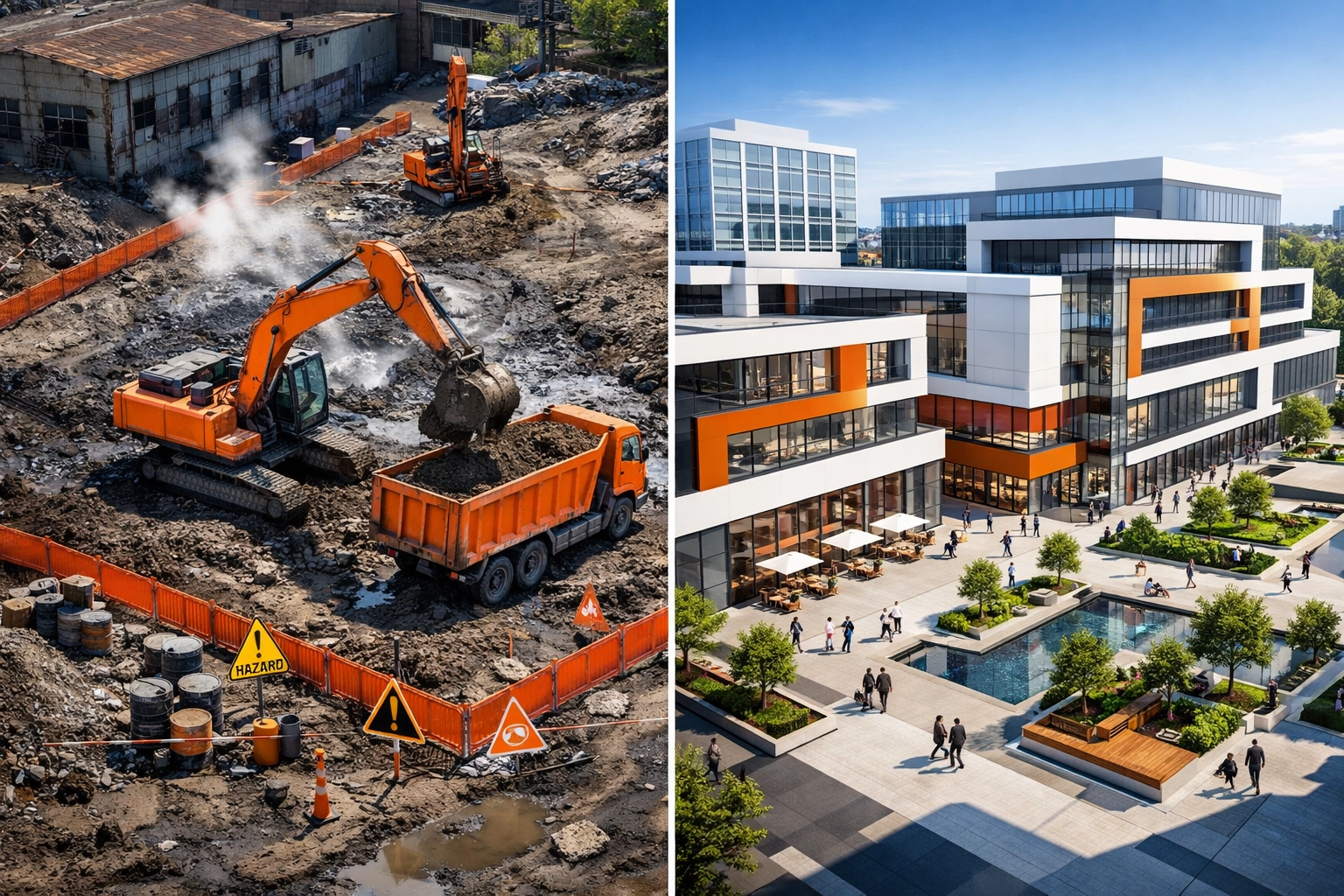
Site contamination added another layer of complexity. The West Oakland BART parking lot sits on land with a century of industrial use, requiring environmental assessments and remediation before construction can begin.[1] The soil testing underway this week will determine the extent of contamination and remediation costs: a critical step that many transit-oriented developments face when building on former industrial sites near rail infrastructure.[7] These costs, often unpredictable until detailed testing occurs, can derail projects or require renegotiating financial agreements.
Political and bureaucratic hurdles compounded technical challenges. BART operates as a regional transit agency with governance structures spanning multiple counties, making decision-making slower than single-jurisdiction projects.[8] The pandemic disrupted planning timelines across the region, and shifting priorities at BART headquarters meant that TOD projects competed for staff attention with operational concerns like ridership recovery and safety improvements.[8]
The project's persistence through these obstacles demonstrates the development team's commitment and the strength of the underlying fundamentals. But it also highlights a sobering reality: even approved projects with strong community support and experienced developers can face multi-year delays in the Bay Area's current development environment.
The Four Development Areas: A Phased Approach
The Mandela Station Partners organized the 5.5-acre site into four distinct development areas, each designed to serve different functions and income levels.[1] This phased approach allows construction to begin on priority areas while continuing to secure financing and permits for later phases.
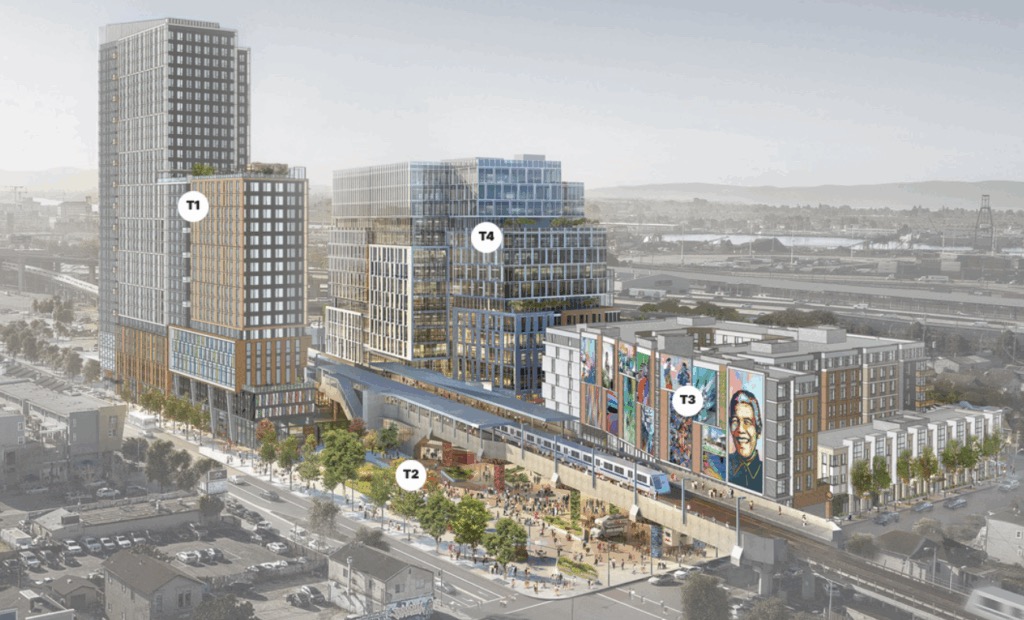
Development Area T1 will rise 31 stories as the project's signature tower, delivering 522 market-rate residential units and 14,350 square feet of ground-floor retail.[1] The slim, mixed-façade design breaks from the blocky apartment buildings dominating much of Oakland's recent development, with articulated window patterns and varied materials creating visual interest.[1] Market-rate units provide critical revenue that cross-subsidizes public improvements and helps make the overall project financially viable: a model that cities increasingly rely on as federal housing support remains inadequate.[9]
Development Area T2 focuses on public realm improvements rather than vertical construction, creating a surface plaza and circulation enhancements for the BART station.[1] These improvements matter enormously for transit riders and neighborhood residents, transforming what is currently a car-dominated parking lot into pedestrian-friendly space with seating, landscaping, and improved wayfinding. Transit-oriented development only works when the station environment itself is welcoming and accessible: a lesson that early TOD projects often ignored in their rush to maximize density.[10]
Development Area T3 delivers the project's affordable housing component: a 7-story mid-rise building with 240 affordable multi-family units and approximately 16,000 square feet of ground-floor retail.[1][2] The building's bold, multicolored façade design signals that affordable housing deserves the same architectural attention as market-rate development: a departure from the bland, cost-engineered approach that characterized many earlier affordable projects.[1] With construction slated to begin in mid-2026, this phase represents the project's most immediate community impact.[2]
Development Area T4 adds a 100-foot-tall commercial office building with 300,000 square feet of office space and approximately 23,000 square feet of ground-floor retail.[1] The mostly-glass façade with deep inset terraces provides outdoor space for office workers while creating a distinctive architectural presence. The office component's success depends heavily on West Oakland's ability to attract companies seeking alternatives to San Francisco's higher rents: a trend that accelerated during the pandemic but faces headwinds from hybrid work patterns.[11]
Development Area Breakdown
| Area | Building Type | Height | Residential Units | Commercial/Retail Space | Affordability |
|---|---|---|---|---|---|
| T1 | High-rise | 31 stories | 522 units | 14,350 sq ft retail | Market-rate |
| T2 | Public realm | N/A | 0 | Plaza and circulation | Public space |
| T3 | Mid-rise | 7 stories | 240 units | 16,000 sq ft retail | 100% Affordable |
| T4 | Office tower | 100 feet | 0 | 300,000 sq ft office + 23,000 sq ft retail | Commercial |
| Total | 762 units | 353,000 sq ft | 31% affordable |
This phasing strategy allows the development team to sequence construction based on financing availability, market conditions, and community priorities. It also creates opportunities to learn from each phase and adjust approaches in subsequent areas: a flexibility that monolithic, single-phase mega-projects lack.
The Development Team: Experience Matters
The Mandela Station Partners brings together three development firms with complementary expertise and proven track records in complex urban projects.[1]
MacFarlane Partners, the lead developer, specializes in institutional-quality real estate investments with a focus on emerging markets and underserved communities.[6] Founded in 1987, the firm manages approximately $4.5 billion in assets and has developed projects across the United States.[6] Their experience with mixed-income, transit-oriented developments includes work at other BART stations and similar projects in Los Angeles and Seattle, providing crucial institutional knowledge about navigating public agency partnerships and complex capital stacks.[6]
Pacific West Companies adds residential development expertise, with a portfolio spanning market-rate and affordable housing across California.[12] The firm's understanding of Bay Area entitlement processes and relationships with local jurisdictions helps navigate Oakland's specific requirements and community expectations.
Strategic Urban Development Alliance (SUDA) brings community development focus and expertise in projects serving low- and moderate-income residents.[13] SUDA's involvement helps ensure that the project delivers genuine community benefits rather than simply extracting value from public land and transit investments: a critical distinction in neighborhoods with justified skepticism about gentrification and displacement.[13]
The design teams: AO (Architecture Office) and JRDV Urban International: bring architectural vision that goes beyond generic "five-over-one" apartment buildings.[1] Their designs incorporate eclectic modern elements, with each building holding distinct character while maintaining overall project coherence.[1] This architectural ambition matters for neighborhood identity and long-term asset value, creating a development that enhances rather than degrades the public realm.
Transit-Oriented Development: Why Location Determines Success
Transit-oriented development has emerged as the dominant planning paradigm for cities seeking to address housing shortages while reducing car dependency and greenhouse gas emissions.[10] The concept is straightforward: concentrate housing, jobs, and retail within walking distance of frequent transit service, allowing residents to access employment and amenities without private vehicles.[10]
The environmental case is compelling. Transportation accounts for approximately 27% of U.S. greenhouse gas emissions, with light-duty vehicles (cars and small trucks) representing the largest share.[14] California has set aggressive targets to reduce transportation emissions 40% below 1990 levels by 2030: a goal that requires fundamentally changing development patterns, not just switching to electric vehicles.[15] Residents of transit-oriented developments drive significantly less than suburban residents, with studies showing 20-40% reductions in vehicle miles traveled depending on transit quality and surrounding density.[10]
The housing affordability argument is equally strong. Bay Area households spend an average of 19% of income on transportation costs, second only to housing itself.[16] For families living in car-dependent suburbs, transportation costs can exceed 25% of income when accounting for vehicle purchases, insurance, fuel, and maintenance.[16] TOD reduces these costs by enabling car-free or car-light lifestyles, effectively increasing household purchasing power. When combined with proximity to jobs, this can offset higher per-square-foot housing costs in urban locations.
The fiscal case matters for cities. Suburban sprawl requires expensive infrastructure: roads, utilities, schools, emergency services: spread across large areas serving relatively few residents.[17] Transit-oriented development concentrates housing near existing infrastructure and transit investments, reducing per-capita service costs while generating higher property tax revenues from more valuable urban land.[17]
The West Oakland project exemplifies these principles: 762 housing units on a 5.5-acre parking lot, steps from a major BART station with service to San Francisco, downtown Oakland, Berkeley, and the East Bay.[1] Residents will have genuine transportation choices, access to regional employment centers, and walkable amenities: if the retail spaces attract quality businesses and the station area improvements create a pleasant pedestrian environment.
Learning from Other BART Station TODs
The Mandela Station development follows earlier transit-oriented projects at MacArthur BART, Fruitvale BART, and Lake Merritt BART stations in Oakland, each offering lessons about what works and what challenges remain.[1][18]
The MacArthur Station development, completed in phases between 2017 and 2021, added approximately 600 residential units and ground-floor retail near the transit hub.[18] The project succeeded in activating a previously car-dominated area and demonstrated market demand for transit-adjacent housing. However, retail spaces struggled to achieve full occupancy, partly due to the station area's limited foot traffic outside commute hours: a reminder that TOD requires more than just housing density to create vibrant streetscapes.[18]
Fruitvale Transit Village, developed in the early 2000s, pioneered the mixed-income TOD model in Oakland with 114 affordable and market-rate apartments, a medical clinic, and Latino-focused retail.[19] The project won national awards for its community-centered design and has maintained high occupancy rates for two decades.[19] Its success demonstrated that thoughtful TOD can enhance rather than displace existing communities when affordable housing is prioritized and retail caters to current residents rather than only anticipated newcomers.[19]
Lake Merritt BART's TOD, still in development, faces challenges balancing new density with an established neighborhood's character concerns.[20] Community opposition delayed earlier proposals, leading to reduced heights and additional affordable housing requirements.[20] The project illustrates that even well-located TOD sites face political challenges when existing residents fear displacement or neighborhood change.
These precedents suggest the Mandela Station development's success will depend on factors beyond construction quality: retail tenant selection that serves existing West Oakland residents, affordable housing management that prevents displacement of current community members, and public space programming that creates destinations rather than just pass-through zones.
West Oakland's Historical Context: From Prosperity to Decline to Renewal
Understanding West Oakland's trajectory from prosperous neighborhood to economically devastated area: and now, potential renewal: provides crucial context for evaluating the Mandela Station project's significance.
The pre-freeway era (1870s-1950s) saw West Oakland develop as a thriving working-class neighborhood, initially home to European immigrants and, by the 1920s, increasingly African American residents drawn by employment opportunities at the Port of Oakland and during World War II shipbuilding.[4] The neighborhood featured commercial corridors along 7th Street and San Pablo Avenue, with Victorian homes, churches, and parks creating a complete community.[4] At its peak, West Oakland was the cultural and economic heart of Oakland's Black community.
The Cypress Freeway's construction in the 1950s initiated the neighborhood's decline, with the elevated double-decker structure literally splitting West Oakland in two.[4] The freeway's route destroyed homes, businesses, and community gathering places, while noise, pollution, and physical separation from the waterfront accelerated economic disinvestment.[4] Middle-class residents who could afford to move relocated to East Oakland neighborhoods or suburbs, while those remaining faced declining property values, reduced services, and increasing poverty.[4]
The 1989 Loma Prieta earthquake killed 42 people when the Cypress Freeway collapsed, but the tragedy created an opportunity to reimagine West Oakland's future.[4] The freeway was demolished rather than rebuilt, with a replacement structure (I-880) following a less intrusive route.[4] The former freeway corridor, including land near the BART station, became available for redevelopment: but progress was slow, hampered by contamination, unclear ownership, and lack of coordinated planning.[4]
Recent years have brought both challenges and opportunities. West Oakland has experienced gentrification pressures as artists, young professionals, and tech workers priced out of San Francisco and downtown Oakland discovered the neighborhood's affordable housing stock, walkability, and industrial-chic character.[21] Property values have risen sharply, creating wealth for longtime homeowners but also displacement risks for renters.[21] The Mandela Station development enters this context as a high-stakes test: can large-scale TOD contribute to neighborhood renewal without accelerating displacement?
What Smart Critics Argue
Not everyone celebrates the Mandela Station development. Thoughtful critics raise legitimate concerns that deserve serious consideration.
Gentrification and displacement worries top the list. While the project includes 240 affordable units (31% of total residential), critics argue this isn't enough to offset the displacement pressures that 522 market-rate units and 300,000 square feet of office space will create.[22] New high-income residents and increased property values inevitably put upward pressure on rents and property taxes in surrounding blocks, potentially forcing out longtime residents and small businesses.[22] The project's 31% affordability exceeds Oakland's standard requirements, but falls short of the 50%+ that some housing advocates demand for developments on public land.[22]
The office component faces skepticism given Bay Area market conditions. Office vacancy rates in Oakland reached 22.8% in late 2025, up from 14.2% pre-pandemic.[11] With remote and hybrid work models seemingly permanent, critics question whether 300,000 square feet of new office space makes sense, particularly in a neighborhood with limited existing office amenities.[11] If Development Area T4 sits partially vacant, it fails to generate expected foot traffic for retail and creates a deadening effect on street vitality.
Environmental justice advocates note the irony of building dense housing near I-880, which still generates significant air pollution and noise despite being less intrusive than the old Cypress Freeway.[23] Studies show that proximity to major highways increases respiratory problems, particularly for children.[23] While transit access reduces resident vehicle use, the development will expose hundreds of families to elevated pollution levels: a pattern that disproportionately affects low-income people and communities of color.[23]
Some urbanists question BART's competence as a development partner given the agency's struggles maintaining existing infrastructure and service quality.[8] BART has deferred billions in maintenance needs while ridership remains well below pre-pandemic levels.[8] Critics argue the agency should focus on core transit operations rather than becoming a real estate developer, and worry that TOD projects distract from service improvements that would benefit existing riders.
These criticisms have merit and highlight genuine tradeoffs. The response shouldn't dismiss concerns but rather acknowledge them while arguing that thoughtfully designed TOD: even imperfect projects: advances important goals around housing production, climate change, and neighborhood investment that decades of inaction have clearly failed to address. The relevant question isn't whether the Mandela Station development is perfect, but whether it's substantially better than the status quo of a parking lot serving single-occupancy vehicles.
Project Management and Construction Considerations
From a construction project management perspective, the Mandela Station development presents several noteworthy challenges and innovations that real estate development firms and project managers should study.
The site remediation phase will largely determine the project's near-term timeline and costs. Contaminated urban sites require careful excavation, soil removal or treatment, and ongoing monitoring: work that's expensive and unpredictable until detailed testing is complete.[7] The soil testing underway this week represents the first step in a process that could take months and potentially reveal contamination levels requiring more extensive remediation than originally budgeted.[7] Experienced construction project management teams build significant contingency into schedules and budgets for this work, recognizing that discoveries during excavation can require redesigned remediation approaches.
Coordinating construction across four development areas requires sophisticated sequencing to manage site logistics, utilities, and access while minimizing disruption to operating BART service.[24] The project team must maintain station access for thousands of daily riders throughout construction: a constraint that affects staging areas, material deliveries, and crane locations.[24] Phased construction allows some flexibility, but creates coordination challenges as different areas advance at different rates.
The 31-story T1 tower pushes the limits of Oakland's construction capacity. While the Bay Area has extensive high-rise experience in San Francisco, Oakland's building trades have less recent practice with projects at this scale.[25] Recruiting experienced tower crane operators, elevator installers, and curtain wall specialists may require drawing workers from San Francisco projects, adding labor costs.[25] Quality control becomes more challenging at height, requiring more inspection personnel and more sophisticated safety protocols than mid-rise construction.
Coordinating multiple financing sources creates unique construction project management challenges. Different funding sources often have different compliance requirements, inspection protocols, and draw schedules.[5] The affordable housing component typically faces more stringent oversight from public agencies than market-rate construction, requiring additional documentation and approvals throughout construction.[5] Successful project managers establish clear communication protocols with all stakeholders and build buffer into schedules to accommodate public agency review timelines.
What to Do Next: Lessons for Developers, Cities, and Community Organizations
The Mandela Station development offers actionable insights for stakeholders involved in urban neighborhood revitalization and transit-oriented projects.
For Real Estate Development Firms:
-
Start community engagement during site control negotiations, not after approvals. The Mandela Station project benefited from years of community input that shaped the affordable housing percentage, design guidelines, and retail strategy. Early engagement prevents later opposition and creates genuine partnerships.
-
Structure financing with contingency for extended timelines. This project sat approved for multiple years before construction began: a pattern increasingly common in California's complex regulatory environment. Financing structures must accommodate delays without triggering defaults or losing critical funding sources.
-
Invest in design excellence even when budgets are tight. The architectural variety across development areas creates distinctive identity and signals respect for the neighborhood. Generic buildings save money upfront but reduce long-term asset value and community acceptance.
-
Plan retail tenant mix to serve existing residents first, anticipated newcomers second. Too many TOD projects fill ground-floor retail with chains and luxury services that ignore current community needs, creating resentment and limiting success.
-
Build flexibility into phasing plans. Market conditions, financing availability, and community priorities shift over multi-year projects. The four-area structure allows the Mandela Station team to adjust sequencing as circumstances change.
For Cities and Transit Agencies:
-
Streamline TOD approvals with dedicated staff and clear timelines. Projects that sit approved but unbuilt represent failures of implementation, not just development economics. Create fast-track processes for projects meeting TOD criteria.
-
Invest in station area improvements before private development begins. Public realm quality determines whether TOD creates vibrant neighborhoods or just dense parking lots without cars. Don't rely entirely on private developers to create inviting public space.
-
Require meaningful affordability but recognize the financial limits. Oakland's approach: requiring significant affordable housing while acknowledging that 100% affordable projects rarely pencil without massive subsidies: reflects practical wisdom. Cities that demand impossible affordability percentages often get nothing built.
-
Coordinate contamination assessment and remediation early in planning. Environmental surprises during construction cause project failures. Public agencies should assess contamination and potentially fund remediation on public land before selecting development partners.
For Community Organizations and Housing Advocates:
- Engage seriously with TOD proposals while maintaining principled positions. Boycotting planning processes or demanding that every project be 100% affordable reduces influence over actual outcomes. The Mandela Station project's 31% affordability reflects negotiated community input: imperfect but tangible.
Key Takeaways: Why the Mandela Station Development Matters
-
Movement from approval to construction signals that even complex, multi-phase TOD projects can overcome financing and regulatory hurdles in the current Bay Area environment: offering hope for other stalled projects.
-
The 762-unit project demonstrates the housing production potential of transit-oriented development on underutilized public land, particularly parking lots that serve single-occupancy vehicles rather than housing or community uses.
-
Mixed-income development (31% affordable, 69% market-rate) provides a financially viable model that delivers more affordable units than purely market-rate projects while avoiding the extensive subsidies required for 100% affordable developments.
-
West Oakland's historical context: from prosperous community to freeway-scarred decline to potential renewal: illustrates how transit-oriented development can help correct decades of destructive planning decisions, though displacement risks require ongoing attention.
-
The phased, multi-area approach offers flexibility to adjust to market conditions and community feedback over the project's multi-year construction timeline, reducing all-or-nothing risks that plague single-phase mega-projects.
-
Success depends on factors beyond construction quality: retail tenant selection, public space programming, station area improvements, and anti-displacement measures will determine whether the project enhances or disrupts the existing community.
-
For construction project management professionals, the soil remediation, tower construction, and multi-stakeholder coordination challenges provide a case study in managing complex urban infill projects on contaminated sites near operating transit infrastructure.
McFadden Finch Holdings Company: Partnering in Urban Revitalization
At McFadden Finch Holdings Company, we recognize that projects like the Mandela Station development represent the future of sustainable urban growth. Our expertise in real estate development, construction project management, and community-focused investment positions us to partner with cities, developers, and community organizations on transit-oriented projects that create lasting value while addressing housing affordability and neighborhood revitalization.
We believe that successful urban development requires more than financial engineering: it demands commitment to community impact, operational excellence in project execution, and long-term perspective on asset value creation. Whether you're a public agency seeking development partners for underutilized transit sites, a development firm navigating complex financing and regulatory challenges, or a community organization working to ensure that growth benefits existing residents, MFHC brings the experience and commitment to help turn ambitious plans into reality.
Ready to discuss how transit-oriented development can work in your community? Contact McFadden Finch Holdings Company today at (510) 973-2677 or visit www.m-fhc.com/contact-us to explore partnership opportunities.
Sources
[1] Gabriel Clark-Clough, "Initial Construction On West Oakland Transit-Oriented Development Planned To Start This Year," SocketSite, February 10, 2026, https://socketsite.com, Accessed February 10, 2026.
[2] BART, "West Oakland BART Station Transit-Oriented Development," San Francisco Bay Area Rapid Transit District, January 2026, https://www.bart.gov/about/business/tod/west-oakland, Accessed February 10, 2026.
[3] Urban Land Institute, "Transit-Oriented Development in the Bay Area: 2025 Status Report," ULI San Francisco, December 2025, https://sanfrancisco.uli.org, Accessed February 10, 2026.
[4] Oakland Museum of California, "West Oakland: A Legacy of Innovation and Struggle," OMCA Historical Archives, 2023, https://museumca.org/west-oakland-history, Accessed February 10, 2026.
[5] Enterprise Community Partners, "Layered Financing in Affordable Housing Development: A Guide for Practitioners," Enterprise, November 2024, https://www.enterprisecommunity.org, Accessed February 10, 2026.
[6] MacFarlane Partners, "About MacFarlane Partners," Company Overview, 2025, https://www.macfar.com/about, Accessed February 10, 2026.
[7] U.S. Environmental Protection Agency, "Brownfields and Land Revitalization: Site Remediation," EPA, August 2025, https://www.epa.gov/brownfields, Accessed February 10, 2026.
[8] BART, "BART Board of Directors Meeting Minutes," Bay Area Rapid Transit District, September 2025, https://www.bart.gov/about/bod, Accessed February 10, 2026.
[9] Terner Center for Housing Innovation, "Subsidizing Affordable Housing in Mixed-Income Developments," UC Berkeley Terner Center, March 2025, https://ternercenter.berkeley.edu, Accessed February 10, 2026.
[10] Institute for Transportation and Development Policy, "TOD Standard v3.0," ITDP, June 2024, https://www.itdp.org/tod-standard, Accessed February 10, 2026.
[11] CBRE, "Oakland Office Market Report Q4 2025," CBRE Research, January 2026, https://www.cbre.com/insights/reports/oakland-office-market, Accessed February 10, 2026.
[12] Pacific West Companies, "Portfolio: Residential Development," Company Projects, 2025, https://www.pacificwestco.com, Accessed February 10, 2026.
[13] Strategic Urban Development Alliance, "Community Development Projects," SUDA, 2025, https://www.sudahousing.org, Accessed February 10, 2026.
[14] U.S. Environmental Protection Agency, "Sources of Greenhouse Gas Emissions: Transportation Sector," EPA, November 2025, https://www.epa.gov/ghgemissions/sources-greenhouse-gas-emissions, Accessed February 10, 2026.
[15] California Air Resources Board, "California's 2030 Climate Commitment," CARB, May 2024, https://ww2.arb.ca.gov/our-work/programs/ab-32-climate-change-scoping-plan, Accessed February 10, 2026.
[16] Metropolitan Transportation Commission, "Transportation Costs and Affordability in the Bay Area," MTC Vital Signs, September 2025, https://www.vitalsigns.mtc.ca.gov/transportation-costs, Accessed February 10, 2026.
[17] American Planning Association, "Fiscal Impacts of Sprawl versus Smart Growth," Planning Advisory Service Report 596, March 2024, https://www.planning.org, Accessed February 10, 2026.
[18] Oakland Planning and Building Department, "MacArthur Transit Village Development Status," City of Oakland, June 2025, https://www.oaklandca.gov/projects/macarthur-transit-village, Accessed February 10, 2026.
[19] Urban Land Institute, "Fruitvale Transit Village: Case Study in Community-Centered TOD," ULI Case Studies, October 2023, https://casestudies.uli.org/fruitvale-transit-village, Accessed February 10, 2026.
[20] East Bay Times, "Lake Merritt BART development faces community pushback on height, affordability," East Bay Times, July 2025, https://www.eastbaytimes.com, Accessed February 10, 2026.
[21] Urban Displacement Project, "Gentrification and Displacement in the Bay Area," UC Berkeley Haas Institute, April 2025, https://www.urbandisplacement.org/maps/sf-bay-area, Accessed February 10, 2026.
[22] Oakland Tenants Union, "Position Statement on Transit-Oriented Development and Affordable Housing Requirements," OTU Policy Statements, August 2025, https://www.oaklandtenantsunion.org, Accessed February 10, 2026.
[23] American Lung Association, "State of the Air 2025: Bay Area Air Quality Report," ALA, April 2025, https://www.lung.org/research/sota, Accessed February 10, 2026.
[24] Construction Management Association of America, "Managing Multi-Phase Urban Construction Projects," CMAA Best Practices Guide, January 2025, https://www.cmaanet.org, Accessed February 10, 2026.
[25] Engineering News-Record, "High-Rise Construction Labor Market Analysis: Bay Area 2025," ENR California, November 2025, https://www.enr.com/california, Accessed February 10, 2026.
#TransitOrientedDevelopment #WestOakland #AffordableHousing #UrbanRevitalization #BayAreaRealEstate