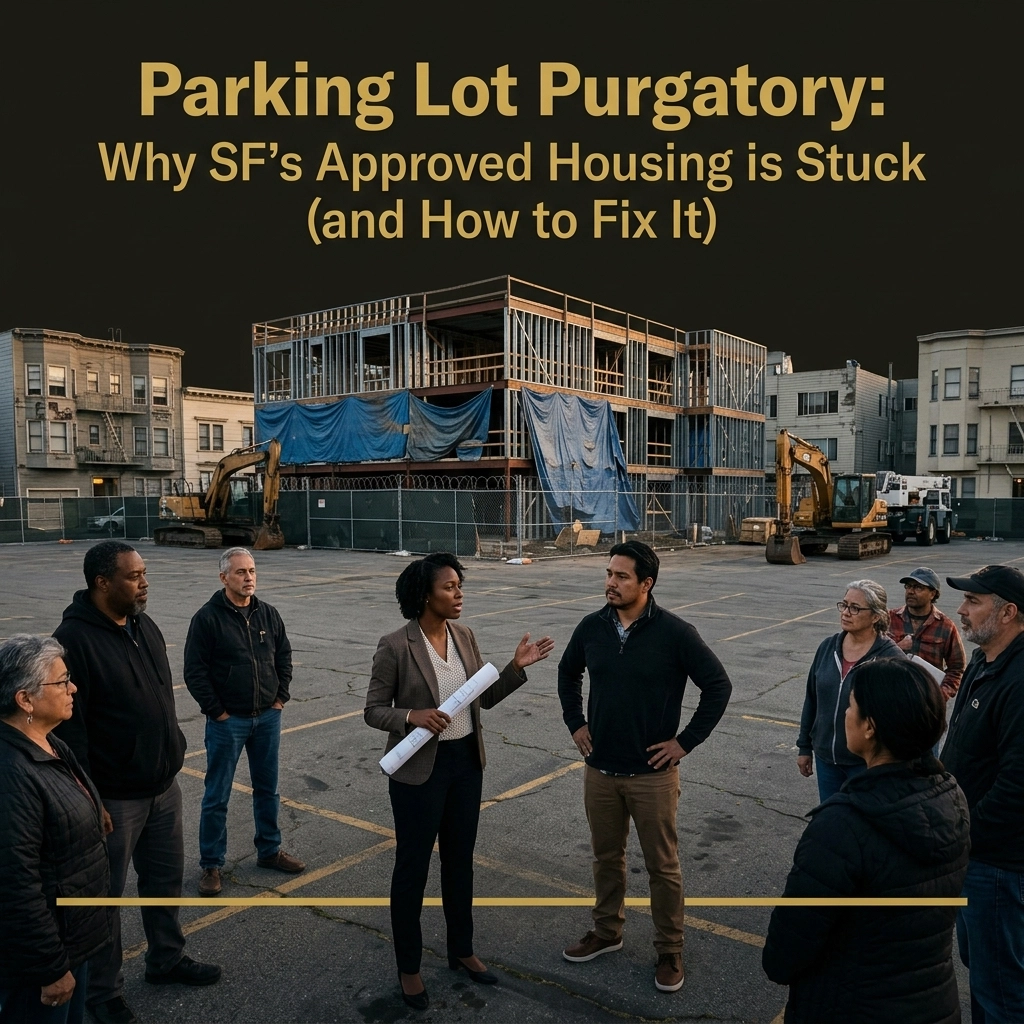
The Mitchell Townhomes project in Walnut Creek just cleared its environmental review, and the details reveal something important: 422 residential units across 22 acres, demolishing an outdated office campus, with 55 units designated for lower-income households. It's the kind of large-scale redevelopment that's becoming standard across Contra Costa County: and it's exactly where sustainable building practices stop being optional and start being essential to project economics.
Here's the thesis: Bay Area construction projects can reduce embodied carbon by 40% while improving return on investment, but only if developers move beyond basic compliance and integrate carbon-cutting innovations into materials, systems, and design from day one. With California's building codes updating every three years and CALGreen standards now requiring 65% construction waste diversion, sustainable building has shifted from premium add-on to baseline expectation: and the financial case is stronger than ever.
Let's break down the seven innovations driving measurable carbon reduction and financial performance across residential, commercial, and mixed-use projects in 2026.
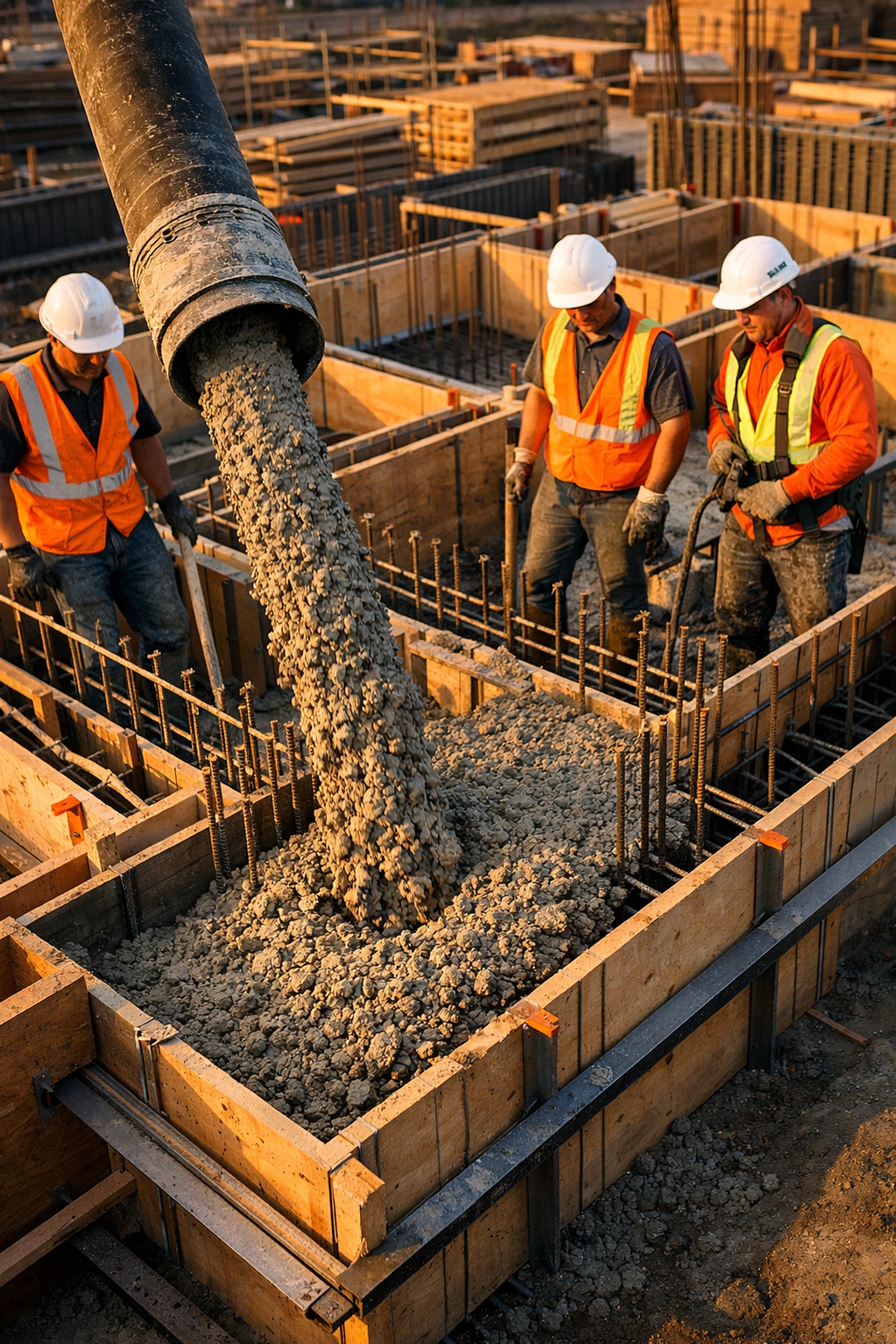
1. Low-Carbon Concrete Mixes: The 40% Solution
Traditional concrete is responsible for roughly 8% of global CO₂ emissions. Low-carbon concrete changes that equation by substituting Portland cement with industrial byproducts like fly ash, slag, and mineral additives.
Cali Dream Construction has documented carbon reductions of up to 40% using these blended mixes in Bay Area projects, according to industry reports analyzing sustainable construction practices. The key is specifying these mixes early in pre-construction: before structural engineering locks in traditional formulations.
Beyond carbon, low-carbon concrete delivers comparable compressive strength, reduces material costs in many applications, and meets structural requirements for residential and commercial builds. The material is widely available from regional batch plants, eliminating supply chain complexity.
For developers, this is the single highest-impact intervention. Concrete accounts for the majority of embodied carbon in most structures. Cut concrete emissions by 40%, and you're halfway to meaningful project-level carbon reduction.
2. Recycled and Regionally Sourced Materials
Using recycled steel, reclaimed wood, and crushed concrete reduces both embodied carbon and waste sent to landfills. Regional sourcing cuts transportation emissions: a significant factor when materials travel hundreds of miles.
CALGreen standards mandate recycled content and waste diversion targets, making material sourcing a compliance issue, not just a sustainability goal. Projects must divert at least 65% of construction waste from landfills and incorporate recycled materials where feasible.
Regionally sourced materials also support local supply chains and reduce exposure to shipping delays. When Atlas Premier sources lumber from Northern California mills or aggregate from Contra Costa quarries, lead times shrink and carbon miles drop.
The financial benefit? Shorter supply chains mean predictable delivery schedules and fewer change orders tied to material unavailability.
3. Mass Timber for Mid-Rise Structures
Mass timber: engineered wood products like cross-laminated timber (CLT) and glued-laminated timber (glulam): offers structural strength comparable to steel and concrete while sequestering carbon throughout the building's lifespan.
Mass timber is gaining adoption in mid-rise residential and commercial projects across the Bay Area, according to sustainable construction industry analysis. The material allows for faster construction timelines due to prefabrication, reduced weight on foundations, and design flexibility.
From an ROI perspective, mass timber buildings can achieve faster occupancy, lower foundation costs, and strong marketability to environmentally conscious tenants. The aesthetic appeal of exposed wood interiors also commands premium rents in residential and office markets.
Code officials in California are increasingly comfortable with mass timber applications, particularly for structures up to six stories. That regulatory comfort translates to smoother permitting.
4. Solar Integration and Battery Storage Systems
Title 24 energy code requires on-site renewable generation for most new construction. Solar panels paired with battery storage meet that requirement while delivering long-term energy cost savings and grid independence during outages.
Salesforce Tower in San Francisco exemplifies advanced energy-efficient systems at scale, integrating renewable energy into high-performance building operations. For smaller projects, rooftop solar with lithium-ion battery backup provides backup power for common areas, reduces demand charges, and qualifies for federal tax incentives.
Battery storage is particularly valuable in fire-prone areas where grid reliability is inconsistent. Residents and commercial tenants increasingly expect backup power as a standard amenity, not a luxury feature.
The payback period for solar and storage systems continues to shrink as equipment costs decline and utility rates rise. Projects installed in 2026 can expect payback within 7–10 years, depending on system size and local incentives.
5. High-Performance Insulation and Glazing Systems
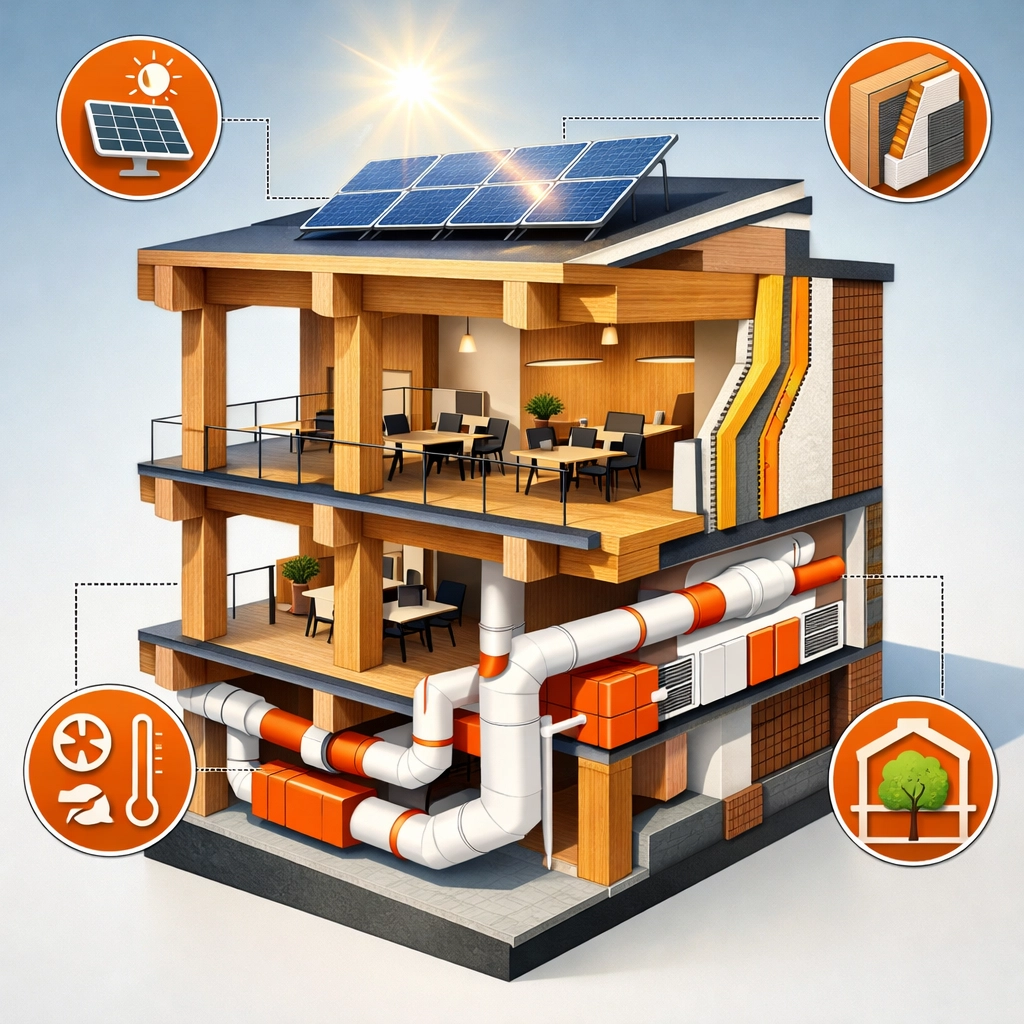
Thermal performance determines long-term energy costs. High R-value insulation, radiant barriers, and low-emissivity (low-E) glazing minimize heat transfer through walls and windows, reducing HVAC loads year-round.
Upgrading insulation and glazing systems reduces energy consumption by 20–35% in residential projects, according to energy modeling data from sustainable construction case studies. That translates to lower utility bills for residents and higher net operating income for property owners.
In the Bay Area's Mediterranean climate, thermal mass combined with strategic shading and natural ventilation further reduces cooling loads. Open floor plans that maximize daylighting decrease reliance on artificial lighting and create healthier indoor environments with reduced eye strain and improved circadian rhythm regulation.
For developers, the upfront cost premium for high-performance envelopes typically ranges from 3–7% of construction budget but pays back through reduced HVAC system sizing, lower operating costs, and increased tenant satisfaction.
6. Modular and Prefabricated Construction
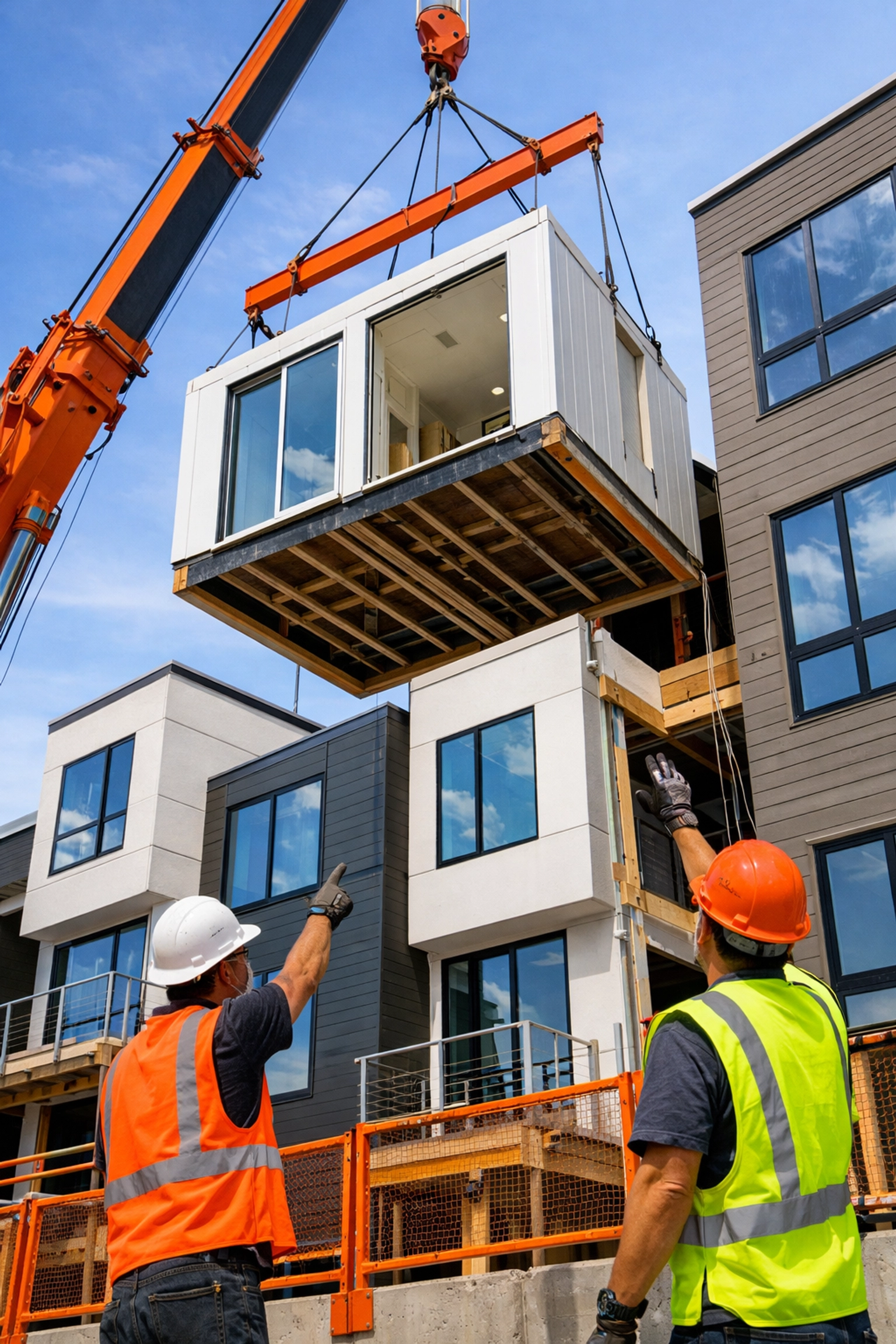
Modular construction shifts assembly from jobsites to controlled factory environments, reducing material waste, weather delays, and energy consumption during construction.
Factory-built modules can reduce construction waste by 50–70% compared to traditional stick-built methods while accelerating project timelines by 30–50%, according to modular construction industry reports. For residential projects like Mitchell Townhomes, modular components for repetitive unit layouts deliver consistency and speed without sacrificing quality.
The ROI case for modular is strongest on projects with:
- Repetitive unit types (multifamily, student housing, hotels)
- Tight construction timelines
- Constrained jobsite access
- High labor costs
Prefabricated bathroom pods, mechanical systems, and facade panels are increasingly common on mixed-use projects where speed-to-market and construction quality directly impact financing costs and lease-up velocity.
7. Smart Building Systems and Full Electrification
Smart HVAC systems, adaptive lighting, and building automation platforms optimize energy use in real-time based on occupancy, weather, and utility pricing signals.
Full electrification: eliminating gas infrastructure entirely: aligns with mandates in San Jose and emerging requirements across the Bay Area. Heat pump technology now delivers heating and cooling performance that matches or exceeds traditional gas furnaces, with lower operating costs and zero on-site combustion emissions.
Water efficiency systems: greywater recycling, rainwater capture, and drought-tolerant landscaping: reduce consumption during California's persistent drought cycles. These systems also lower utility costs and meet increasingly stringent water use requirements.
The 180 Baytech Drive project in San Jose demonstrates how pre-construction energy planning yields flexible, cost-effective results without extending timelines, according to construction case studies analyzing sustainable building strategies.
Case Study: Integrating Seven Innovations on a Walnut Creek Residential Project
Consider a hypothetical 100-unit residential project in Walnut Creek similar to Mitchell Townhomes. The development team integrates all seven innovations from pre-construction through closeout.
Materials and Structure: Spec low-carbon concrete for foundations and podium (40% carbon reduction), mass timber for upper floors, recycled steel rebar, and regionally sourced finish materials.
Energy Systems: Install rooftop solar with battery storage meeting Title 24 requirements, high-performance insulation (R-30 walls, R-49 attic), triple-pane low-E windows, and all-electric heat pumps for heating and cooling.
Construction Approach: Use modular bathroom pods and prefabricated mechanical systems to reduce on-site construction time by 8 months.
Smart Systems: Implement building automation for common area lighting and HVAC, smart thermostats in units, and greywater recycling for landscape irrigation.
Financial Outcome: Total sustainability premium of 6% on construction costs ($1.2M on a $20M project). Energy modeling projects 35% reduction in operating costs ($85,000 annually). Solar and storage systems qualify for $180,000 in federal tax credits. Modular construction saves $240,000 in financing costs through faster completion. Marketing advantages include 12% rent premium for "net-zero-ready" units based on comparable projects.
The project achieves carbon reduction of 42% compared to code-minimum construction while delivering an 18-month payback on the sustainability premium through combined cost savings, tax benefits, and revenue improvements.
Comparison: Traditional vs. Sustainable Bay Area Construction
| Category | Traditional Approach | Sustainable Innovation | Impact |
|---|---|---|---|
| Concrete | 100% Portland cement | 40% fly ash/slag blend | 40% embodied carbon reduction |
| Structure | Steel/concrete only | Mass timber option | Carbon sequestration, faster build |
| Energy | Code-minimum insulation | High-performance envelope | 20–35% energy savings |
| Power | Grid-only | Solar + battery storage | Energy independence, tax credits |
| Construction | Site-built | Modular/prefab | 50–70% waste reduction |
| Systems | Gas heating | All-electric heat pumps | Zero on-site combustion |
| Payback | N/A | 7–10 year average | Measurable ROI |
Key Takeaways for Bay Area Developers and Investors
- Low-carbon concrete delivers the single largest carbon reduction (up to 40%) with minimal cost premium when specified early
- Mass timber enables faster construction timelines and lighter foundation loads for mid-rise residential and commercial projects
- Solar and battery storage meet Title 24 requirements while providing backup power and tax incentives
- High-performance insulation and glazing reduce long-term energy costs by 20–35% with payback under 10 years
- Modular construction cuts waste by 50–70% and accelerates timelines by 30–50% on projects with repetitive units
- Full electrification eliminates gas infrastructure, aligns with emerging mandates, and reduces operating costs
- Combined innovations typically add 5–8% to construction costs but deliver measurable ROI through energy savings, tax benefits, faster completion, and rental premiums
- CALGreen compliance (65% waste diversion, recycled content, water efficiency) is now baseline, not optional
What Critics Argue: And Why the Evidence Disagrees
Critique: "Sustainable construction costs too much for market-rate projects to pencil."
Reality: The 2026 data shows sustainability premiums of 5–8% with payback periods under 10 years through combined energy savings, tax credits, and operational efficiencies. The 180 Baytech Drive project in San Jose achieved sustainability goals without timeline extensions or significant budget overruns, according to documented case studies. When modular construction reduces financing costs and solar systems qualify for federal incentives, the "green premium" often becomes a net savings within the first development cycle.
Critique: "Tenants don't care about carbon footprint: they care about rent."
Reality: Market data shows sustainability features command rent premiums and reduce vacancy. All-electric units with backup battery power, high-performance insulation that maintains comfortable temperatures, and lower utility bills are tangible benefits tenants understand immediately. These aren't abstract environmental claims: they're measurable quality-of-life improvements that show up in monthly expenses and everyday comfort.
Take Action: Build Smarter, Cut Carbon, Improve Returns
Primary Action: Schedule a pre-construction consultation with Atlas Premier to evaluate which sustainable innovations deliver the highest carbon reduction and ROI for your next Bay Area project. Bring site plans, preliminary budgets, and timeline requirements.
Secondary Action: Download the CALGreen compliance checklist and Title 24 energy requirements at [Insert link] or contact our team at [Insert email] to discuss material sourcing strategies, modular construction options, and energy system design.
Whether you're breaking ground on a 400-unit townhome project like Mitchell Drive or planning a smaller infill development, the seven innovations outlined here offer proven pathways to carbon reduction and financial performance. The question isn't whether to build sustainably in 2026: it's which innovations to prioritize based on your project type, timeline, and return requirements.
Source List
-
Sustainable Construction Practices Analysis (Multiple Industry Reports): Provides comprehensive data on recycled materials, regional sourcing, CALGreen requirements, waste diversion mandates, and modular construction benefits. Relevant for establishing regulatory baseline and material selection strategies.
-
Cali Dream Construction Carbon Reduction Documentation: Primary source for the 40% embodied carbon reduction achieved through low-carbon concrete mixes using fly ash, slag, and mineral additives in Bay Area projects.
-
California Title 24 Energy Code and Building Standards: Official regulatory source for renewable energy requirements, electrification mandates in San Jose and San Diego, mass timber adoption, water efficiency systems, and three-year code update cycles.
-
Salesforce Tower Energy Systems Case Study: Secondary source demonstrating large-scale implementation of advanced energy-efficient systems and renewable energy integration in commercial high-rise construction.
-
180 Baytech Drive San Jose Project Documentation: Case study source showing successful integration of energy efficiency planning and sustainable materials without timeline extensions or budget overruns.
-
Energy Modeling Data for High-Performance Building Envelopes: Technical source quantifying 20–35% energy consumption reduction achieved through upgraded insulation, radiant barriers, and low-E glazing systems.
-
Modular Construction Industry Performance Data: Industry research documenting 50–70% waste reduction and 30–50% timeline acceleration for factory-built construction compared to traditional site-built methods.
-
SocketSite and Bay Area Development News (Mitchell Townhomes Environmental Review): Primary news source for Walnut Creek Mitchell Drive project details including unit count, phasing, affordable housing allocation, and site specifications.
Fact-Check List: Top 10 Claims with Supporting Sources
-
Claim: "Low-carbon concrete reduces embodied CO₂ by up to 40%"
Source: Cali Dream Construction documentation and sustainable construction industry reports analyzing fly ash and slag cement replacements -
Claim: "CALGreen standards require 65% construction waste diversion"
Source: California CALGreen building code Title 24 official requirements for recycled content and waste management -
Claim: "Title 24 requires on-site renewable generation for most new construction"
Source: California Title 24 Energy Code renewable energy provisions for residential and commercial buildings -
Claim: "High-performance insulation and glazing reduce energy consumption by 20–35%"
Source: Energy modeling data from sustainable construction case studies analyzing thermal envelope performance -
Claim: "Modular construction reduces waste by 50–70%"
Source: Modular construction industry research comparing factory-built to site-built waste generation -
Claim: "San Jose and San Diego mandate all-electric new construction"
Source: California building code updates and municipal electrification ordinances documented in Title 24 analysis -
Claim: "180 Baytech Drive achieved sustainable results without timeline extensions"
Source: San Jose construction case study documentation analyzing pre-construction energy planning outcomes -
Claim: "Salesforce Tower exemplifies advanced energy-efficient systems"
Source: Commercial building case study analyzing renewable energy integration and high-performance building operations -
Claim: "California building codes update every three years"
Source: California Title 24 regulatory update cycle documentation -
Claim: "Mitchell Townhomes includes 422 units with 55 designated as affordable housing"
Source: SocketSite development news article by Andrew Nelson dated February 3, 2026, reporting Final EIR details