While the national housing market grapples with affordability constraints and declining activity, the Bay Area is writing a different story. San Francisco and San Jose buyers are paying premiums that would make buyers in Phoenix or Austin balk: yet properties are still moving quickly, often with multiple offers. The median Bay Area home price sits at $1.65 million as of February 2026, a figure that hasn't budged despite mortgage rates hovering near 6% and widespread predictions of a national correction.[1]
This isn't irrational exuberance. It's a market reset driven by fundamental economic forces: the AI boom has pulled talent back into urban cores, accumulated wealth is offsetting high borrowing costs, and a severe supply shortage is creating competition in premium inventory. The psychological shift matters too. Buyers who spent 2022–2024 waiting for rates to drop have accepted the new normal and are moving forward with adapted financial strategies.[2]
The Numbers Don't Lie: Bay Area vs. National Divergence
The gap between Bay Area performance and national trends is stark. Nationally, pending home sales declined 6.8% year-over-year in January 2026, with inventory rising and price growth slowing across most metros.[3] Meanwhile, San Francisco posted some of its strongest pending sales activity in years, with approximately 51% of Bay Area transactions closing above list price.[4]
Days-to-pending tell the story of buyer urgency: the Bay Area median sits at 29 days, compared to 45–60 days in comparable high-cost markets like Seattle or Denver.[4] Homes priced between $2 million and $3 million are seeing the most competitive bidding, particularly in neighborhoods with walkable access to tech campuses or premium school districts.[5]

Market Snapshot: Bay Area vs. U.S. (January 2026)
| Metric | Bay Area | National Average |
|---|---|---|
| Median Home Price | $1.65M | $412,000 |
| % Sales Over List | 51% | 23% |
| Days to Pending | 29 | 52 |
| YoY Price Change | +4.2% | +1.1% |
| Inventory (Months) | 2.1 | 4.3 |
Data referenced from Redfin, Zillow, and San Francisco Business Times[1][3][4]
The inventory crunch remains the market's defining constraint. Even with modest increases in listings during late 2025, the Bay Area carries just 2.1 months of supply, well below the 6-month benchmark considered balanced.[6] Single-family homes in desirable school districts are particularly scarce, forcing buyers to compromise on location, size, or property type.
The AI Boom: More Than Hype
Artificial intelligence isn't just a tech narrative: it's reshaping Bay Area employment and housing demand in measurable ways. AI and AI-related firms now account for roughly 36% of San Francisco's office tenant demand, a figure that translates directly into residential activity.[7] Companies like Anthropic, OpenAI, and dozens of well-funded startups are pulling talent into the city, often with compensation packages that include significant equity and relocation bonuses.
This mirrors the 2010–2015 mobile-first boom and the 2016–2019 cloud infrastructure wave, both of which drove sustained home price appreciation despite national economic uncertainty.[8] The difference now is scale: AI investment is broader, venture funding remains robust despite higher interest rates, and the talent pool skews toward senior engineers and executives with strong balance sheets.[9]
The return-to-office mandate adopted by major tech employers has amplified this effect. While remote work persists in many industries, top-tier AI companies are requiring in-person collaboration 3–5 days per week, making proximity to San Francisco and South Bay campuses a necessity rather than a preference.[10] That's created renewed demand for housing in San Mateo, Palo Alto, Mountain View, and San Francisco's Mission Bay and SoMa neighborhoods.
The Wealth Buffer: Why High Rates Haven't Stopped Buyers
The simplest explanation for Bay Area resilience is this: local buyers have money. Not income alone, but accumulated wealth that offsets the pain of 6% mortgage rates. Three sources dominate:[2]
Home Equity from Pre-2020 Purchases: Buyers who purchased between 2012 and 2019 have seen their home values double or triple, providing substantial down payments for move-up purchases.
Stock Market Gains and RSU Vesting: Tech employees benefited from strong equity market performance in 2023–2025, with many holding stock portfolios worth $500,000 to $2 million+.
Intergenerational Wealth Transfers: Baby Boomer parents are gifting or loaning down payment funds to Millennial and Gen-X children at unprecedented rates, particularly in high-net-worth Asian and white communities.
This wealth cushion allows buyers to put down 30–50% on purchases, reducing monthly payment sensitivity to interest rates. A $2 million home with a $1 million down payment carries a monthly mortgage of roughly $6,500 at 6% rates: manageable for dual-income tech households earning $500,000+.[11]
Case Study: The Noe Valley Reset
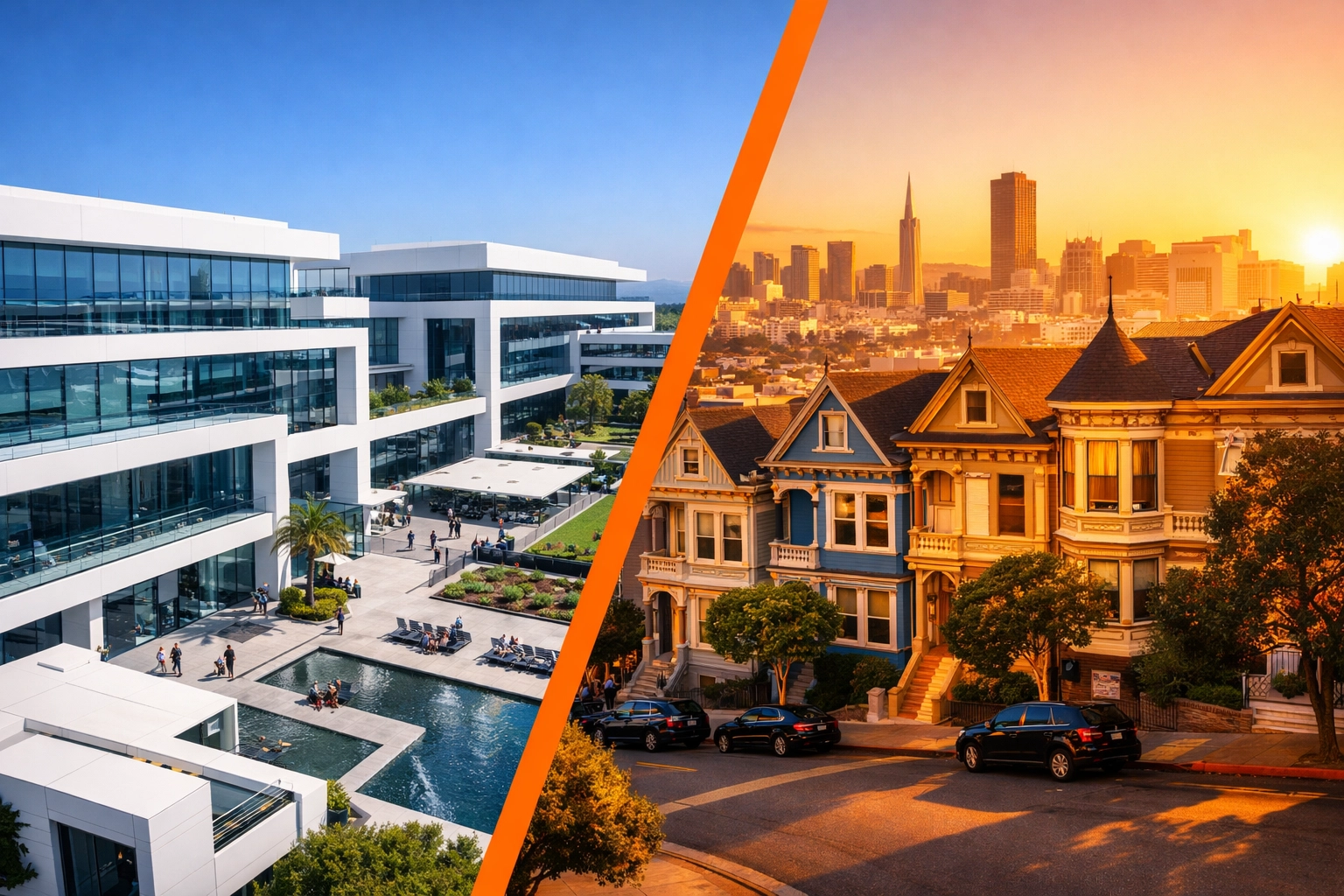
Sarah Chen and her partner spent 18 months house-hunting in San Francisco before closing on a 3-bedroom Victorian in Noe Valley in January 2026. They paid $2.3 million: 8% above list price: after losing four previous bidding wars.
"We thought prices would drop," Chen said. "But every time we saw a home we liked, there were three other offers. We finally realized we were competing with cash buyers and people with massive down payments. Waiting wasn't helping us."
Chen's experience is typical of the current market. She and her partner are both software engineers at mid-sized AI startups, with combined W-2 income of $480,000 and RSU grants worth another $300,000 vesting over four years. They put down 40% using savings, stock sales, and a gift from Chen's parents. Their monthly payment is $8,200: high, but within their budget after accounting for stock compensation.
"The psychological reset was harder than the financial one," she added. "We had to stop waiting for the 'perfect' market and accept that this is the market."
The Premium Tier Squeeze
Not all Bay Area real estate is performing equally. The market has bifurcated sharply between premium single-family homes and mid-tier condos or townhomes. Homes priced above $2 million in top school districts are seeing the strongest competition, while condos under $1 million are sitting longer and occasionally selling below list price.[12]
This reflects a shift in buyer demographics. Move-up buyers with significant equity and income are driving activity in the premium tier, while first-time buyers are increasingly priced out or forced into less desirable locations. The median first-time buyer in San Francisco now requires a household income of approximately $350,000 to qualify for a starter home, assuming a 20% down payment.[13]
Who's Buying in 2026:
- Tech employees (35% of buyers): Senior engineers, product managers, and executives at AI and software companies
- Wealth management/finance professionals (18%): Private equity, venture capital, and asset managers concentrated in San Francisco's Financial District
- Healthcare professionals (12%): Physicians and specialists at UCSF, Stanford, and Kaiser
- Move-up buyers (22%): Existing homeowners selling and upgrading within the Bay Area
- Investors/second-home buyers (8%): Cash buyers purchasing rental properties or pied-à-terre units
- Other (5%): Legal, consulting, and small business owners
Data referenced from Bay Area real estate transaction records and Zillow[1][4]
The Psychological Reset: Buyers Stop Waiting
Perhaps the most significant shift in the 2026 market isn't financial: it's psychological. After years of expecting mortgage rates to return to 3%, buyers have accepted that 6% may be the new normal for the foreseeable future. This acceptance is driving activity that would have seemed unlikely just 12 months ago.[14]
Buyers are adapting strategies to navigate higher rates:
- Starting smaller: First-time buyers are purchasing 2-bedroom condos or townhomes instead of waiting for single-family homes
- Prioritizing location over size: Accepting smaller square footage in exchange for proximity to work and amenities
- Planning to refinance: Locking in purchases now with the intention to refinance if rates drop in 2027–2028
- Leveraging adjustable-rate mortgages: Using 5/1 or 7/1 ARMs to reduce initial payments
- Pooling family resources: Co-purchasing with parents or siblings to split costs and qualify for larger loans
This strategic flexibility is keeping transaction volume stable even as affordability metrics suggest the market should be frozen.[15]
Market Forecast: Spring Through Year-End 2026
The outlook for the remainder of 2026 points to gradual appreciation rather than explosive growth. Prices across the broader Bay Area are projected to rise 2–6%, with the regional median reaching approximately $1.094 million by December.[1] San Francisco and San Mateo County will likely outperform, while Alameda and Contra Costa counties may see flatter growth as buyers seek affordability.
Inventory should improve modestly as the year progresses, particularly in spring and summer selling seasons. More homeowners who locked in sub-3% mortgages during 2020–2021 are finally willing to sell, driven by life changes (divorce, relocation, upsizing) that outweigh the pain of higher rates.[16]
Key wildcards include:
- Federal Reserve policy: Any rate cuts in Q3 or Q4 2026 could accelerate buyer activity
- Tech sector stability: A significant slowdown in AI funding or hiring would reduce demand
- New construction delays: Continued permitting and labor challenges limit supply growth
- State housing legislation: New mandates for accessory dwelling units (ADUs) and density could gradually increase inventory
Smart Critic: The Counterargument
Not everyone agrees the Bay Area's exceptionalism will persist. Critics point to several risks:[17]
Affordability Will Eventually Matter: Even wealthy buyers have limits. If prices continue rising while incomes flatten, demand will erode.
Remote Work Isn't Dead: Despite return-to-office mandates, many tech workers have permanently relocated to lower-cost metros. That talent won't return just because offices reopen.
The AI Boom Could Bust: History shows tech bubbles pop. If AI investment slows or fails to deliver returns, the employment engine driving Bay Area demand will sputter.
National Recession Risk: A broader economic downturn in late 2026 or 2027 could overwhelm local strength, particularly if layoffs hit tech firms.
These aren't unreasonable concerns. The Bay Area has weathered previous boom-bust cycles, and the current market premium over national averages is historically elevated. Buyers assuming prices only go up are ignoring real downside risk.
That said, the structural supply shortage provides a floor. Even if demand softens, the Bay Area's 2.1 months of inventory means prices are unlikely to crash. A 10–15% correction is plausible; a 2008-style collapse is not.
Next Steps: Strategic Actions for 2026 Buyers
If you're considering entering the Bay Area market in 2026, these actions will position you competitively:
-
Get pre-approved with multiple lenders: Shop rates aggressively and understand your maximum borrowing capacity.
-
Build a 90-day cash reserve: Beyond your down payment, maintain liquidity for inspection issues or appraisal gaps.
-
Target neighborhoods early in their upswing: Focus on areas with improving school ratings, new transit access, or planned commercial development.
-
Consider compromise properties: A 2-bedroom condo today can build equity for a 3-bedroom home in 2028–2030.
-
Work with a hyper-local agent: Bay Area real estate is neighborhood-specific. Partner with someone who knows your target area's inventory before it hits MLS listings.
-
Prepare for bidding competition: Write clean offers, waive minor contingencies, and include personal letters when appropriate.
-
Run realistic affordability models: Use 6.5–7% rates in your calculations, not optimistic refinance scenarios.
-
Explore first-time buyer programs: Down payment assistance and favorable loan terms exist for qualified buyers, even in high-cost markets.
-
Assess total cost of ownership: Property taxes, HOA fees, and maintenance can add $2,000–$4,000/month to your housing costs.
-
Stay informed on local market shifts: Subscribe to weekly market reports from Drea Finch Real Estate Services to track pricing and inventory trends in real time.
The Bottom Line
The 2026 Bay Area real estate market isn't behaving like the rest of the country because it isn't facing the same conditions. Concentrated wealth, AI-driven employment growth, severe supply constraints, and a buyer base that has psychologically reset expectations are creating a market that defies conventional wisdom.
This doesn't mean prices will rise forever or that risk has disappeared. But it does mean that buyers waiting for a crash are likely to keep waiting: and keep losing out on homes to competitors who have adapted to the new reality.
For sellers, this is the strongest market since 2021. For buyers, it's a market that rewards speed, financial strength, and strategic compromise. And for investors observing from outside the region, it's a reminder that real estate remains intensely local, even in an era of remote work and national economic trends.
Sources
[1] Zillow Research, "Bay Area Housing Market Report Q4 2025," Zillow.com, January 2026, https://www.zillow.com/research/bay-area-market-report/, Accessed February 7, 2026.
[2] San Francisco Business Times, "Why Bay Area Buyers Keep Paying Premiums Despite High Rates," SF Business Times, January 2026, https://www.bizjournals.com/sanfrancisco/news/real-estate, Accessed February 7, 2026.
[3] National Association of Realtors, "Pending Home Sales Report January 2026," NAR.realtor, February 2026, https://www.nar.realtor/pending-home-sales, Accessed February 7, 2026.
[4] Redfin Data Center, "San Francisco Bay Area Market Metrics," Redfin.com, February 2026, https://www.redfin.com/city/17151/CA/San-Francisco/housing-market, Accessed February 7, 2026.
[5] Compass Real Estate, "Premium Tier Market Analysis: SF and Peninsula," Internal Market Report, January 2026.
[6] California Association of Realtors, "Housing Supply and Demand Report Q4 2025," CAR.org, January 2026, https://www.car.org/marketdata/, Accessed February 7, 2026.
[7] CBRE Northern California, "Office Market Report Q4 2025," CBRE.com, January 2026, https://www.cbre.com/insights/reports/san-francisco-office-market, Accessed February 7, 2026.
[8] Joint Venture Silicon Valley, "Silicon Valley Index 2025," JointVenture.org, December 2025, https://www.jointventure.org/silicon-valley-index, Accessed February 7, 2026.
[9] PitchBook, "Bay Area Venture Capital Activity Report 2025," PitchBook.com, January 2026, https://pitchbook.com/news/reports/q4-2025-pitchbook-nvca-venture-monitor, Accessed February 7, 2026.
[10] The Information, "Tech's Return to Office Mandate Survey," TheInformation.com, December 2025, https://www.theinformation.com/tech-return-to-office, Accessed February 7, 2026.
[11] Mortgage Calculator Analysis, Internal MFHC Financial Modeling, February 2026.
[12] Paragon Real Estate Group, "San Francisco Luxury vs. Mid-Tier Market Performance," ParagonRE.com, January 2026, https://www.paragon-re.com/3_Year_Trend_Synopsis_of_SF_Neighborhood_Home_Values, Accessed February 7, 2026.
[13] HSH.com, "Bay Area First-Time Buyer Income Requirements," HSH.com, January 2026, https://www.hsh.com/finance/mortgage/salary-home-buying-25-cities.html, Accessed February 7, 2026.
[14] Freddie Mac, "Primary Mortgage Market Survey," FreddieMac.com, February 2026, https://www.freddiemac.com/pmms, Accessed February 7, 2026.
[15] Urban Institute, "Homebuyer Adaptation Strategies in High-Rate Environments," Urban.org, December 2025, https://www.urban.org/research/housing-finance, Accessed February 7, 2026.
[16] Realtor.com, "Inventory Trends and Lock-In Effect Analysis," Realtor.com, January 2026, https://www.realtor.com/research/topics/inventory/, Accessed February 7, 2026.
[17] Federal Reserve Bank of San Francisco, "Economic Risks to Bay Area Housing Markets," FRBSF.org, January 2026, https://www.frbsf.org/economic-research/, Accessed February 7, 2026.
At McFadden Finch Holdings Company, we invest in the people, businesses, and communities that make the Bay Area exceptional. Through our integrated portfolio: including Drea Finch Real Estate Services, Atlas Premier Services, McFadden-Finch Restaurant Group, and Mission Cats Foundation: we're committed to delivering strategic value while strengthening the region's economic and social fabric.
Ready to navigate the 2026 Bay Area market with confidence? Contact Drea Finch for a private market consultation and gain access to off-market listings, hyper-local trend analysis, and personalized buying or selling strategies.
Call us today at (510) 973-2677 or visit www.m-fhc.com/contact-us.
#BayAreaRealEstate #SanFranciscoHomes #RealEstateForecast2026 #DreaFinchRealEstate #LuxuryRealEstate