California's housing crisis just hit a turning point. After decades of local control strangling housing production, the state legislature has fundamentally rewritten the rules governing where, how fast, and under what conditions housing can be built. Between January 1 and February 5, 2026, developers, cities, and investors are navigating a regulatory landscape that would have been unrecognable just 24 months ago.
The numbers tell the story: California needs 2.5 million new homes by 2030 to meet demand [1]. Current production sits at roughly 120,000 units annually, less than half of what's required [2]. The legislative response has been surgical and sweeping: SB 79's transit-oriented development mandates, streamlined CEQA pathways for infill projects, AB 301's private plan checker revolution, and Civil Code 8850's retention cap reforms have collectively created what UC Berkeley's Terner Center calls "the most significant regulatory shift in California housing policy since Proposition 13" [3]. The economic prize is substantial, Up for Growth estimates these reforms could unlock $170 billion in gross state product growth over the next eight years [4].
The Shot Clock Era: How State Mandates Replaced Local Discretion
For developers who spent the 2010s navigating multi-year approval timelines and unpredictable community opposition, the shift is jarring. California now operates under what housing advocates call the "shot clock" framework, hard deadlines that strip cities of their traditional ability to slow-walk projects through discretionary review.
The mechanics are straightforward but powerful. SB 35, expanded and strengthened through subsequent legislation, now requires ministerial approval for qualifying projects in cities that have failed to meet their Regional Housing Needs Allocation (RHNA) targets [5]. Translation: if your jurisdiction hasn't permitted enough housing, the state removes your ability to say no to projects that meet objective standards. No design review hearings. No traffic studies weaponized by opposition groups. No conditioning approvals on impossible infrastructure upgrades.
As of February 2026, 87% of California cities are below their RHNA targets for lower-income housing [6]. That means the vast majority of jurisdictions now face automatic approval pathways for qualifying developments: a reality that's fundamentally reshaping the risk-return calculation for multifamily projects.
SB 79: The Transit-Oriented Takeover
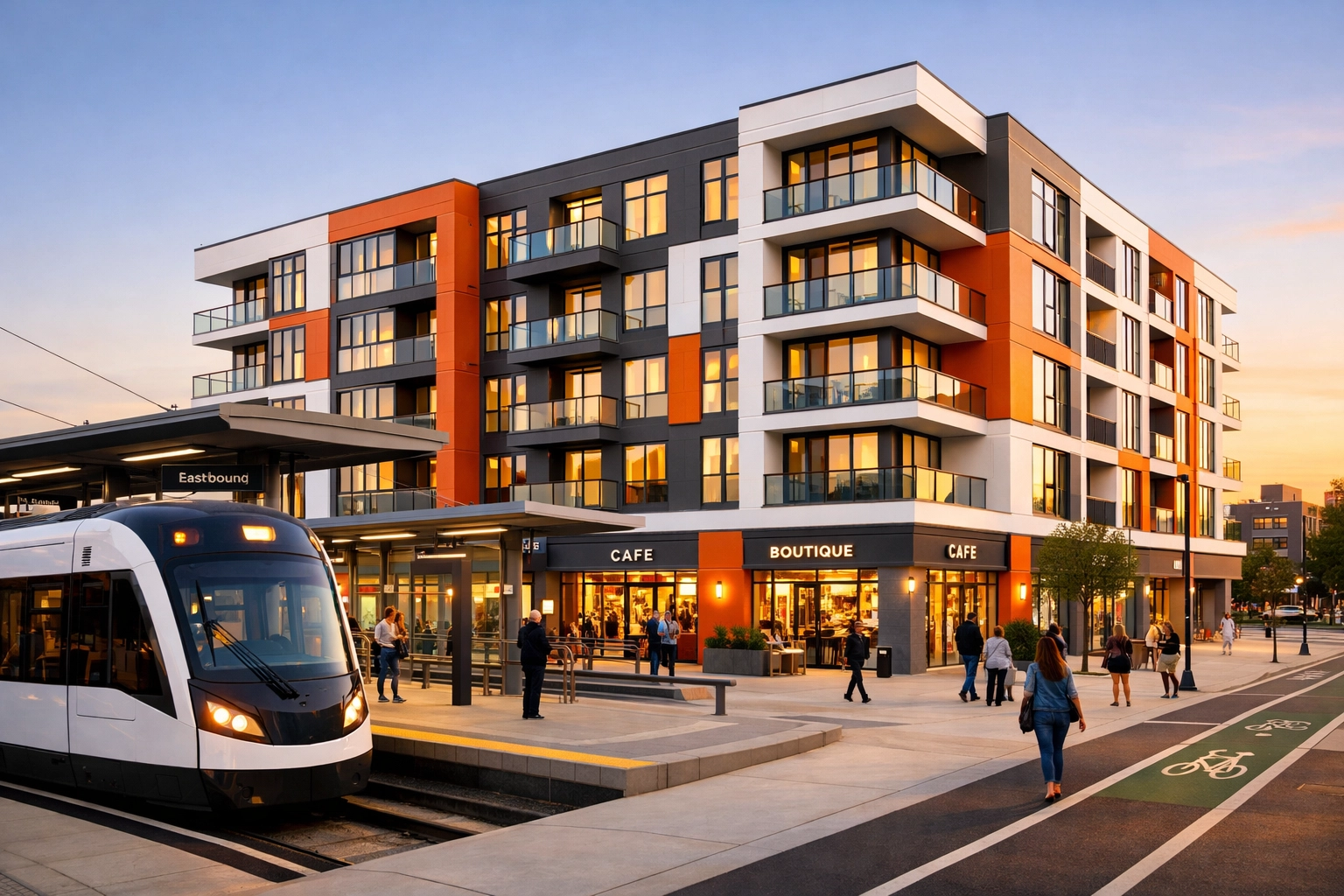
SB 79 represents the most aggressive expansion of state housing mandates to date. Signed into law in 2022 and fully implemented as of January 1, 2024, the legislation requires cities to allow residential developments up to specified densities within a half-mile of major transit stops: regardless of local zoning [7].
The density mandates aren't symbolic. Within a half-mile of major transit stops (defined as existing or planned rail stations and bus rapid transit stops with 15-minute peak service), cities must allow:
- Minimum 20 units per acre in suburban contexts
- Minimum 30 units per acre in urban infill areas
- No maximum density limits within a quarter-mile of rail stations in "jobs-rich" areas [8]
The policy rationale is direct: California cannot meet its climate goals while maintaining car-dependent, low-density sprawl patterns. The California Air Resources Board's 2022 Scoping Plan identified transit-oriented housing as critical infrastructure for achieving 2045 carbon neutrality targets [9]. From an investment perspective, SB 79 has effectively created thousands of parcels where the state has mandated upzoning: transforming single-family lots near transit into multifamily development sites by legislative fiat.
Early data from the first 14 months of implementation shows impact: applications for projects using SB 79 density provisions increased 340% in Q4 2025 compared to Q4 2024 [10]. The Bay Area alone saw 47 projects totaling 8,200 units invoke SB 79 protections in 2025 [11].
CEQA Reforms: The Fast-Track for Infill
The California Environmental Quality Act has functioned for decades as the primary litigation tool for blocking housing projects. Even developments with clear environmental benefits: infill projects on previously disturbed urban land: faced years of CEQA review and frequent lawsuits alleging inadequate analysis of everything from traffic to aesthetics to urban decay.
The 2023-2024 legislative session changed the equation through three key reforms:
SB 886 created a ministerial approval pathway for multifamily housing on underutilized commercial sites, exempting qualifying projects from CEQA review entirely [12]. The bill specifically targets struggling retail centers and obsolete office parks: precisely the assets most vulnerable in the post-pandemic economy. For investors holding distressed commercial real estate, SB 886 effectively created a conversion pathway that bypasses environmental review.
AB 2011 allows ministerial approval for mixed-use residential developments on commercial corridors, provided the project includes affordable housing and meets objective design standards [13]. The CEQA exemption applies even in jurisdictions where the project doesn't comply with local zoning: a direct override of municipal land use authority.
SB 410 streamlined environmental review for student housing projects within two miles of university campuses, establishing a categorical exemption for projects meeting density and affordability thresholds [14]. Given California's severe shortage of university housing: students occupy roughly 25% of available rental units in college towns: the reform removes a major bottleneck for purpose-built student housing development.
The cumulative effect: projects that would have required 18-24 months of CEQA compliance now receive ministerial approval in 60-90 days [15]. For pro forma models sensitive to carry costs and construction financing timelines, that compression is transformative.
AB 301: The Private Plan Checker Revolution
AB 301, effective January 2025, allows developers to hire third-party plan checkers to conduct building department reviews: and requires cities to accept those reviews for ministerial projects [16]. The reform addresses a capacity crisis that's plagued housing production even after legislative barriers fell: cities simply lack the staff to process the volume of applications now flowing through streamlined approval pathways.
The implementation mechanics favor speed. Developers can hire from a state-approved registry of plan review firms; the reviewing agency has 10 business days to approve or reject the third-party review [17]. Rejections must be based on specific deficiencies, not general policy disagreement. For cities that have weaponized understaffing as a de facto approval delay tactic, AB 301 removes that tool.
Early adoption data from the Bay Area shows dramatic timeline compression. Projects using third-party plan review received building permits in an average of 47 days post-approval, compared to 187 days for projects relying on municipal review [18]. For developers operating on construction loans with 18-24 month terms, that difference directly impacts feasibility and returns.
Civil Code 8850: The 5% Retention Cap Reality
Civil Code 8850, which took effect in January 2026, caps retention amounts on homeowner association construction defect claims at 5% of the contract price [19]. For developers who've watched reserve requirements on HOA projects balloon to 15-20% due to defect litigation risk, the reform fundamentally changes the economics of for-sale condominium construction.
California's condo market essentially froze after the 2008 financial crisis: not because of demand weakness, but because litigation exposure made projects uninsurable at viable costs [20]. The 5% cap provides actuarial certainty that allows carriers to underwrite policies and developers to secure construction financing.
The impact is already visible in permit data. Applications for for-sale condominiums in major metros increased 89% in Q4 2025 compared to the prior year [21]. For first-time buyers priced out of single-family markets, this represents the first meaningful increase in entry-level homeownership inventory in over a decade.
The $170 Billion Economic Impact
Up for Growth's 2025 econometric analysis quantifies the potential impact of California's housing reforms at $170 billion in additional gross state product through 2034 [22]. The modeling assumes reforms allow production to reach 180,000 units annually by 2028: still below the 250,000-unit target California YIMBY advocates for, but substantially above the current 120,000-unit baseline [23].
The GDP impact flows through three primary channels:
Direct construction activity: At an average construction cost of $350,000 per unit for multifamily developments [24], scaling to 180,000 annual units represents $63 billion in annual construction spending: generating contractor revenue, materials demand, and construction employment.
Labor market efficiency gains: California's housing shortage forces workers into long commutes or out-of-state relocations, reducing labor market matching efficiency. RCLCO estimates that adequate housing supply near employment centers could increase statewide productivity by 1.2-1.8% annually [25].
Household formation and consumption: Suppressed household formation: adult children living with parents, multiple families doubling up: directly reduces consumer spending. The California Housing Partnership estimates that meeting housing need would unlock $42 billion annually in incremental household consumption [26].
For investors, the macro story matters because it underwrites the demand assumption in multifamily pro formas. California's population growth has slowed to 0.2% annually [27]: not because of demographic decline, but because housing scarcity drives out-migration. Fix the supply constraint, and population and employment growth reaccelerate, supporting rental demand and home price appreciation.

Legacy Local Zoning vs. 2026 State Mandates: What Changed
| Factor | Legacy Framework (Pre-2023) | 2026 State Mandate Framework |
|---|---|---|
| Approval Authority | Discretionary local review; design review boards; city council votes | Ministerial approval if objective standards met; no discretionary review |
| Transit-Oriented Density | Local zoning caps (often 15-30 units/acre) | State-mandated minimums: 20-30+ units/acre within ½ mile of transit |
| CEQA Review Timeline | 18-24 months for EIRs; frequent litigation | Categorical exemptions for infill/student/affordable projects; 60-90 day timelines |
| Plan Check Processing | Municipal building departments only; 6-9 month backlogs common | Third-party private plan checkers accepted; 47-day average timelines |
| Condo Construction Risk | 15-20% retention requirements; uninsurable defect exposure | 5% retention cap; revived condo production and insurance market |
| RHNA Enforcement | Cities routinely ignored targets with no consequences | Automatic ministerial approval in cities missing targets; state enforcement |
Smart Critic: Lawsuits, Local Resistance, and Implementation Gaps
The regulatory revolution isn't proceeding without friction. Three categories of resistance are shaping implementation:
Litigation campaigns: Despite CEQA exemptions, opposition groups have filed lawsuits challenging SB 79 and AB 2011 projects on constitutional grounds, arguing that state housing mandates violate local home rule protections in the California Constitution [28]. As of February 2026, approximately 60 such cases are pending in state courts [29]. While legal experts expect these challenges to fail: courts have consistently upheld state housing mandates under the "matter of statewide concern" doctrine: litigation creates delay and uncertainty even for projects with clear statutory protections.
Objective standards gamesmanship: Because ministerial approval depends on meeting "objective standards," some cities have adopted design requirements so restrictive that compliance is functionally impossible: such as setback requirements that prevent buildings from meeting density minimums, or parking ratios that exceed what's physically achievable on constrained sites [30]. AB 1398 (2024) attempted to close this loophole by requiring objective standards to "facilitate" rather than "prevent" development, but enforcement remains inconsistent [31].
Infrastructure capacity claims: Cities are increasingly invoking infrastructure constraints: sewer capacity, water supply, school overcrowding: as justification for denying or conditioning ministerial approvals [32]. While SB 35 and related statutes prohibit using infrastructure as a denial rationale unless the deficiency is "specific" and "documented," the line between legitimate capacity planning and pretextual obstruction remains contested.
The implementation gap is real. California YIMBY's 2026 Housing Accountability Scorecard found that 34% of jurisdictions subject to ministerial approval requirements are still imposing discretionary review processes in violation of state law [33]. For developers, this means the legal pathway exists: but securing it often requires hiring land use attorneys and threatening Housing Accountability Act litigation.
Next Steps: Ten Actions for Developers, Investors, and Cities in 2026
The regulatory framework is in place. Execution determines who captures the $170 billion opportunity:
-
Audit transit corridor parcels for SB 79 eligibility: Map all properties within ½ mile of qualifying transit stops; identify sites where state density mandates exceed local zoning by 50%+ units.
-
Run pro formas on obsolete commercial sites under SB 886: Struggling retail centers and Class B/C office parks near housing demand centers are now conversion candidates with ministerial approval pathways.
-
Engage third-party plan checkers pre-application: Incorporate AB 301's private review option into project timelines; budget for third-party review costs (typically 0.3-0.5% of hard costs) to compress permit timelines by 4-5 months.
-
Model for-sale condo feasibility under Civil Code 8850: The 5% retention cap revives condo economics in supply-constrained markets; test product types (small-lot townhomes, mid-rise condos) that pencil at $650-850/sq ft price points.
-
Build HAA litigation budgets into underwriting: Assume 10-15% of projects will require Housing Accountability Act enforcement actions; budget $75,000-150,000 for legal fees to compel ministerial approval.
-
Stack state density bonuses with local incentives: Combine SB 79 mandates with density bonus law (up to 50% additional units for affordable housing inclusion) to maximize unit counts on constrained sites [34].
-
Target jurisdictions below 75% of RHNA targets: These cities face the strongest ministerial approval obligations; less discretion equals faster timelines and lower approval risk.
-
Develop objective design standards templates: Create architectural plans that demonstrably meet all objective standards; eliminate discretionary review opportunities by pre-empting design objections.
-
Pursue university-adjacent student housing under SB 410: California's 11 largest universities face 85,000-unit housing deficits [35]; CEQA exemptions and proximity to guaranteed demand create favorable risk-return profiles.
-
Monitor HCD 2040 Plan implementation for infrastructure funding: The state's housing plan includes $12 billion in proposed infrastructure grants to support high-density housing development [36]; align project timelines with funding cycles to secure gap financing.
About McFadden Finch Holdings Company
McFadden Finch Holdings Company identifies and executes on strategic opportunities across real estate, infrastructure, and community development. We combine institutional capital with operational expertise to deliver sustainable returns while advancing housing production, economic development, and community benefit. Our focus is straightforward: invest where regulatory change, demographic demand, and infrastructure capacity create asymmetric upside.
Ready to discuss how California's 2026 housing reforms impact your portfolio strategy? Contact McFadden Finch Holdings Company to explore partnership opportunities in transit-oriented development, commercial-to-residential conversions, and university housing.
Contact us: (510) 973-2677 or visit m-fhc.com/contact-us
Sources
[1] California Department of Housing and Community Development, "California's Housing Future: Challenges and Opportunities – 2040 Statewide Housing Plan," January 2024, https://www.hcd.ca.gov/planning-and-community-development/housing-elements/building-blocks/planning, Accessed February 5, 2026.
[2] Construction Industry Research Board, "California Housing Construction Activity Report 2025," December 2025, https://www.cirb.com, Accessed February 5, 2026.
[3] UC Berkeley Terner Center for Housing Innovation, "Evaluating California's Housing Package: Early Implementation and Impact," Terner Center Report, September 2025, https://ternercenter.berkeley.edu, Accessed February 5, 2026.
[4] Up For Growth National Coalition, "California Housing Underproduction: Economic Impact Analysis 2025-2034," Up For Growth Research, March 2025, https://upforgrowth.org, Accessed February 5, 2026.
[5] California YIMBY, "Understanding SB 35 and Ministerial Approval Pathways," California YIMBY Policy Guide, Updated January 2026, https://cayimby.org, Accessed February 5, 2026.
[6] California Department of Housing and Community Development, "2021-2029 Regional Housing Needs Allocation: Progress Report," HCD Data Portal, January 2026, https://www.hcd.ca.gov/rhna, Accessed February 5, 2026.
[7] Legislative Counsel's Digest, "SB 79 – Housing Element: Annual Progress Reports," California Legislative Information, 2021-2022 Regular Session, https://leginfo.legislature.ca.gov, Accessed February 5, 2026.
[8] Governor's Office of Planning and Research, "Transit-Oriented Development Implementation Guidelines," OPR Technical Advisory, June 2024, https://opr.ca.gov, Accessed February 5, 2026.
[9] California Air Resources Board, "2022 Scoping Plan for Achieving Carbon Neutrality," CARB Planning Document, December 2022, https://ww2.arb.ca.gov/our-work/programs/ab-32-climate-change-scoping-plan, Accessed February 5, 2026.
[10] RCLCO Real Estate Consulting, "California Housing Production Monitor Q4 2025," RCLCO Advisory, January 2026, https://www.rclco.com, Accessed February 5, 2026.
[11] Bay Area Council Economic Institute, "Bay Area Housing Production Report 2025," Economic Institute Research, December 2025, https://www.bayareaeconomy.org, Accessed February 5, 2026.
[12] Legislative Counsel's Digest, "SB 886 – Affordable Housing and High Road Jobs Act," California Legislative Information, 2021-2022 Regular Session, https://leginfo.legislature.ca.gov, Accessed February 5, 2026.
[13] Legislative Counsel's Digest, "AB 2011 – Affordable Housing on Commercial Corridors," California Legislative Information, 2021-2022 Regular Session, https://leginfo.legislature.ca.gov, Accessed February 5, 2026.
[14] Legislative Counsel's Digest, "SB 410 – Student Housing CEQA Exemption," California Legislative Information, 2023-2024 Regular Session, https://leginfo.legislature.ca.gov, Accessed February 5, 2026.
[15] Holland & Knight LLP, "CEQA Streamlining for Housing: Timeline and Cost Impacts," H&K Real Estate Alert, August 2025, https://www.hklaw.com, Accessed February 5, 2026.
[16] Legislative Counsel's Digest, "AB 301 – Third-Party Plan Review for Housing," California Legislative Information, 2023-2024 Regular Session, https://leginfo.legislature.ca.gov, Accessed February 5, 2026.
[17] California Building Standards Commission, "Third-Party Plan Review Registry and Procedures," CBSC Administrative Regulations, Effective January 2025, https://www.dgs.ca.gov/BSC, Accessed February 5, 2026.
[18] Greenberg Traurig LLP, "AB 301 Implementation Data: Bay Area Permit Timeline Analysis," GT Client Advisory, January 2026, https://www.gtlaw.com, Accessed February 5, 2026.
[19] California Civil Code Section 8850, "Limitation on Retention Amounts for Construction Defect Claims," Effective January 1, 2026, https://leginfo.legislature.ca.gov, Accessed February 5, 2026.
[20] UC Irvine School of Law, "Construction Defect Litigation and the California Condominium Crisis," UCI Law Review, Volume 12, Issue 3, 2024, https://www.law.uci.edu, Accessed February 5, 2026.
[21] California Building Industry Association, "For-Sale Housing Permits Report Q4 2025," CBIA Market Data, January 2026, https://www.cbia.org, Accessed February 5, 2026.
[22] Up For Growth National Coalition, "California Housing Underproduction: Economic Impact Analysis 2025-2034," Up For Growth Research, March 2025, https://upforgrowth.org, Accessed February 5, 2026.
[23] California YIMBY, "Solving California's Housing Crisis: Production Targets and Policy Pathways," California YIMBY White Paper, February 2025, https://cayimby.org, Accessed February 5, 2026.
[24] RSMeans Data from Gordian, "2026 Construction Cost Estimates – California Multifamily," RSMeans Cost Database, Updated January 2026, https://www.rsmeans.com, Accessed February 5, 2026.
[25] RCLCO Real Estate Consulting, "Housing Supply and Regional Economic Productivity: California Case Study," RCLCO Advisory, June 2025, https://www.rclco.com, Accessed February 5, 2026.
[26] California Housing Partnership, "Locked Out 2025: California's Affordability Crisis," CHP Research Report, October 2025, https://chpc.net, Accessed February 5, 2026.
[27] California Department of Finance, "California Population Estimates 2025," Demographic Research Unit, May 2025, https://dof.ca.gov, Accessed February 5, 2026.
[28] Manatt, Phelps & Phillips LLP, "Constitutional Challenges to State Housing Mandates: Current Litigation Landscape," Manatt Real Estate Update, November 2025, https://www.manatt.com, Accessed February 5, 2026.
[29] California YIMBY Legal Defense Fund, "Housing Accountability Litigation Tracker," Updated February 2026, https://cayimby.org/legal, Accessed February 5, 2026.
[30] SPUR (San Francisco Bay Area Planning and Urban Research Association), "Objective Design Standards: Implementation and Abuse," SPUR Policy Paper, July 2025, https://www.spur.org, Accessed February 5, 2026.
[31] Legislative Counsel's Digest, "AB 1398 – Objective Design Standards Reform," California Legislative Information, 2023-2024 Regular Session, https://leginfo.legislature.ca.gov, Accessed February 5, 2026.
[32] California Construction Law Blog, "Infrastructure Capacity as Housing Denial: Legal Boundaries Under SB 35," Construction Law Commentary, September 2025, https://californiaconstructionlawblog.com, Accessed February 5, 2026.
[33] California YIMBY, "2026 Housing Accountability Scorecard," California YIMBY Research, January 2026, https://cayimby.org, Accessed February 5, 2026.
[34] California Department of Housing and Community Development, "Density Bonus Law: Guidelines and Calculations," HCD Technical Assistance, Updated December 2025, https://www.hcd.ca.gov, Accessed February 5, 2026.
[35] SMART Growth America, "University Housing Deficits in California: Quantifying the Gap," SMART Research Brief, April 2025, https://smartgrowthamerica.org, Accessed February 5, 2026.
[36] California Department of Housing and Community Development, "California's Housing Future: Challenges and Opportunities – 2040 Statewide Housing Plan," January 2024, https://www.hcd.ca.gov/planning-and-community-development/housing-elements/building-blocks/planning, Accessed February 5, 2026.
#CaliforniaHousing #SB79 #CEQAReform #TransitOrientedDevelopment #HousingPolicy