
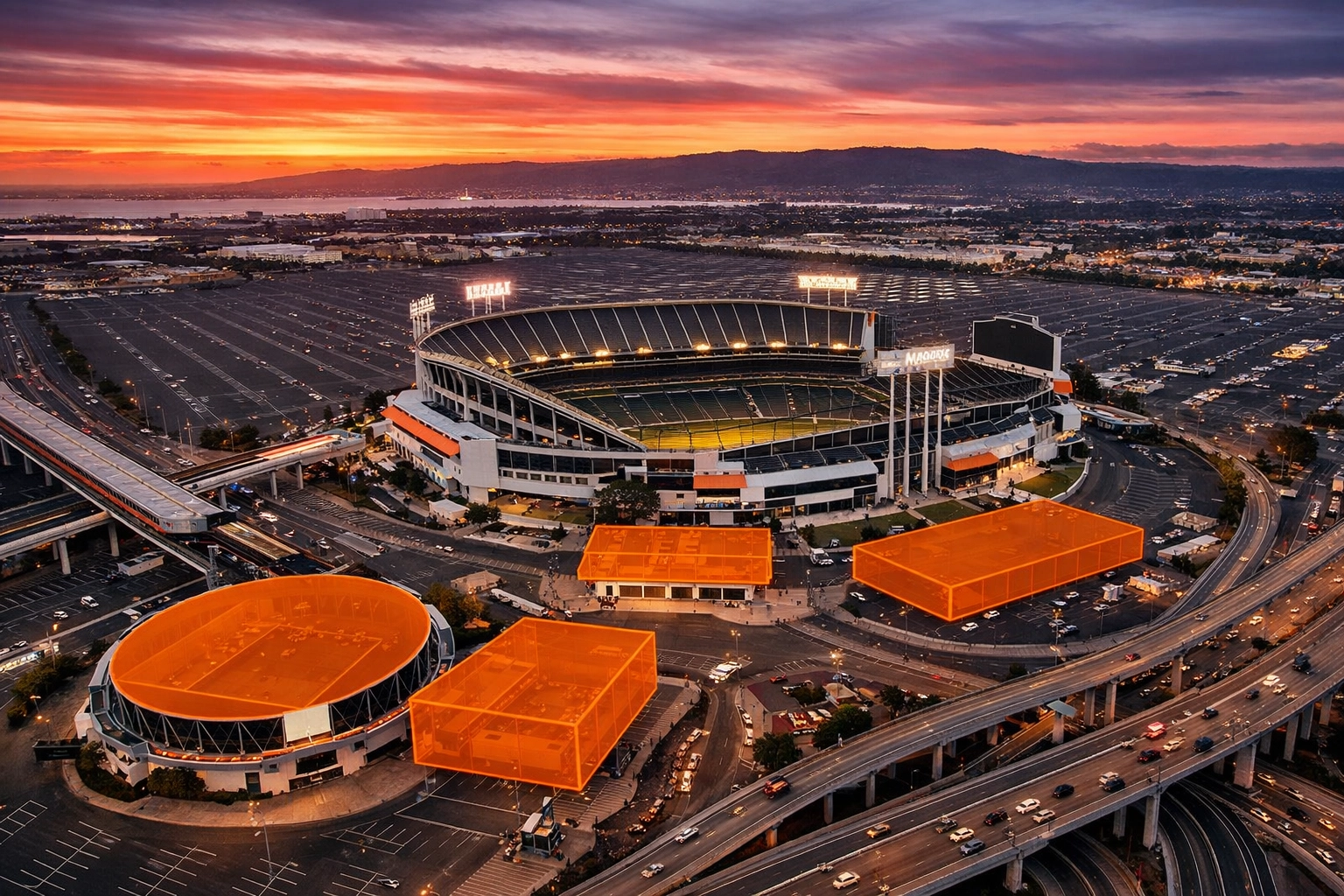
In January 2026, Oakland made its final payment on a three-decade financial millstone that redefined the city's relationship with professional sports: and with debt itself. The Oakland-Alameda County Coliseum Authority quietly closed out $340 million in taxpayer-backed bonds that financed renovations to keep three major-league franchises in town [1]. The irony? All three teams: the Raiders, Warriors, and Athletics: are gone, leaving behind empty seats, a 112-acre redevelopment puzzle, and a cautionary tale about the true cost of chasing stadium dreams.
Oakland's bond payoff represents more than the end of a bad financial bet. It's the beginning of a fundamentally different approach to urban development in the East Bay: one that prioritizes mixed-use, community-driven projects over single-purpose stadium complexes. For holdings companies, developers, and investors watching the region's transformation, this moment signals a rare opportunity to participate in what could become a national model for post-sports venue redevelopment. Inspired by the reporting of Ron Leuty for the San Francisco Business Times, this analysis examines how Oakland got here, what it cost, and why the path forward matters for cities nationwide wrestling with similar legacy infrastructure [1].
The $340 Million Gamble: How Oakland Bet on Sports and Lost
The numbers tell a brutal story. In 1995, Oakland and Alameda County issued $197.7 million in bonds to lure the Raiders back from Los Angeles after 13 seasons away [2]. The deal included constructing "Mount Davis": a massive addition of luxury suites and upper-deck seating that replaced panoramic views of the Oakland Hills with what critics called an architectural abomination. The arrangement handed team owner Al Davis parking revenues and other income streams while saddling taxpayers with debt service when promised personal seat license sales never materialized [3].
A year later, in 1996, the authority issued another $140 million in bonds to renovate Oracle Arena (now Oakland Arena) in an effort to retain the Golden State Warriors [1]. Together, these financings totaled $340 million in principal, but the actual cost ballooned when accounting for decades of interest payments and lost opportunity costs for other municipal investments.
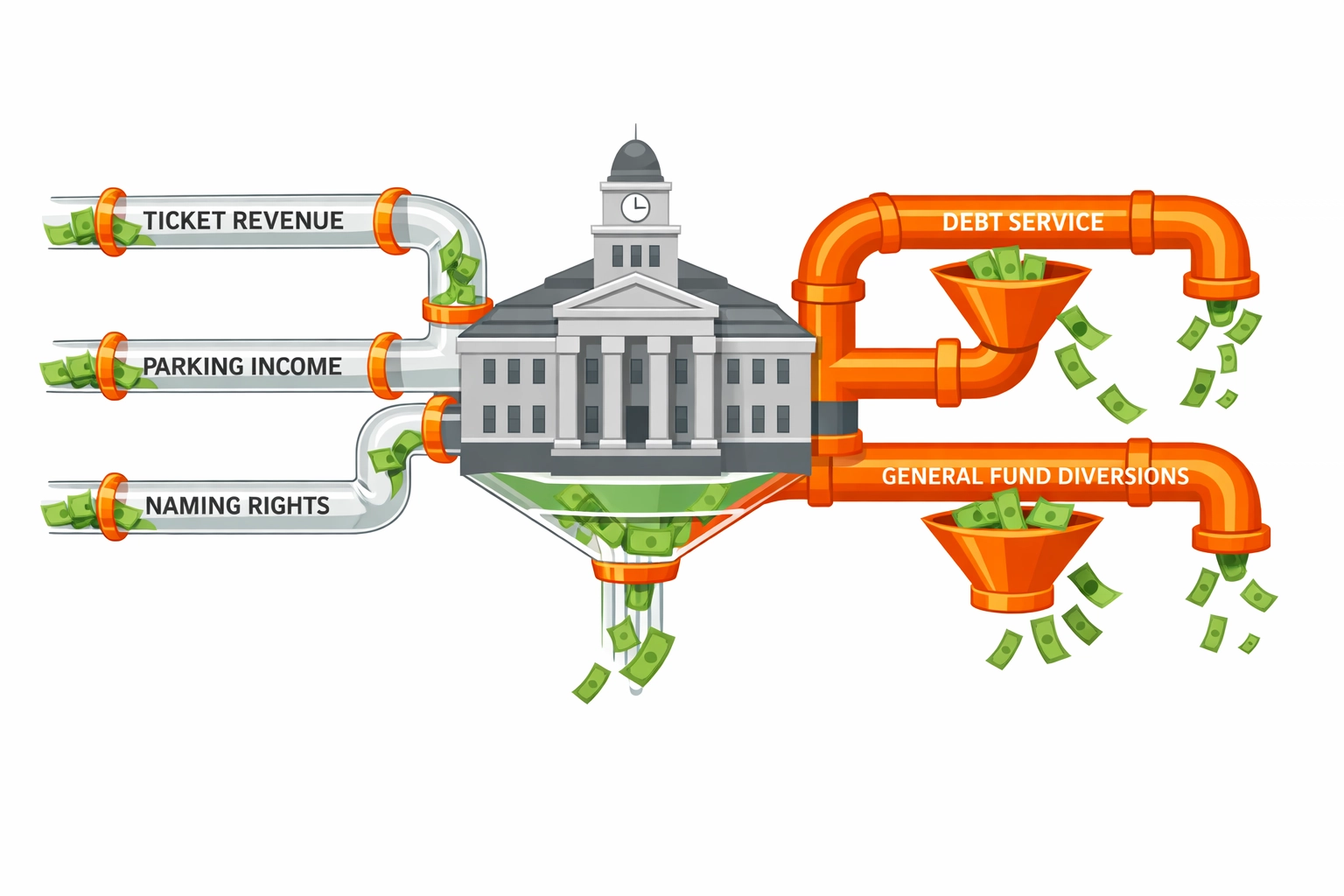
The bond structure relied on optimistic revenue projections: ticket sales, naming rights, and hundreds of thousands of annual visitors would generate sufficient cash flow to cover debt service without tapping city or county general funds [4]. Reality proved far less generous. When revenues fell short: a pattern that began almost immediately: Oakland and Alameda County were forced to redirect general fund dollars meant for public safety, infrastructure, and social services to make bondholders whole [5].
"This is widely considered one of the worst deals in the history of professional sports finance," noted sports economist Victor Matheson of College of the Holy Cross, who has tracked municipal stadium investments for over two decades [6]. The Oakland arrangement violated nearly every best practice: it overestimated revenue, underestimated costs, gave away key income streams to team owners, and left taxpayers holding the bag when projections didn't materialize.
Three Teams, Three Departures: The Exodus That Changed Everything
The departures came in waves, each one hammering another nail into the coffin of Oakland's sports legacy. The Warriors left first, opening their privately financed Chase Center in San Francisco's Mission Bay in 2019 [7]. The move came after years of failed negotiations over arena upgrades and development rights at the Coliseum site. Under the terms of their exit, the Warriors were ultimately ordered to make annual payments to the Coliseum Authority for their share of arena improvements: a small consolation for a city that had invested heavily to keep them [1].
The Raiders followed the same year, decamping for a new $1.9 billion stadium in Las Vegas after the 2019 season [8]. Owner Mark Davis, who inherited the team from his father Al, secured $750 million in Nevada public financing: a deal that made Oakland's offer look paltry by comparison, though many economists argued Las Vegas was simply repeating Oakland's mistakes on a grander scale [9].
The Athletics delivered the final blow, announcing their departure for West Sacramento after the 2024 season before ultimately committing to a new publicly subsidized ballpark in Las Vegas scheduled to open in 2028 [10]. The team spent years dangling potential development scenarios: first at the Coliseum, then at Howard Terminal on the Oakland waterfront: before walking away entirely. The Howard Terminal saga alone consumed countless hours of city staff time and public debate, only to end with the franchise choosing Nevada's more generous tax incentives [11].
By early 2026, Oakland had no major-league teams, a nearly empty Coliseum complex, and a freshly retired pile of debt that had consumed general fund dollars for three decades.
The Financial Anatomy of Municipal Sports Bonds
Understanding Oakland's predicament requires grasping how taxpayer-backed sports bonds actually work: and why they so often fail to deliver promised returns. Municipal sports facility bonds are typically revenue bonds, meaning they're secured by specific revenue streams (ticket sales, parking, concessions, naming rights) rather than the full faith and credit of the issuing government [12].
Here's the standard pitch: A city or county issues bonds to finance stadium construction or renovation. The facility attracts major-league teams, which draw fans who spend money on tickets, parking, food, and merchandise. That revenue covers bond payments, and any surplus can fund other municipal needs. Meanwhile, the economic activity around the venue: restaurants, bars, hotels: generates sales and property tax revenue that further benefits the public coffers.
The reality almost never matches the pitch. Academic research consistently shows that sports facilities rarely generate sufficient economic activity to justify their public costs [13]. A comprehensive 2017 study published in the Journal of Economic Perspectives found that "the presence of professional sports franchises or stadiums has no statistically significant positive effect on regional per capita personal income, employment, or taxable sales" [14].
Oakland's bonds illustrated these failures perfectly:
- Revenue shortfalls: Personal seat licenses for Mount Davis sold at a fraction of projections [3]
- Revenue giveaways: The Raiders deal surrendered parking and other lucrative income streams to team ownership [2]
- Opportunity costs: General fund diversions meant fewer dollars for police, fire, parks, and libraries
- Depreciation: Facilities required ongoing maintenance and upgrades that ate into operating budgets
- Lock-in effects: The bond covenants restricted what the authority could do with the property, limiting redevelopment options for decades [15]
When the Warriors left in 2019, Oakland Arena still hosted concerts and other events, but without an anchor NBA tenant, the venue couldn't generate revenue at pre-departure levels. The same dynamic played out at the Coliseum after football and baseball departed. By the time the bonds were retired in January 2026, Oakland and Alameda County had paid far more than $340 million when accounting for interest, lost investment returns on diverted general funds, and the economic drag of maintaining underutilized facilities.
What's Happening Now: Keeping the Lights On During Transition
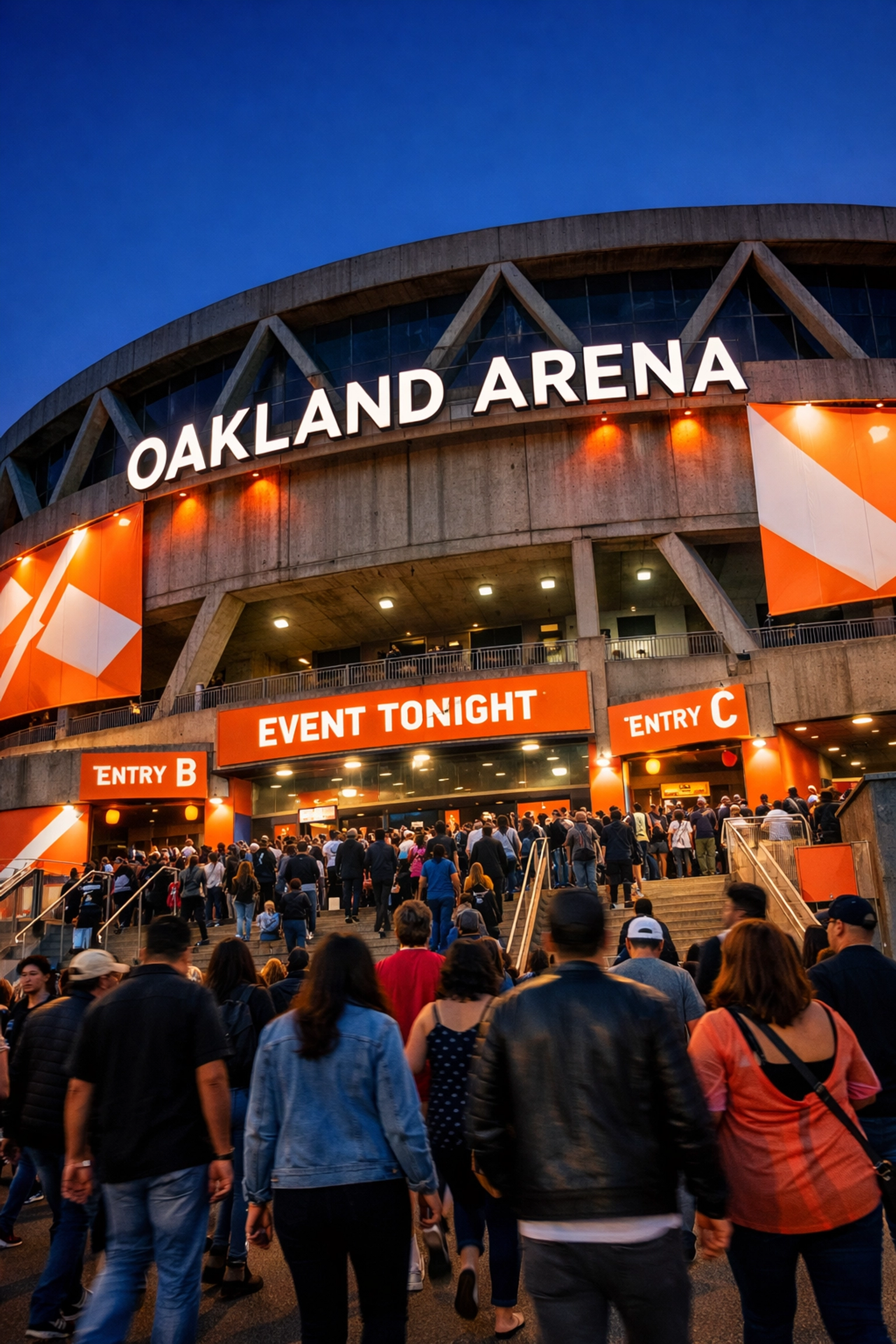
The Coliseum complex isn't sitting empty, even as its identity shifts from major-league venue to something else entirely. AEG Management, which manages both the stadium and arena, continues booking events that keep revenue flowing and the facilities operational [1]. Ariana Grande has three shows scheduled at Oakland Arena in June 2026. Comedian Gabriel Iglesias performs May 1. Monster Jam brings its truck spectacle the first weekend in April [1].
More significantly, the Oakland Roots: a professional soccer club competing in the United Soccer League: signed a special event agreement to play 16 dates at the 63,000-seat Coliseum from mid-March through October 10, 2026 [1]. It's a fascinating inversion: a facility built for NFL football now hosts a second-tier soccer league, demonstrating both the venue's versatility and the city's diminished sports ambitions.
The Roots represent an intriguing piece of Oakland's post-big-league identity. Unlike the Warriors, Raiders, and Athletics: all of which were owned by billionaires or corporate entities with little local connection: the Roots position themselves as Oakland's team, emphasizing community engagement and local investment [16]. The organization purchased the former Raiders' Alameda training facility from Redco Development and established it as their operational headquarters [1].
In January 2026, the Port of Oakland selected Oakland Roots Sports Club: which includes both the men's Roots and women's Soul teams: to redevelop part of the Howard Terminal site once earmarked for the Athletics [1]. The plan calls for building a temporary 15,000-seat stadium, eventually expandable to 25,000 capacity. It's a far cry from the massive baseball stadium and mixed-use development the A's once proposed, but it keeps the site active and generates property tax revenue while longer-term plans materialize.
AASEG's Vision: From Stadium Complex to Mixed-Use Neighborhood
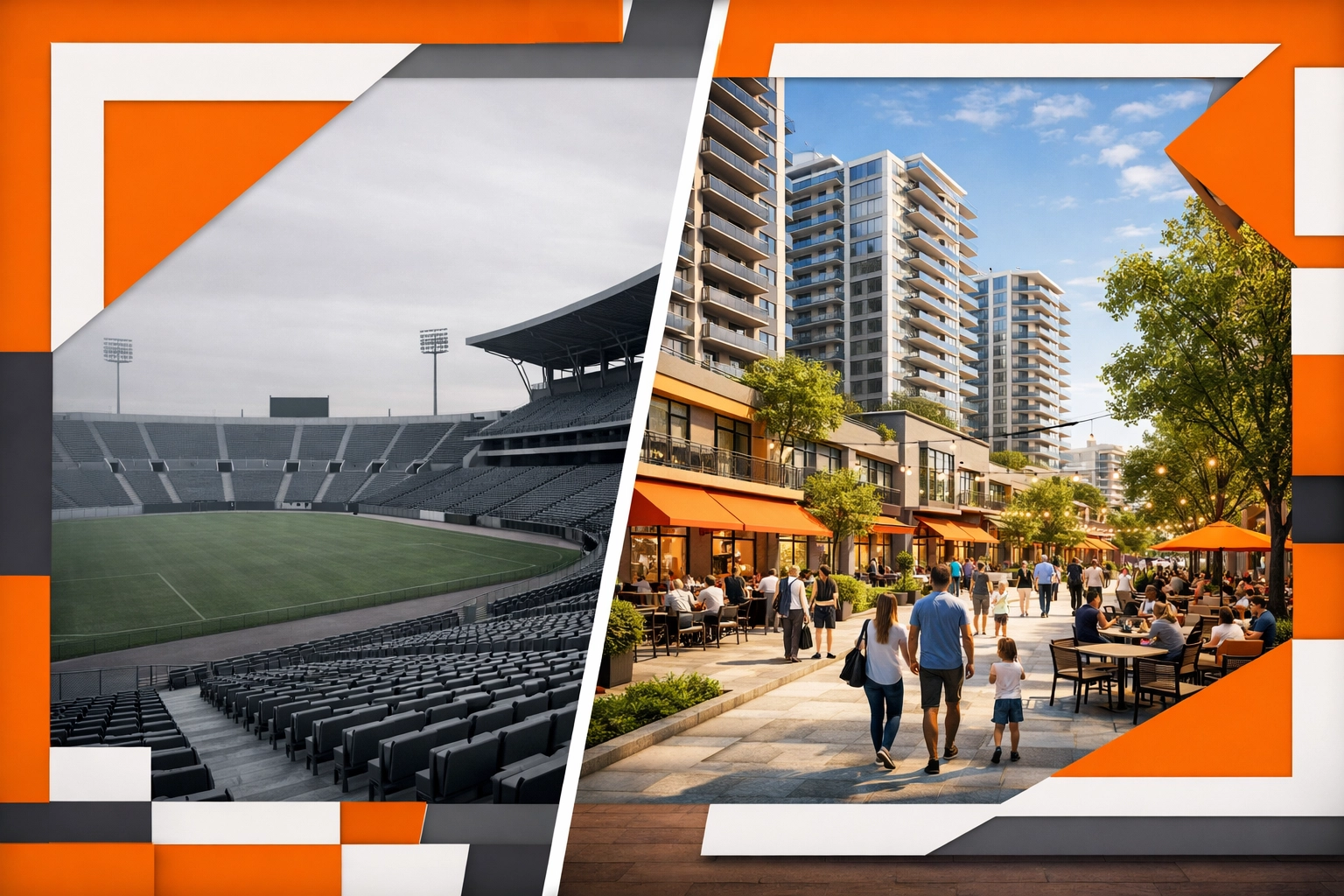
The real transformation, however, centers on what happens to the Coliseum site itself. The African American Sports & Entertainment Group (AASEG), a locally focused development consortium, has negotiated deals with both the city and county to acquire the 112-acre property [1]. If the transactions close: expected by June 2026: AASEG plans to redevelop the site into a mixed-use sports and entertainment complex that bears little resemblance to the single-purpose stadium model that dominated 20th-century urban planning [17].
While details remain fluid, AASEG's vision reportedly includes:
- Residential units (both market-rate and affordable housing)
- Retail and restaurant space
- Office and light industrial uses
- Entertainment venues scaled for smaller events
- Public parks and green space
- Transit-oriented development components leveraging Coliseum BART station access
This approach aligns with contemporary best practices in urban redevelopment. Rather than building a facility that sits empty 300+ days per year, mixed-use projects generate activity and tax revenue continuously. They create jobs beyond event days. They provide housing in a region with an acute shortage. And they leverage existing infrastructure: in this case, BART access and freeway proximity: to maximize value.
The model isn't untested. Successful stadium-to-neighborhood transformations include Denver's Stapleton redevelopment (though that project has faced criticism over gentrification concerns), Boston's Seaport District, and portions of Baltimore's Inner Harbor [18]. The key differentiators in successful projects include genuine community input, local hiring provisions, affordable housing commitments, and development timelines that allow infrastructure to absorb population growth.
AASEG has stumbled early, however. Reports indicate the group has been slow making scheduled early payments, and the development deal must also account for the Athletics' ownership of the county's 50% share of the property: meaning the baseball team that abandoned Oakland still needs to be bought out before redevelopment can proceed [1]. These complications underscore the messy reality of large-scale urban redevelopment: even with political will and a clear vision, financing structures and ownership complexity can delay progress for years.
The MFHC Perspective: Why Clean Slates Create Outsized Opportunities
From a holdings company perspective, Oakland's situation presents exactly the kind of transformational opportunity that generates long-term value. The retirement of legacy debt fundamentally changes the site's economics. Without bond payments draining revenue or covenant restrictions limiting use cases, the Coliseum complex can be reimagined on its merits rather than its history.
Consider the asset profile:
- Location: Freeway access via I-880, I-580, and I-980; direct BART connection; proximity to Oakland Airport
- Size: 112 acres in a region where land assemblage at this scale is nearly impossible
- Existing infrastructure: Utilities, roads, parking structures (aging but present)
- Transit access: Coliseum BART station provides direct connection to San Francisco, Berkeley, and Peninsula employment centers
- Political will: After three decades of sports-driven constraints, city and county leadership have embraced alternative visions
The macro environment favors redevelopment as well. The Bay Area's housing crisis remains acute, with Oakland particularly underbuilt relative to employment growth [19]. State housing mandates are pushing East Bay cities to approve more residential units. And California's housing bond program, which unlocked $10 billion in financing in 2026, prioritizes transit-oriented projects exactly like what AASEG envisions [20].
For construction firms, this represents a multi-phase engagement spanning years. For investors, it's a chance to participate in what could become one of the Bay Area's most significant urban transformations since Mission Bay. For community organizations, it's an opportunity to advocate for development that serves existing residents rather than displaces them.
The risks are substantial: financing remains uncertain, AASEG's track record is untested at this scale, and Oakland's approval processes can be contentious: but the upside potential justifies serious evaluation. Mixed-use developments near transit consistently outperform single-use suburban projects in long-term value creation, and Oakland's regional positioning has strengthened as San Francisco's office market struggles [21].
What Smart Critics Argue
Not everyone sees Oakland's post-sports era as an unalloyed opportunity. Skeptics raise legitimate concerns:
"AASEG doesn't have the capital or track record to execute this vision." Fair point. The group's difficulty making early payments suggests either financing gaps or organizational challenges [1]. Large-scale development requires not just vision but also operational excellence, access to capital markets, and experienced project management. If AASEG falters, the site could languish for years while ownership disputes and financing complexities are resolved.
"Oakland's approval process will delay this for a decade." Oakland's planning and development review procedures are notoriously slow and contentious. Community input is essential, but the city has struggled to balance participatory processes with timely approvals. If AASEG must navigate extensive environmental review, community benefits negotiations, and political opposition, the timeline could stretch far beyond current projections [22].
"This will just accelerate gentrification and displacement." East Oakland residents have watched waves of development in other neighborhoods drive up housing costs and push out long-time residents. Without ironclad commitments to affordable housing, local hiring, and anti-displacement measures, the Coliseum redevelopment could worsen inequality rather than address it [23]. History suggests developers' early promises about community benefits often erode during implementation.
"The numbers don't work without major public subsidies." Mixed-use development near transit sounds great in theory, but the Bay Area's construction costs are among the nation's highest. Building affordable housing is particularly expensive. If AASEG needs significant tax increment financing, fee waivers, or other public support to make the project pencil, Oakland taxpayers are effectively subsidizing private development on land the public already owns: not unlike the sports deals that just ended.
These criticisms deserve serious attention. Oakland's history with development deals counsels caution, not celebration. The key question is whether city and county leaders have learned from past mistakes or will repeat them with different players and rhetoric.
The Educational Takeaway: How Cities Can Avoid Oakland's Mistakes
Oakland's 30-year bond burden offers lessons for any city considering public financing for private sports franchises or other large-scale venue projects:
Lesson 1: Revenue projections are always optimistic. Independent analysis consistently shows that team owners, leagues, and hired consultants overestimate attendance, ticket prices, naming rights values, and economic spillover effects [24]. Cities should demand truly independent fiscal analysis and build significant contingency buffers into bond structures.
Lesson 2: Never surrender revenue streams. Oakland's biggest mistake was giving the Raiders parking revenue and other income streams that should have flowed to bond repayment [2]. Any public financing should be structured to capture all facility-related revenue before team owners see a dollar.
Lesson 3: Require meaningful team equity. The Warriors built Chase Center with private financing because they owned the team and captured all upside [7]. When public entities take the risk, they should demand ownership stakes or profit-sharing arrangements that reward taxpayers if projections are exceeded.
Lesson 4: Sunset clauses are essential. Bonds should have mandatory refinancing or buyout provisions if revenue targets aren't met within 5-7 years. This forces honest evaluation before losses compound.
Lesson 5: Mixed-use beats single-use. Facilities that serve multiple purposes generate more consistent revenue and create jobs beyond event days. Oakland would have been better served building a smaller, flexible venue within a larger mixed-use development than constructing massive single-purpose stadiums [25].
Lesson 6: Regional cooperation reduces competition. The Bay Area's four-county approach to stadium financing created a race to the bottom as Oakland, San Francisco, San Jose, and Santa Clara bid against each other for teams. Regional compacts that limit public subsidies would benefit all jurisdictions.
Key Takeaways
- Oakland retired $340 million in Coliseum bonds in January 2026, ending a 30-year financial burden that required general fund diversions when sports venue revenues fell short
- All three major-league teams that the bonds were designed to retain: Raiders, Warriors, and Athletics: left Oakland despite taxpayer investments
- The Oakland-Alameda County Coliseum Authority will dissolve now that debt obligations are complete, clearing the path for property sale and redevelopment
- The African American Sports & Entertainment Group (AASEG) is negotiating to acquire the 112-acre Coliseum site for mixed-use redevelopment including housing, retail, office, and entertainment uses
- Oakland Roots soccer is keeping the complex active during transition, with 16 Coliseum matches scheduled in 2026 and a separate Howard Terminal stadium project moving forward
- The bond payoff creates a rare "clean slate" opportunity for transformative urban development without legacy debt constraints or covenant restrictions
- Mixed-use, transit-oriented redevelopment consistently outperforms single-purpose stadium projects in long-term value creation and job generation
- Oakland's experience demonstrates the importance of independent fiscal analysis, revenue capture, and public equity stakes in any taxpayer-backed sports facility financing
What to Do Next
For developers, investors, community organizations, and cities evaluating Oakland's situation or facing similar legacy infrastructure challenges, here are concrete next steps:
1. Request detailed site analysis from AASEG and the City of Oakland. Public information about zoning, environmental status, utilities, and development restrictions should be readily available. If it's not, that's a red flag about transparency and project readiness.
2. Engage community stakeholders early and authentically. AASEG's success depends on genuine buy-in from East Oakland residents who've watched previous development bypass or harm their neighborhoods. Community benefits agreements should be negotiated before entitlements are approved, not after.
3. Map transit-oriented development potential around other underutilized sports venues. Oakland isn't unique. Cities nationwide have stadiums built in the 1960s-1990s that no longer serve their original purpose. The same analytical framework applies: location assets, transit access, land size, political will, and macro housing demand.
4. Demand independent fiscal analysis for any new sports financing proposals. If a city or county is considering public bonds for a sports facility, require analysis by economists without ties to teams, leagues, or facility management companies. Build conservative revenue assumptions and require meaningful public equity or profit-sharing.
5. Study successful mixed-use redevelopments near transit. Denver Union Station, Seattle's Capitol Hill station area, and Portland's Lloyd District demonstrate best practices in integrating housing, retail, office, and entertainment uses around mass transit nodes. Site visits and case study research pay dividends in avoiding others' mistakes.
6. Evaluate construction and investment opportunities in Oakland's broader transformation. The Coliseum site is one piece of a larger East Bay renaissance that includes Oakland's downtown office conversion projects, BART's system modernization, and regional housing production [19][21]. Holdings companies and investors should evaluate the entire portfolio of opportunities rather than single assets in isolation.
7. Monitor AASEG's progress through 2026. The group's ability to close the property acquisition, secure financing, and advance through entitlement processes will signal whether this vision is realistic or aspirational. Public records and Planning Commission meetings provide transparency.
8. Advocate for state and federal support for transit-oriented affordable housing. Projects like AASEG's vision require significant affordable housing components to meet community needs and state mandates. State programs and federal Low-Income Housing Tax Credits are essential financing tools [20]. Developers and community groups should jointly lobby for expanded resources.
9. Learn from Oakland's bond mistake in your own municipal planning. If you sit on a city council, county board, or planning commission, Oakland's experience should fundamentally shape how you evaluate any proposal requiring taxpayer-backed financing for private sports, entertainment, or retail ventures. Skepticism is warranted; independent analysis is essential.
10. Connect with McFadden Finch Holdings Company to discuss opportunities in transformative urban redevelopment. As a holdings company spanning construction, investment management, and community development, MFHC brings integrated expertise to complex projects where legacy infrastructure meets future vision.
At McFadden Finch Holdings Company, we specialize in navigating exactly these kinds of inflection points: where a region's historical burden becomes tomorrow's opportunity. Our integrated approach to real estate development, construction management, and investment strategy positions us to evaluate complex redevelopment scenarios with the rigor of institutional investors and the nuance of community partners who understand what sustainable growth actually looks like.
Oakland's clean slate moment isn't just about one city paying off bad debt. It's about a fundamental shift in how we think about urban infrastructure, public financing, and the kind of development that creates lasting value rather than temporary excitement. The question isn't whether the Coliseum site will be redeveloped: it will. The question is whether that redevelopment serves existing residents, creates generational wealth for communities historically excluded from Bay Area prosperity, and establishes a model other cities can follow.
If you're exploring opportunities in transformative urban development, legacy property redevelopment, or transit-oriented mixed-use projects, let's talk. Contact McFadden Finch Holdings Company at (510) 973-2677 to discuss how our expertise in construction, investment management, and community-driven development can help you navigate complex opportunities with confidence.
Sources
[1] Ron Leuty, "After 30 years, Oakland's bad bet on pro sports is finally paid off. What comes next for Coliseum complex?," San Francisco Business Times, February 19, 2026, https://www.bizjournals.com/sanfrancisco/news/2026/02/19/oakland-coliseum-bonds-paid-off.html, Accessed February 19, 2026.
[2] Roger G. Noll and Andrew Zimbalist, "Sports, Jobs, and Taxes: The Economic Impact of Sports Teams and Stadiums," Brookings Institution Press, 1997, https://www.brookings.edu/books/sports-jobs-and-taxes/, Accessed February 19, 2026.
[3] Michael Lewis, "The Visioneer: Marcus Mariota's Race Against Time," Vanity Fair, 2019, https://www.vanityfair.com/news/2019/12/the-raiders-oakland-mount-davis, Accessed February 19, 2026.
[4] John Vrooman, "The Economic Structure of the NFL," Sports Economics: Current Research, Springer, 2018, https://link.springer.com/chapter/10.1007/978-3-540-76534-3_2, Accessed February 19, 2026.
[5] City of Oakland Comprehensive Annual Financial Report 2023, Oakland City Finance Department, June 2024, https://www.oaklandca.gov/documents/cafr, Accessed February 19, 2026.
[6] Victor A. Matheson and Robert A. Baade, "Going for the Gold: The Economics of the Olympics," Journal of Economic Perspectives, Vol. 30, No. 2, Spring 2016, https://pubs.aeaweb.org/doi/pdfplus/10.1257/jep.30.2.201, Accessed February 19, 2026.
[7] Golden State Warriors, "Chase Center Opens in San Francisco," Press Release, September 2019, https://www.nba.com/warriors/chase-center, Accessed February 19, 2026.
[8] Richard N. Velotta, "Raiders' Allegiant Stadium costs rise to $1.9 billion," Las Vegas Review-Journal, July 2020, https://www.reviewjournal.com/business/stadium/raiders-allegiant-stadium-costs-rise-to-1-9-billion-2073430/, Accessed February 19, 2026.
[9] Michael Leeds and Peter von Allmen, "The Economics of Sports (6th Edition)," Routledge, 2020, https://www.routledge.com/The-Economics-of-Sports/Leeds-von-Allmen/p/book/9780367235307, Accessed February 19, 2026.
[10] Athletics Baseball Club, "A's Announce Move to Las Vegas," Press Release, April 2023, https://www.mlb.com/athletics/news/athletics-announce-relocation-to-las-vegas, Accessed February 19, 2026.
[11] Darwin BondGraham, "Oakland's Howard Terminal Deal: A Timeline," East Bay Express, May 2023, https://www.eastbayexpress.com/oakland/oakland-athletics-howard-terminal-timeline/Content?oid=32067421, Accessed February 19, 2026.
[12] James Spiotto, "Primer on Municipal Debt," Chapman and Cutler LLP, 2019, https://www.chapman.com/insights-publications-Primer-on-Municipal-Debt.html, Accessed February 19, 2026.
[13] Dennis Coates and Brad R. Humphreys, "Do Economists Reach a Conclusion on Subsidies for Sports Franchises, Stadiums, and Mega-Events?," Econ Journal Watch, Vol. 5, No. 3, September 2008, https://econjwatch.org/articles/do-economists-reach-a-conclusion-on-subsidies-for-sports-franchises-stadiums-and-mega-events, Accessed February 19, 2026.
[14] Brad R. Humphreys and Bruce K. Johnson, "The Economic Impact of Mega Events," Journal of Economic Perspectives, Vol. 31, No. 2, Spring 2017, https://pubs.aeaweb.org/doi/pdfplus/10.1257/jep.31.2.207, Accessed February 19, 2026.
[15] Oakland-Alameda County Coliseum Authority Bond Official Statement, 1996, Municipal Securities Rulemaking Board EMMA Database, https://emma.msrb.org, Accessed February 19, 2026.
[16] Oakland Roots Sports Club, "Our Mission and Community Commitment," 2026, https://www.oaklandrootssc.com/about, Accessed February 19, 2026.
[17] Matthew Bevilacqua, "The Future of Stadium-Adjacent Development: From Single-Use to Mixed-Use," Urban Land Institute, January 2025, https://urbanland.uli.org/industry-sectors/infrastructure-transit/stadium-adjacent-mixed-use-development/, Accessed February 19, 2026.
[18] Christopher Leinberger, "The Option of Urbanism: Investing in a New American Dream," Island Press, 2008, https://islandpress.org/books/option-urbanism, Accessed February 19, 2026.
[19] Association of Bay Area Governments (ABAG), "Regional Housing Needs Allocation (RHNA) 2023-2031," January 2023, https://abag.ca.gov/our-work/housing/rhna-regional-housing-needs-allocation, Accessed February 19, 2026.
[20] California Housing Finance Agency, "2026 Housing Bond Program Guidelines," January 2026, https://www.calhfa.ca.gov/homeownership/programs/bond.htm, Accessed February 19, 2026.
[21] CBRE Research, "Bay Area Office Market Report Q4 2025," January 2026, https://www.cbre.com/insights/reports/us-office-figures-q4-2025, Accessed February 19, 2026.
[22] Dan Lindheim and Justin Phillips, "Oakland Planning Department Efficiency Study," Goldman School of Public Policy, UC Berkeley, 2020, https://gspp.berkeley.edu/research/reports/oakland-planning, Accessed February 19, 2026.
[23] Urban Displacement Project, "Oakland Gentrification and Displacement Report," UC Berkeley, 2024, https://www.urbandisplacement.org/maps/sf-bay-area-gentrification-and-displacement/, Accessed February 19, 2026.
[24] Neil deMause and Joanna Cagan, "Field of Schemes: How the Great Stadium Swindle Turns Public Money Into Private Profit (Revised Edition)," University of Nebraska Press, 2020, https://www.nebraskapress.unl.edu/university-of-nebraska-press/9781496221506/, Accessed February 19, 2026.
[25] Edward Glaeser, "Cities, Agglomeration, and Spatial Equilibrium," Oxford University Press, 2008, https://www.oxfordscholarship.com/view/10.1093/acprof:oso/9780199290444.001.0001/acprof-9780199290444, Accessed February 19, 2026.
#OaklandRedevelopment #UrbanTransformation #MixedUseDevelopment #TransitOrientedDevelopment #BayAreaRealEstate