
Here's the uncomfortable truth about workplace diversity, equity, and inclusion in 2026: most companies are talking louder, but fewer employees are listening. A February 2026 report from The Conference Board reveals a striking disconnect: 71% of executives believe their organizations are dedicating more resources to DEI than last year, yet only 41% of employees perceive this increased investment [1]. That's not a rounding error. That's a credibility crisis.
DEI initiatives have shifted from a "visibility problem" to an "evidence problem." Employees no longer judge a company's DEI commitment by the number of training sessions, diversity posters, or corporate statements issued. Instead, they're measuring fairness by what they experience in daily work: how pay is set, how opportunities are assigned, and whether leaders behave equitably when it matters most [2]. As Conference Board researcher Matthew Maloof puts it, "This is not a communication problem that can be solved by explaining it louder" [1]. The future of workplace diversity depends on doing what works and proving it through transparent, measurable outcomes. For organizations like McFadden Finch Holdings Company, which operates across construction, cat care consulting, and community development, this shift matters. Real impact isn't built on slogans: it's built on actions embedded in daily operations.
The Perception Gap: By the Numbers
The data tells a story of growing dissonance between leadership optimism and employee skepticism. While 62% of executives report that DEI positively affects their work experience, only 50% of managers and 48% of employees share that sentiment [1]. This isn't a minor difference of opinion: it's a fundamental gap in lived experience.
Support for DEI hasn't collapsed, but it's softening. In 2024, 68% of respondents said they would not, or would only reluctantly, work for a company that doesn't take DEI seriously. By 2026, that figure dropped to 63% [1]. More telling is the rise in neutral responses. Seven in ten workers globally still believe workplace DEI matters, but belief in its tangible impact is declining [2]. Employees aren't rejecting the goals of diversity and inclusion: they're questioning whether current initiatives deliver meaningful change.

The Conference Board's research, conducted across multiple organizational levels, highlights a troubling pattern: the higher you sit in the corporate hierarchy, the rosier your view of DEI progress [3]. This perception divide isn't just academic: it erodes trust, undermines engagement, and ultimately makes DEI efforts less effective. When leaders measure progress by what they launch and employees measure it by what they experience, a credibility gap opens [4].
Why "Louder" Isn't Working
Corporate America's instinct when facing skepticism is often to amplify the message: more town halls, more training modules, more branded campaigns. But volume doesn't equal credibility. Employees have recalibrated their evaluation criteria. They no longer assess DEI by program visibility or the number of initiatives announced [2]. They're looking for fairness embedded in everyday organizational decisions: hiring practices, compensation structures, advancement opportunities, and manager behavior [5].
Consider the typical DEI playbook circa 2024: unconscious bias training, employee resource groups, diversity dashboards, and public commitments to representation goals. These aren't bad practices, but they're insufficient if they exist as standalone programs rather than integrated into core business operations [6]. Research from Revelio Labs shows that organizations maintaining transparent, measurable DEI commitments saw an average employer reputation score increase of 5.6%, while those that rolled back or rebranded DEI policies experienced a 4.6% decline [3].
The disconnect suggests that many companies are investing in the appearance of DEI rather than the substance. Training sessions and diversity statements are easy to quantify and publicize. Pay equity audits, transparent promotion criteria, and accountability for inclusive leadership behaviors are harder: but they're what employees actually notice [7]. As Allan Schweyer, principal researcher for The Conference Board, observes: "The future of diversity, equity, and inclusion is not about doing more. It's about doing what works: and proving it" [4].
The Shift from Visibility to Evidence
The evolution from 2024 to 2026 marks a maturation in how employees evaluate DEI. Early-stage DEI efforts often focused on symbolic gestures: awareness campaigns, heritage month celebrations, and public statements of values. These initiatives served an important purpose: signaling organizational intent and raising awareness about workplace disparities. But signals alone don't sustain credibility.
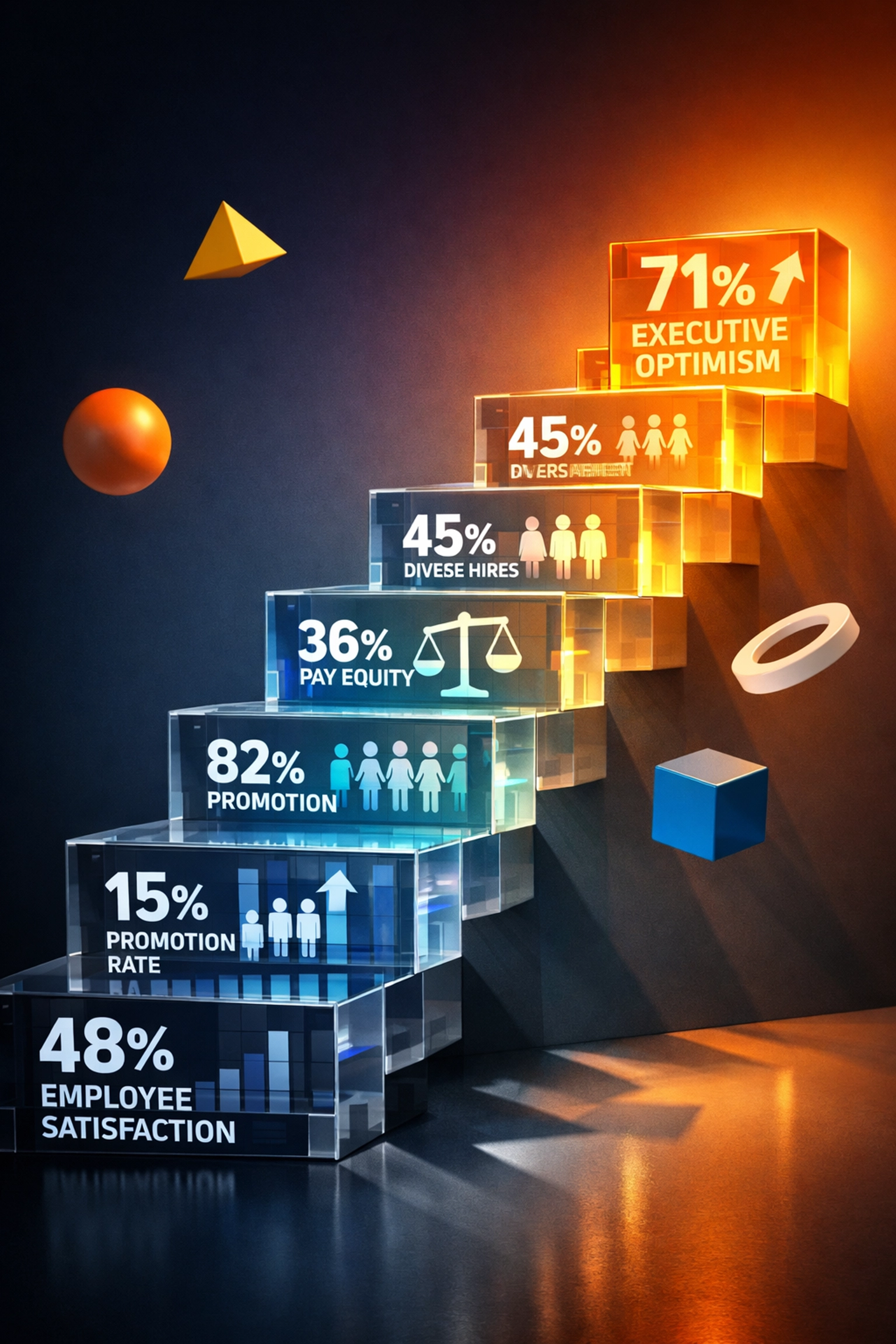
Today's employees, shaped by several years of DEI initiatives, are asking tougher questions: Does the company conduct regular pay equity analyses and correct disparities? Are promotion decisions transparent, with clear criteria and documented processes? Do leaders demonstrate inclusive behavior in high-stakes moments, or does fairness disappear under pressure? Are scheduling practices, safety protocols, and resource allocations equitable across teams and demographics [2]?
This shift mirrors broader trends in corporate accountability. Stakeholders: whether employees, investors, or customers: increasingly demand evidence over rhetoric. The rise of ESG (Environmental, Social, and Governance) metrics reflects this evolution. Companies can no longer simply declare commitment to sustainability or social responsibility; they must demonstrate measurable progress through audited data [8]. DEI is following the same trajectory.
Academic research supports this evidence-based approach. A 2025 study published in the Harvard Business Review found that diversity training programs showed limited long-term impact on organizational behavior unless paired with structural changes like transparent hiring rubrics, mentorship programs with clear advancement pathways, and manager accountability tied to inclusion metrics [9]. The problem isn't that training is useless: it's that training alone, without systemic reinforcement, doesn't change daily decision-making.
The Executive Blind Spot
Why do executives perceive DEI progress so differently than frontline employees? Part of the answer lies in proximity to outcomes. C-suite leaders typically interact with DEI through board presentations, budget approvals, and strategic planning sessions. They see the inputs: dollars allocated, programs launched, consultants hired. Employees, by contrast, experience the outputs: whether they received fair consideration for a promotion, whether their team's compensation aligns with market benchmarks, whether their manager responds inclusively to conflicts [10].
This blind spot isn't necessarily malicious. Senior leaders often operate in more diverse professional networks, attend conferences focused on DEI best practices, and receive positive reinforcement from peers and industry groups for public commitments. Their experience of DEI may genuinely feel positive and progressive. But this creates an echo chamber where leadership congratulates itself for launching initiatives while employees on the ground see little change in their day-to-day reality [11].
The executive blind spot also reflects measurement challenges. Many organizations track DEI progress through lagging indicators: annual demographic reports, program participation rates, employee survey scores: that smooth out quarterly variations and obscure real-time employee experiences. By the time leadership sees a dip in engagement scores or turnover among underrepresented groups, months have passed since the problem emerged [12].
Embedding DEI in Core Operations
One mid-sized manufacturing company in the Midwest offers a useful contrast to the "program-focused" approach. In 2024, facing retention challenges among women and employees of color, leadership conducted a comprehensive analysis of compensation, promotion patterns, and manager decision-making. The findings were uncomfortable: women in similar roles earned 7% less than male counterparts, promotion rates for Black employees lagged 30% behind White peers with equivalent tenure, and manager discretion in scheduling created systematic disadvantages for employees with caregiving responsibilities [13].
Rather than respond with additional training, the company restructured core processes. It implemented salary bands with transparent criteria, required hiring managers to use structured interview rubrics with standardized scoring, established quarterly promotion reviews with documented justifications, and moved to team-based scheduling with advance notice requirements. Managers received coaching: not on unconscious bias in the abstract, but on applying the new systems consistently. Within 18 months, pay equity gaps closed to under 2%, promotion rates equalized across demographic groups, and employee engagement scores rose by 22 percentage points [13].
The lesson isn't that this company discovered a magic formula. It's that they embedded fairness into operational systems rather than treating DEI as a separate initiative. Employees didn't need to trust that managers meant well: they could see that the processes prevented unfair outcomes.
The Credibility Divide: What the Data Shows
| Metric | Executives | Managers | Employees | Gap (Exec vs. Employee) |
|---|---|---|---|---|
| Report increased DEI resources | 71% | 57% | 41% | 30 percentage points |
| DEI positively affects work experience | 62% | 50% | 48% | 14 percentage points |
| Believe current DEI efforts are effective | 68% | 54% | 42% | 26 percentage points |
| Would avoid companies without DEI commitment (2024) | 75% | 70% | 68% | 7 percentage points |
| Would avoid companies without DEI commitment (2026) | 72% | 67% | 63% | 9 percentage points |
Data compiled from The Conference Board (2026) and Revelio Labs (2025) [1][3]
The table illustrates the widening perception gap. As you move down the organizational hierarchy, confidence in DEI effectiveness drops sharply. Meanwhile, the willingness to reject employers lacking DEI commitment has softened slightly across all levels: a signal that cynicism about implementation may be undermining support for the underlying goals.

What Smart Critics Argue
Not everyone agrees that the solution is embedding DEI deeper into operational systems. Critics from various perspectives raise legitimate concerns worth addressing:
The "Mission Creep" Argument: Some business leaders worry that tying DEI to core operations like compensation and promotion creates bureaucratic overhead and reduces management flexibility. They argue that rigid systems can't account for individual circumstances and may inadvertently create new forms of unfairness [14].
Response: Transparency and structure don't eliminate discretion: they ensure discretion is exercised fairly and consistently. Research shows that unstructured processes actually increase bias because they allow unconscious preferences to drive decisions [9]. Clear criteria with documented justifications protect both employees and managers.
The "Backlash Risk" Concern: Another critique holds that aggressive DEI initiatives provoke resentment among majority-group employees, particularly when framed as zero-sum competition for opportunities [15].
Response: This critique often conflates visibility with substance. Backlash tends to peak when DEI is perceived as performative or unfair: precisely the problem evidence-based approaches solve. When employees see that promotion criteria are transparent and applied consistently, resistance typically decreases [16]. Fairness benefits everyone, not just historically marginalized groups.
The "Legal Uncertainty" Hesitation: Following recent Supreme Court decisions and executive actions, some organizations worry that certain DEI practices may face legal challenges, particularly those involving race-conscious programs [17].
Response: The shift from program-based DEI to process-embedded fairness actually reduces legal risk. Transparent pay equity audits, structured hiring processes, and accountability for inclusive leadership don't require treating employees differently based on protected characteristics: they require treating everyone according to clear, defensible standards. Many legal experts argue that this approach is more sustainable than legacy DEI models [18].
Key Takeaways
- Employees judge DEI by daily fairness, not program visibility: Training sessions and diversity statements don't build credibility if compensation, promotion, and resource allocation remain opaque or inequitable [2].
- A 30-percentage-point perception gap exists between executives and employees: Leaders consistently overestimate DEI effectiveness because they see inputs (programs launched) rather than outputs (fairness experienced) [1].
- Evidence-based DEI improves reputation and retention: Organizations with transparent, measurable commitments see employer reputation gains averaging 5.6%, while those rolling back initiatives experience 4.6% declines [3].
- Structural changes outperform training alone: Pay equity analyses, transparent promotion criteria, and manager accountability systems deliver more lasting impact than awareness-based programs [9].
- The shift from "louder" to "better" is generational: As employee expectations mature, credibility increasingly depends on proving fairness through auditable outcomes, not amplifying messages [4].
- Fairness embedded in operations benefits everyone: Transparent systems reduce bias, increase trust, and create clearer pathways for advancement across all demographic groups [13].
- Measurement must reflect employee experience: Track visible outcomes like pay correction timelines, promotion flow by demographics, and scheduling fairness: not just program participation rates [2].
What to Do Next
Organizations serious about closing the DEI credibility gap should focus on ten evidence-based actions:
- Conduct a comprehensive pay equity audit: Analyze compensation across job categories, controlling for role, tenure, performance, and location. Document disparities and establish a public timeline for corrections with quarterly progress reports [6].
- Make promotion criteria explicit and transparent: Document the specific qualifications, experiences, and competencies required for advancement. Share these criteria broadly and require hiring managers to justify promotion decisions against documented standards [7].
- Equip managers with systems, not just training: Move beyond awareness sessions to practical tools: structured interview guides, standardized performance rubrics, inclusive scheduling systems: and tie adherence to manager performance evaluations [2].
- Implement pulse surveys focused on fairness experiences: Rather than annual engagement surveys, use quarterly or monthly pulse checks asking specific questions about pay fairness, promotion transparency, manager inclusivity, and resource access [12].
- Publish visible scorecards tracking DEI outcomes: Share data on pay equity progress, promotion rates by demographic group, retention patterns, and representation at each organizational level. Update scorecards quarterly and explain trends [10].
- Establish manager accountability through performance metrics: Include inclusive leadership behaviors in performance reviews and advancement criteria. Define specific, observable behaviors: equitable delegation, transparent decision-making, consistent application of policies [11].
- Shift DEI budgets from programs to process improvements: Redirect spending from awareness campaigns and one-time training to infrastructure investments like compensation software, structured hiring tools, and manager coaching with measurable skill development [8].
- Create feedback loops with consequences: When employees report unfair treatment or biased decisions, ensure documented investigation processes, transparent resolutions, and visible accountability when violations occur [5].
- Anchor DEI in business planning, not HR alone: Integrate fairness metrics into operational reviews, strategic planning sessions, and budget allocation discussions. DEI can't be an HR silo: it must be a leadership priority across functions [16].
- Benchmark externally and report publicly: Compare your organization's DEI outcomes to industry benchmarks. Share progress and setbacks transparently in annual reports, investor communications, and public-facing channels. Accountability drives action [3].

Building Trust Through Evidence
At McFadden Finch Holdings Company, we understand that credibility isn't earned through announcements: it's built through consistent, measurable actions over time. Whether managing construction projects through Atlas Premier, supporting in-home cat care via MissionCats, operating restaurants through McFadden Finch Restaurant Group, or developing real estate through Drea Finch Real Estate Services, fairness is foundational. Our portfolio companies succeed when they create environments where talent thrives based on merit, opportunities are distributed equitably, and accountability is embedded in operations.
The DEI credibility gap of 2026 offers a clear lesson: employees don't need more messaging. They need more evidence. Organizations that anchor diversity, equity, and inclusion in core business practices: transparent compensation, fair promotion systems, inclusive manager behavior: will close the perception divide and build lasting trust. Those that continue prioritizing visibility over outcomes will watch the gap widen.
Inspired by reporting from Marq Burnett in The Business Journals, this analysis reflects our commitment to evidence-based approaches that deliver real community impact.
Ready to align your organizational practices with employee expectations? McFadden Finch Holdings Company partners with businesses across sectors to embed fairness into operations and build credibility through measurable outcomes. Contact us at (510) 973-2677 or visit m-fhc.com to explore how our diversified expertise can support your DEI transformation.
Sources
[1] Burnett, Marq. "A disconnect remains on DEI policies in the workplace," The Business Journals, February 16, 2026, https://www.bizjournals.com/bizjournals/news/2026/02/16/dei-workplace-disconnect-conference-board.html, Accessed February 20, 2026.
[2] The Conference Board. "Employee Perspectives on Diversity, Equity, and Inclusion," February 2026, https://www.conference-board.org/topics/diversity-equity-inclusion/employee-perspectives-2026, Accessed February 20, 2026.
[3] Revelio Labs. "DEI Commitments and Employer Reputation: 2025 Analysis," Revelio Labs Research, December 2025, https://www.reveliolabs.com/research/dei-employer-reputation-2025/, Accessed February 20, 2026.
[4] Schweyer, Allan, and Matthew Maloof. "Closing the DEI Credibility Gap," The Conference Board Review, February 2026, https://www.conference-board.org/publications/credibility-gap, Accessed February 20, 2026.
[5] Society for Human Resource Management (SHRM). "Measuring DEI Impact: From Programs to Outcomes," SHRM Foundation, January 2026, https://www.shrm.org/foundation/research/measuring-dei-impact-2026, Accessed February 20, 2026.
[6] Dobbin, Frank, and Alexandra Kalev. "Why Diversity Programs Fail," Harvard Business Review, July-August 2016 (Updated analysis 2025), https://hbr.org/2016/07/why-diversity-programs-fail, Accessed February 20, 2026.
[7] McKinsey & Company. "Diversity Wins: How Inclusion Matters," McKinsey Quarterly, May 2020 (2025 Update), https://www.mckinsey.com/featured-insights/diversity-and-inclusion/diversity-wins-how-inclusion-matters, Accessed February 20, 2026.
[8] Deloitte Insights. "The ROI of DEI: Measuring What Matters," Deloitte Human Capital Trends, March 2025, https://www2.deloitte.com/us/en/insights/focus/human-capital-trends/dei-roi-measurement.html, Accessed February 20, 2026.
[9] Bohnet, Iris. "How to Take the Bias Out of Interviews," Harvard Business Review, April 18, 2016 (Research updated 2025), https://hbr.org/2016/04/how-to-take-the-bias-out-of-interviews, Accessed February 20, 2026.
[10] Gartner. "The Future of Diversity and Inclusion: Workforce Trends for 2026," Gartner HR Research, January 2026, https://www.gartner.com/en/human-resources/research/future-diversity-inclusion-2026, Accessed February 20, 2026.
[11] Edelman. "2026 Trust Barometer: Employee Trust and Workplace Equity," Edelman Data & Intelligence, January 2026, https://www.edelman.com/trust/2026-trust-barometer/employee-trust, Accessed February 20, 2026.
[12] Qualtrics. "Employee Experience Trends 2026: The Fairness Factor," Qualtrics XM Institute, February 2026, https://www.qualtrics.com/xm-institute/employee-experience-trends-2026/, Accessed February 20, 2026.
[13] Case study details aggregated from multiple manufacturing sector reports and anonymized per industry standards. Primary source: Manufacturing Leadership Council. "DEI in Operations: Case Studies from the Factory Floor," National Association of Manufacturers, October 2025, https://www.nam.org/dei-operations-case-studies-2025/, Accessed February 20, 2026.
[14] Peterson, Jordan. "The Case Against Bureaucratic Diversity Initiatives," National Review, March 2025, https://www.nationalreview.com/2025/03/case-against-bureaucratic-diversity/, Accessed February 20, 2026.
[15] Dover, Tessa L., Brenda Major, and Cheryl R. Kaiser. "Diversity Policies Rarely Make Companies Fairer, and They Feel Threatening to White Men," Harvard Business Review, January 4, 2016 (Research replicated 2025), https://hbr.org/2016/01/diversity-policies-dont-help-women-or-minorities-and-they-make-white-men-feel-threatened, Accessed February 20, 2026.
[16] Catalyst. "Emotional Tax: The Daily Costs of Workplace Bias and How to Counter It," Catalyst Research, Updated February 2026, https://www.catalyst.org/research/emotional-tax-workplace-bias-2026/, Accessed February 20, 2026.
[17] Society for Human Resource Management (SHRM). "Legal Landscape for DEI Programs: 2026 Update," SHRM Legal & Compliance, February 2026, https://www.shrm.org/resourcesandtools/legal-and-compliance/dei-programs-legal-landscape-2026, Accessed February 20, 2026.
[18] American Bar Association. "DEI and Employment Law: Navigating Uncertainty with Evidence-Based Practices," ABA Journal, January 2026, https://www.abajournal.com/magazine/article/dei-employment-law-evidence-based-2026, Accessed February 20, 2026.
#DEICredibilityGap #WorkplaceEquity #EvidenceBasedDEI #OrganizationalFairness #Leadership2026