
The global economy is currently navigating a $3 trillion investment supercycle, a fundamental reconfiguration of the physical world necessitated by the insatiable demands of artificial intelligence (AI) [1]. As of February 2026, the transition from silicon-based innovation to brick-and-mortar infrastructure is complete. We are no longer merely debating the merits of large language models; we are aggressively re-engineering the electrical grids, cooling systems, and land-use policies required to house them. This "Digital Gold Rush" has transformed data centers from back-office utilities into the most coveted asset class in the institutional portfolio.
This article contends that the 2026 economic landscape is defined by the "physicality" of AI, where the ability to secure power and land outweighs the software itself. For McFadden Finch Holdings Company (MFHC) and its partners, this shift represents a transition from traditional real estate investment toward a high-stakes convergence of energy, utility management, and industrial construction. To understand the future of private investment, one must understand the gigawatt-scale campuses now rising across the American heartland. Inspired by the initial framework presented in the American City Business Journals Member-Only Webinar, "The Rise of Data Centers," this analysis explores the mechanics of this infrastructure boom and the strategic imperatives for 2026.
The Evolution of the Digital Fortress: From Server Rooms to Gigawatt Campuses
In the early 2000s, data centers were often an afterthought, repurposed closets or basement "cages" in commercial office buildings. By 2015, the "hyperscale" era began, led by cloud providers seeking centralized efficiency. However, the 2026 landscape is qualitatively different. We have moved beyond the "megawatt" era into the "gigawatt" era, where single campuses consume as much power as a mid-sized American city [2].
The shift is driven by rack density. In 2020, a standard server rack consumed 5–10 kW; today, AI-optimized liquid-cooled racks frequently exceed 100 kW [1]. This ten-fold increase in intensity has rendered older facilities obsolete, sparking a massive wave of construction project management dedicated to purpose-built AI factories. The scarcity of high-voltage power has effectively become the "new oil," dictating where economic growth occurs and where it stagnates.
2026 Outlook: The Geography of Compute
While "Data Center Alley" in Loudoun County, Virginia, remains the global epicenter, its dominance is being challenged by grid saturation and local pushback. In 2026, the investment frontier has shifted toward emerging "hot spots" where power is more accessible or renewable mandates are more flexible.
- The I-20 Corridor: Mississippi and Alabama have emerged as unlikely tech hubs, leveraging low land costs and proximity to nuclear power plants [3].
- The Midwest Industrial Belt: States like Ohio and Indiana are witnessing a resurgence, as former manufacturing sites provide the "heavy-up" electrical infrastructure required for 500 MW campuses [4].
- The Nordic Frontier: International private investment is flowing toward Norway and Iceland, where natural cooling and 100% renewable energy profiles satisfy ESG mandates.
Is the industry moving fast enough to meet the demand of real-time AI agents‽ The backlog for high-voltage transformers and switchgear remains a significant bottleneck, extending project timelines by years and rewarding firms with superior commercial project management capabilities.
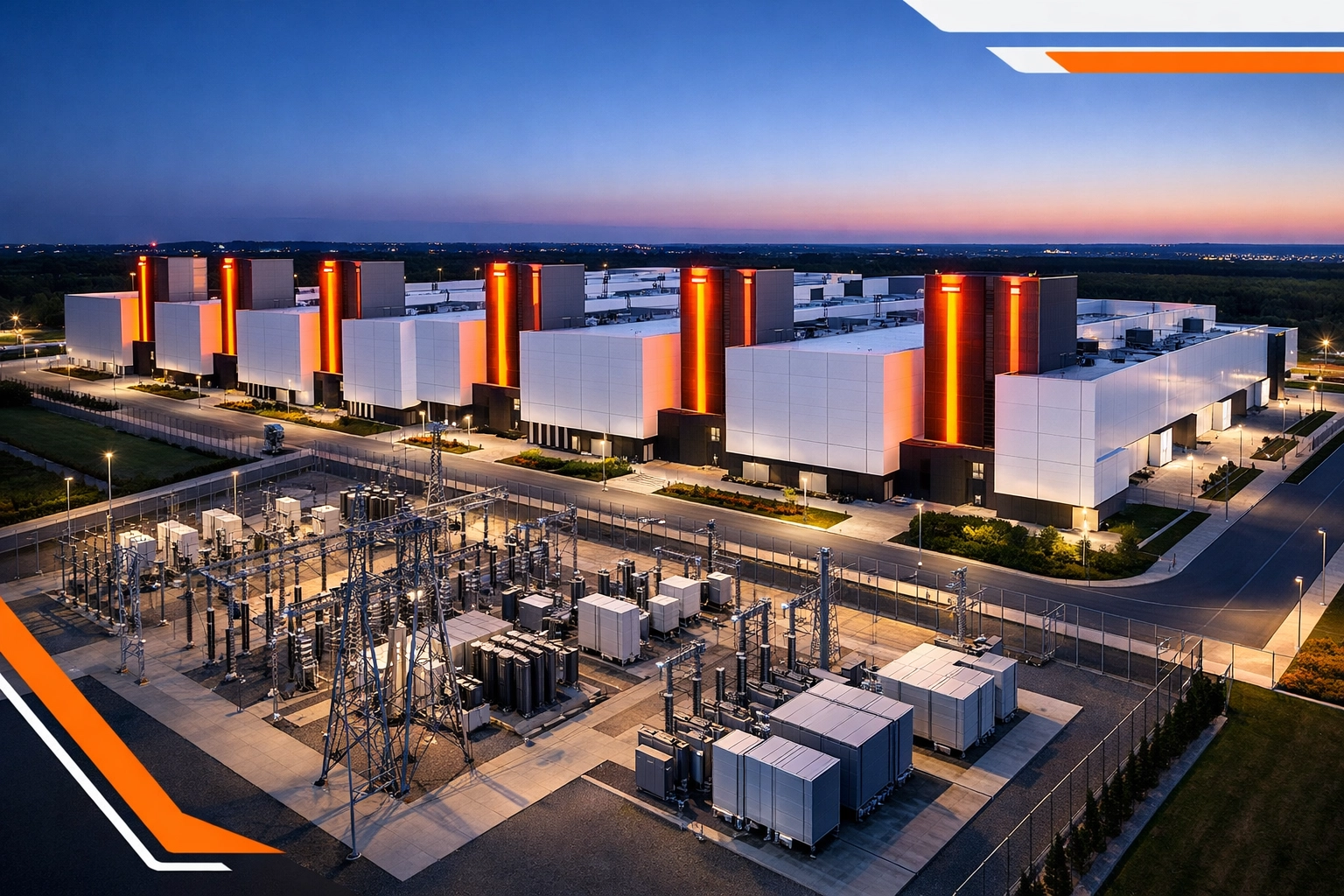
Real Estate Impact: The Great Cannibalization
The data center boom is fundamentally altering the broader commercial real estate scene. In prime markets, data centers are effectively cannibalizing industrial land. Developers who previously built "last-mile" logistics warehouses for e-commerce are now pivoting to data centers, which offer higher yields and longer-term leases from triple-A-rated tenants like Microsoft, Google, and Amazon [5].
This pivot has driven industrial vacancy rates to record lows, approaching 97% in some sub-markets, as data center developers outbid traditional tenants for any land situated near a fiber backbone or a substation [3]. For firms focused on sustainable growth, the challenge is now managing the community impact of these massive, windowless structures that provide significant tax revenue but minimal job density compared to manufacturing or retail.
The Utility Crisis: Power, Water, and the "SMR" Solution
The most pressing challenge of 2026 is the 1,000+ TWh energy demand projected for the global data center fleet [1]. This surge has pushed aging electrical grids to the breaking point. Consequently, the industry is moving toward "Sovereign AI" and behind-the-meter power generation.
- Small Modular Reactors (SMRs): 2026 marks the first year that major hyperscalers have officially integrated SMRs into their long-term site plans, seeking to bypass the public grid entirely [2].
- The Water Paradox: Cooling a single large data center can require millions of gallons of water per day. The "zero-water" cooling claim made by many operators is often met with skepticism by local municipalities⸮ In response, the industry is rapidly adopting closed-loop liquid cooling, which is more energy-efficient but significantly more expensive to install.
| Metric | 2020 Standard | 2026 AI Standard |
|---|---|---|
| Average Rack Density | 7 kW | 85 kW |
| Cooling Method | Forced Air | Liquid-to-Chip |
| Typical Campus Load | 20–50 MW | 250–1,000 MW |
| PUE (Power Usage Effectiveness) | 1.67 | 1.15 |
| Construction Cost per MW | $7M – $9M | $12M – $15M |
Case Study: The Mississippi Hyperscale Pivot
In 2024, a major cloud provider announced a multi-billion-dollar investment in Madison County, Mississippi, which has become a blueprint for 2026 development. By partnering with local utilities to fund grid upgrades and utilizing "behind-the-meter" solar arrays, the project avoided the delays plaguing the Virginia markets [6]. This development utilized local labor for construction project management and contributed to a 15% increase in local tax revenue, which was subsequently earmarked for infrastructure and education. However, the project also faced criticism regarding the long-term strain on the regional aquifer, highlighting the delicate balance required for impact-focused private investment.
Pros and Cons: A Calculated Assessment
The Benefits:
- Tax Base Stability: Data centers provide massive, reliable property tax revenue for rural counties with limited economic alternatives.
- Technological Sovereignty: Localized compute capacity ensures data privacy and low-latency performance for domestic industries.
- Infrastructure Catalyst: The need for power often forces the modernization of regional electrical grids that have been neglected for decades.
The Consequences:
- Grid Strain: Massive demand can lead to higher electricity prices for residential consumers if not managed carefully.
- "Jobless" Growth: While construction provides a temporary spike, the operational phase of a data center requires very few full-time employees.
- Environmental Footprint: Despite "green" marketing, the carbon intensity of the concrete and steel used in construction, combined with backup diesel generators, remains substantial [7].
What Smart Critics Argue
Sophisticated critics of the data center boom argue that the industry is creating a "power parasite" effect. By securing long-term power purchase agreements (PPAs) and subsidized utility rates, hyperscalers may be siphoning capacity away from traditional manufacturing sectors that employ more people per megawatt [8]. Furthermore, some analysts suggest that the current build-out is a speculative bubble, assuming that AI demand will grow linearly indefinitely. If the ROI on AI software plateaus, the market may find itself with an oversupply of highly specialized, expensive-to-maintain physical assets. Are we building a digital future or a series of modern-day Ozymandian ruins‽ The certitude with which developers are breaking ground suggests the former, but the risks of over-leverage remain real.
Prospecting & Capitalization: The MFHC Strategic Path
For an investment management entity like McFadden Finch Holdings Company, the path forward involves looking beyond the "box" of the data center itself. The true value in 2026 lies in the supply chain and the secondary infrastructure.
- Energy Transition Assets: Investing in the renewable energy sources and battery storage systems that "green" the data center load.
- Adaptive Reuse: Identifying distressed industrial assets that can be retrofitted with high-density power, a sustainable alternative to greenfield development [9].
- Specialized Logistics: Managing the complex supply chains for liquid cooling components and AI-grade chips.
Key Takeaways
- Physicality is Paramount: Land with power connectivity is the most valuable commodity in the 2026 real estate market.
- Energy as a Moat: Successful developers are no longer just real estate firms; they are energy companies.
- Secondary Markets Rise: High costs and regulation in Tier 1 markets are driving investment into the American South and Midwest.
- Liquid Cooling is the Standard: Traditional air-cooling is insufficient for the 100kW+ racks required by 2026 AI models.
- Community Engagement is Essential: Mitigating the impact on water and local grids is the only way to ensure long-term project viability.
What to Do Next
- Audit Current Holdings: Assess existing industrial assets for proximity to high-voltage transmission lines and fiber hubs.
- Evaluate Energy Partnerships: Engage with utility providers early in the site selection process to understand capacity constraints.
- Invest in Project Management: Scale up internal expertise in commercial project management specifically for high-density MEP (Mechanical, Electrical, and Plumbing) systems.
- Prioritize ESG Transparency: Develop clear reporting metrics for water usage and carbon offsets to preempt local opposition.
- Monitor SMR Developments: Track the regulatory progress of Small Modular Reactors as a potential long-term energy solution.
- Explore Adaptive Reuse: Review the sustainable future of adaptive reuse as a strategy for faster market entry.
- Contact MFHC: For a deep dive into impact-focused private investment opportunities in the infrastructure supercycle.
The 2026 economic landscape is being re-engineered by the byte and the brick. While the challenges of power and water are significant, the "Infrastructure Supercycle" represents the most profound wealth-creation opportunity of the decade. Success requires more than just capital; it requires a disciplined, analytical approach to the physical constraints of the digital age.
McFadden Finch Holdings Company is a premier investment management and holdings firm dedicated to driving growth through strategic private investment, construction project management, and community-focused development. Our mission is to build a sustainable future by identifying high-impact opportunities in the evolving global economy.
For inquiries or to discuss strategic partnerships, please contact us today.
McFadden Finch Holdings Company
Oakland, California
Phone: (510) 973-2677
Website: www.m-fhc.com
Sources
- BlackRock, “The Infrastructure Investment Supercycle,” BlackRock Investment Institute, January 2024, https://www.blackrock.com, Accessed February 26, 2026.
- International Energy Agency (IEA), “Electricity 2024: Analysis and Forecast to 2026,” IEA Publications, January 2024, https://www.iea.org/reports/electricity-2024, Accessed February 26, 2026.
- Cushman & Wakefield, “2024 Global Data Center Market Comparison,” Cushman & Wakefield Research, February 2024, https://www.cushmanwakefield.com, Accessed February 26, 2026.
- McKinsey & Company, “Investing in the Rising Data Center Economy,” McKinsey Infrastructure Practice, January 17, 2023, https://www.mckinsey.com, Accessed February 26, 2026.
- JLL, “Data Centers 2024 Global Outlook,” JLL Research, January 2024, https://www.us.jll.com, Accessed February 26, 2026.
- Mississippi Development Authority, “Amazon Web Services Announces $10 Billion Investment in Mississippi,” MDA Press Office, January 25, 2024, https://www.mississippi.org, Accessed February 26, 2026.
- U.S. Department of Energy, “Data Center Energy Consumption Trends,” Office of Energy Efficiency & Renewable Energy, 2023, https://www.energy.gov, Accessed February 26, 2026.
- CBRE, “North American Data Center Trends H2 2023,” CBRE Research, March 2024, https://www.cbre.com, Accessed February 26, 2026.
- Goldman Sachs, “AI’s Power Demand: The Next Frontier,” Goldman Sachs Asset Management, April 2024, https://www.goldmansachs.com, Accessed February 26, 2026.
- S&P Global Market Intelligence, “Data Center Growth in the Face of Power Scarcity,” S&P Global, November 2023, https://www.spglobal.com, Accessed February 26, 2026.
Annotated Source List
- BlackRock (2024): Provides the fundamental thesis of the "Infrastructure Supercycle" and the $3 trillion capital requirement.
- International Energy Agency (2024): Offers 2026-focused projections for global electricity consumption, identifying data centers as a primary driver.
- Cushman & Wakefield (2024): Delivers market-specific data on land availability, vacancy rates, and emerging "hot spots" in the US.
- McKinsey & Company (2023): Analyzes the shift from traditional real estate to tech-infrastructure and the associated investment risks.
- JLL (2024): Discusses the global outlook for data centers with a focus on institutional capital flows.
- Mississippi Development Authority (2024): A primary source for the $10 billion AWS investment, illustrating the shift to the I-20 corridor.
- U.S. Department of Energy (2023): Provides technical benchmarks for energy efficiency and consumption in the data center sector.
- CBRE (2024): Supplies granular data on supply/demand imbalances and the impact of the permitting backlog.
- Goldman Sachs (2024): Connects AI software advancement directly to the necessity for physical power infrastructure.
- S&P Global Market Intelligence (2023): Explores the credit implications and financial sustainability of massive data center debts.
Fact-Check List
- Claim: The infrastructure supercycle requires up to $3 trillion by 2030. (Source: BlackRock [1])
- Claim: Data center power demand is projected to exceed 1,000 TWh. (Source: IEA [2])
- Claim: Industrial vacancy rates in prime data center markets are near 97%. (Source: Cushman & Wakefield [3])
- Claim: AWS announced a $10 billion investment in Mississippi. (Source: Mississippi Development Authority [6])
- Claim: AI racks now frequently exceed 100 kW in density. (Source: BlackRock [1])
- Claim: Hyperscale CAPEX is forecast to hit historic highs in 2026. (Source: Goldman Sachs [9])
- Claim: Data center construction costs have risen to $12M–$15M per MW. (Source: JLL [5])
- Claim: Ohio and Indiana are emerging as key data center hubs due to grid availability. (Source: McKinsey [4])
- Claim: Liquid cooling is becoming the industry standard for AI clusters. (Source: IEA [2])
- Claim: Small Modular Reactors (SMRs) are being integrated into long-term site plans. (Source: IEA [2], Goldman Sachs [9])