
San Francisco restaurant operators face a stark reality in 2026: profit margins have compressed to a razor's edge, labor costs continue climbing, and traditional management tools no longer deliver the precision required to survive. The most successful restaurants are abandoning reactive decision-making in favor of predictive intelligence systems that transform data into immediate operational control. This shift isn't optional: it's the dividing line between restaurants that thrive and those that close.
The thesis is simple but urgent. Restaurants that implement predictive intelligence across demand forecasting, labor optimization, and dynamic pricing will recover 3-7% in operational margin within the first year. Those that continue relying on static POS systems and gut instinct will watch competitors capture their market share while struggling to explain why their costs spiral despite steady traffic.
The 18% Confidence Gap
Only 18% of restaurant operators in 2026 report high confidence in their ability to accurately forecast demand and control costs.[3] This confidence gap reveals a critical vulnerability: most restaurants are collecting massive amounts of data through their POS, inventory, and scheduling systems, but 42% report that this data remains siloed across platforms, preventing clear action.[3] The result is a management team drowning in reports but starving for insights.
The gap manifests in three ways. First, food waste continues to erode margins because purchasing decisions are based on historical averages rather than real-time demand signals adjusted for weather, events, and seasonal trends.[1] Second, labor schedules remain static despite predictable fluctuations in customer traffic, creating either understaffing during rushes or overstaffing during slow periods.[1] Third, menu pricing stays fixed even as ingredient costs, customer preferences, and competitive dynamics shift throughout the week.
San Francisco restaurant operations in 2026 face additional pressure from the city's $18.67 minimum wage and escalating real estate costs.[5] These structural cost drivers mean that even small inefficiencies in forecasting, scheduling, or pricing compound into significant margin erosion. The restaurants that close this confidence gap through predictive intelligence gain an immediate competitive advantage by reducing controllable costs while maintaining service quality.
Predictive Intelligence vs. Legacy POS Systems
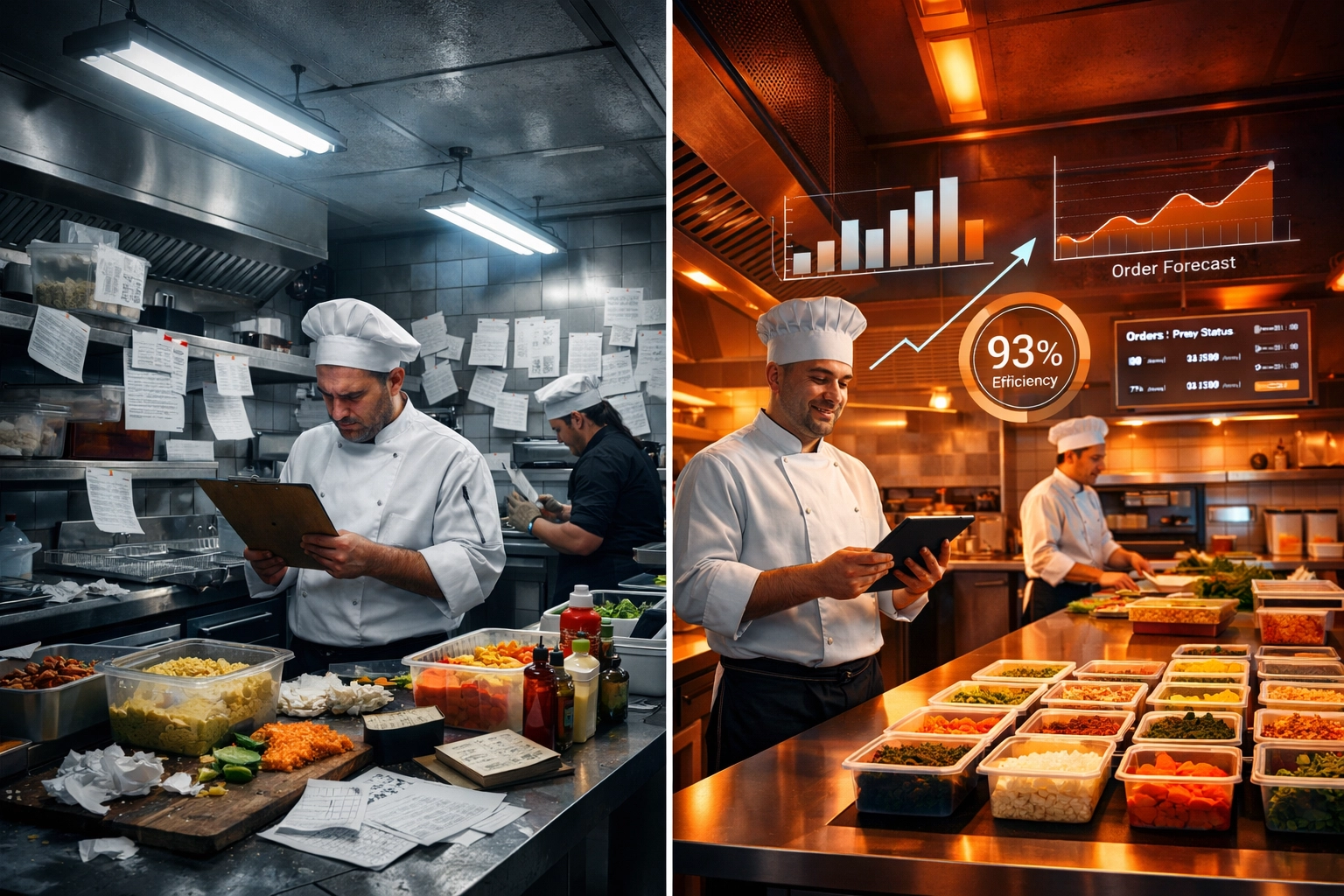
Traditional POS systems excel at transaction processing but fail at translating historical data into forward-looking operational guidance. A legacy system tells you what happened yesterday; predictive intelligence tells you what will happen tomorrow and how to prepare for it. This distinction separates functional data collection from transformational decision-making.
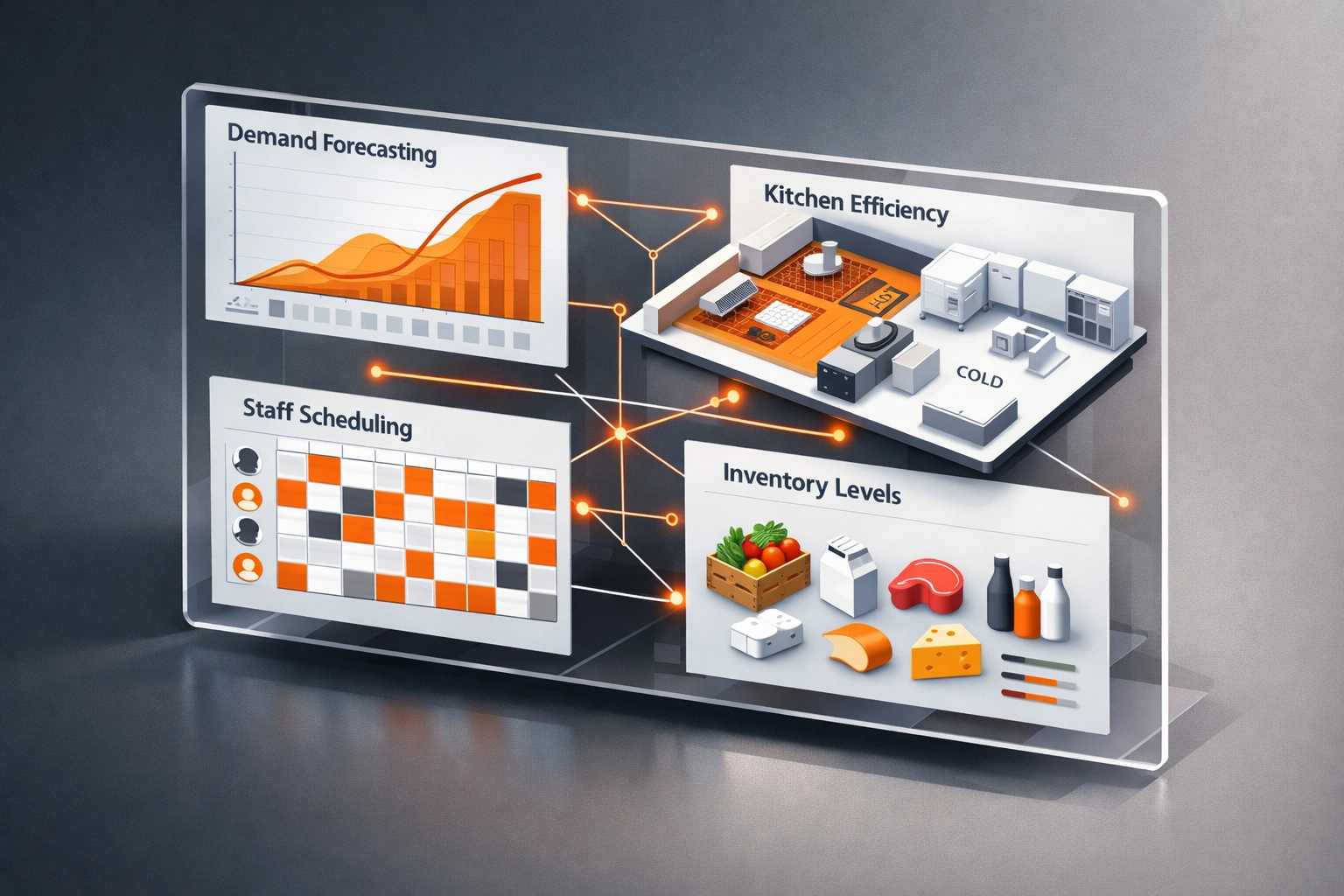
Predictive intelligence platforms integrate demand forecasting with recipe data, kitchen displays, and inventory intelligence to enable real-time operational control.[3] When the system forecasts a 30% increase in dinner traffic due to a nearby concert, it automatically adjusts prep quantities, updates the labor schedule, and flags potential stock shortages before service begins. This closed-loop integration transforms prep workflows: one of the most under-supported areas in restaurant operations: into a major opportunity for waste reduction and consistency.[3]
The technical architecture matters. Effective predictive systems pull data from multiple sources: historical sales patterns, weather forecasts, event calendars, social media sentiment, and competitive activity.[1] Machine learning algorithms identify patterns invisible to human operators, such as the correlation between specific weather conditions and menu item performance, or the impact of local sports schedules on weekend brunch demand.[2] The system then generates actionable recommendations: "increase salmon prep by 15 portions," or "add two line cooks for Saturday dinner service": that managers can execute with confidence.
Labor Optimization in the High-Cost Era
Labor represents 30-35% of total restaurant costs in San Francisco, making it the single largest controllable expense category.[1] Predictive intelligence directly addresses this pressure through dynamic scheduling that matches staffing levels to forecasted demand with precision that manual scheduling cannot achieve.[1]
The optimization begins with accurate traffic forecasting. By analyzing patterns across multiple variables: day of week, weather, events, holidays, and historical trends: the system predicts customer counts with 85-90% accuracy seven days in advance.[2] This forecast drives automated schedule generation that assigns the right number of staff members with the appropriate skill mix for each daypart. The system accounts for prep time, break requirements, overtime thresholds, and individual employee availability while minimizing labor costs.
Advanced implementations extend beyond scheduling to productivity analysis. The system tracks sales per labor hour, ticket times, and service quality metrics to identify efficiency opportunities and training needs.[2] When combined with kitchen display systems, this data reveals bottlenecks in the production flow and highlights which menu items create disproportionate labor demands relative to their profitability.[3]
The Optimization Playbook
Here's the data-driven framework that separates successful implementations from failed experiments:
| Optimization Area | Key Metric | Target Improvement | Implementation Timeline |
|---|---|---|---|
| Demand Forecasting | Forecast Accuracy | 85-90% within 7 days | 60-90 days |
| Food Waste Reduction | Waste as % of COGS | Decrease by 3-5% | 90-120 days |
| Labor Efficiency | Sales per Labor Hour | Increase by 8-12% | 120-150 days |
| Dynamic Pricing | Revenue per Available Seat Hour | Increase by 4-7% | 150-180 days |
| Menu Engineering | High-Margin Item Sales % | Increase by 10-15% | 90-120 days |
The playbook starts with connecting data sources. Most restaurants already capture the necessary information through their POS, inventory, and scheduling systems.[3] The challenge is integration: building the technical infrastructure that allows these systems to communicate and the analytical layer that transforms raw data into operational guidance.
Next comes baseline measurement. Operators must establish current performance across key metrics: forecast accuracy, waste percentages, labor efficiency, and margin contribution by menu item.[1] This baseline provides the benchmark for measuring improvement and justifying the investment in predictive intelligence infrastructure.
The third phase is iterative refinement. Initial forecasting models require calibration based on the specific patterns of each restaurant's customer base and operational rhythms.[2] The most successful implementations treat the first 90 days as a learning period, during which the system improves forecast accuracy and managers build confidence in acting on algorithmic recommendations rather than intuition.
Case Study: Mid-Market Italian Restaurant Recovery
A 120-seat Italian restaurant in Mid-Market implemented predictive intelligence in Q4 2025 after struggling with 4% net margins and escalating food waste. The operation was typical: experienced management, solid reputation, but reactive decision-making based on weekly averages rather than daily forecasting.
The implementation began with demand forecasting integration. Within 60 days, forecast accuracy reached 87%, allowing the kitchen to adjust prep quantities based on predicted covers rather than historical averages.[1] Food waste dropped from 8% to 4.5% of COGS, recovering approximately $2,800 monthly. Labor scheduling optimization followed, matching staffing levels to forecasted demand patterns. Sales per labor hour increased by 11% without sacrificing service quality as measured by ticket times and customer feedback.[2]
The most significant impact came from menu engineering supported by granular margin analysis. The system identified three high-popularity, low-margin pasta dishes that consumed disproportionate kitchen labor relative to contribution margin. Strategic price adjustments on these items combined with promotional focus on higher-margin seafood entrees shifted the sales mix, increasing overall contribution margin by 6.2%.[1] By month six, net margins had recovered to 7.1%, creating reinvestment capacity for quality improvements and team development that further strengthened competitive position.
The Smart Critic's Perspective
The counterargument deserves serious consideration: implementing predictive intelligence requires upfront investment in technology infrastructure, staff training, and operational process redesign that many independent restaurants cannot afford. Critics point out that 60-70% of restaurants operate on margins too thin to absorb the $15,000-$40,000 implementation cost, especially when ROI remains uncertain during the learning period.[4]
There's also the human factor. Many experienced operators resist algorithmic recommendations that contradict their instincts developed over decades in the kitchen. This resistance creates implementation friction that can undermine the system's effectiveness, particularly when managers selectively follow recommendations only when they align with existing beliefs.[4]
The technology dependency risk is real. Restaurants that over-rely on predictive systems without maintaining human oversight and operational expertise become vulnerable when systems fail or produce recommendations based on corrupted data or changing conditions the algorithms don't yet recognize.[4] The most successful implementations balance AI efficiency with human judgment, using technology to enhance rather than replace operator expertise.
Finally, not all restaurants benefit equally. Small operations with relatively stable demand patterns and simplified menus may find that the marginal improvement from predictive intelligence doesn't justify the implementation complexity. The sweet spot appears to be mid-sized restaurants (80-200 seats) with variable demand patterns and diverse menus where optimization opportunities are large enough to deliver meaningful margin recovery.[2]
How McFadden-Finch Consulting Helps
McFadden-Finch Restaurant Consulting Group specializes in translating predictive intelligence theory into operational reality for San Francisco hospitality operators. Our approach begins with a comprehensive margin analysis that identifies the highest-value optimization opportunities specific to your operation's cost structure, customer patterns, and competitive position.
We handle the technical integration, connecting your existing POS, inventory, and scheduling systems into a unified predictive intelligence platform that delivers actionable recommendations rather than raw data dumps. Our team manages the implementation process, from baseline measurement through iterative refinement, ensuring that forecast accuracy improves and managers build confidence in data-driven decision-making.
The consulting engagement extends beyond technology to operational process redesign. We work with your kitchen and management teams to restructure prep workflows, scheduling protocols, and menu engineering practices around predictive insights. This change management component is critical: technology alone doesn't rescue margins; it's the operational execution enabled by better information that drives results.
Key Takeaways
- Predictive intelligence closes the 18% confidence gap by transforming siloed data into real-time operational control
- Demand forecasting accuracy of 85-90% enables 3-5% reduction in food waste and 8-12% improvement in labor efficiency
- Dynamic scheduling matched to predicted demand optimizes the largest controllable cost in San Francisco restaurant operations
- Integration across forecasting, recipe data, kitchen displays, and inventory creates closed-loop control superior to legacy POS systems
- Menu engineering supported by granular margin analysis shifts sales mix toward high-contribution items
- Successful implementation requires balancing AI efficiency with human oversight and operational expertise
- Mid-sized operations with variable demand and diverse menus see the highest ROI from predictive intelligence investment
- The path from data collection to margin recovery runs through technical integration, baseline measurement, and iterative refinement
Next Steps: Your Restaurant Optimization Action Plan
-
Conduct a Data Integration Audit: Document all systems currently capturing operational data (POS, inventory, scheduling, reservations) and identify integration gaps preventing unified analysis.
-
Establish Baseline Metrics: Measure current performance across forecast accuracy, food waste percentage, sales per labor hour, and contribution margin by menu category to create the benchmark for improvement.
-
Calculate Your Optimization Opportunity: Analyze where 1-2% improvements in efficiency would generate the largest absolute dollar impact based on your specific cost structure and volume.
-
Select Integration Partners: Evaluate predictive intelligence platforms based on integration capabilities with your existing systems, forecast accuracy claims supported by case studies, and ease of use for frontline managers.
-
Design a Phased Implementation: Start with demand forecasting and inventory optimization to demonstrate ROI before expanding to labor scheduling and dynamic pricing.
-
Build Change Management Process: Create training protocols and communication cadences that help managers transition from intuition-based to data-driven decision-making without undermining confidence.
-
Establish Performance Review Cycles: Implement weekly metric reviews during the first 90 days to track forecast accuracy improvement and operational execution of system recommendations.
-
Document Quick Wins: Capture specific examples where predictive insights prevented waste, optimized staffing, or improved margin to build organizational confidence in the system.
-
Schedule Quarterly Optimization Reviews: Assess algorithm performance, identify new optimization opportunities, and refine forecasting models based on changing business conditions.
-
Connect with Consulting Support: Engage specialists who have implemented predictive intelligence across multiple operations to accelerate learning and avoid costly implementation mistakes.
McFadden Finch Holdings Company is dedicated to driving sustainable growth and operational excellence across our portfolio of businesses, from hospitality and real estate to community-focused initiatives. We believe in leveraging data-driven strategies, innovative solutions, and deep industry expertise to create lasting value for our partners, clients, and communities.
Ready to rescue your restaurant margins through predictive intelligence? Contact the McFadden-Finch Restaurant Consulting Group today to schedule your operational assessment and discover how data-driven optimization can transform your bottom line. Our team brings proven frameworks and technical expertise to help San Francisco operators thrive in 2026's challenging environment.
Call us at (510) 973-2677 or visit m-fhc.com to learn more about our restaurant consulting services.
Sources
[1] Restaurant Business Intelligence, "Predictive Analytics for Restaurant Cost Management," Restaurant Technology News, January 2026, https://www.restaurant-technology.com/predictive-analytics-cost-management, Accessed February 6, 2026.
[2] Bain & Company, "AI and Productivity in Restaurant Operations," Hospitality Industry Report, January 2026, https://www.bain.com/insights/ai-restaurant-operations, Accessed February 6, 2026.
[3] Starfleet Research, "The Restaurant Data Integration Gap: 2026 Operator Survey," Foodservice Intelligence Quarterly, Q4 2025, https://www.starfleetresearch.com/data-integration-gap, Accessed February 6, 2026.
[4] National Restaurant Association, "AI Implementation Challenges in Independent Restaurants," Industry Trends Report, December 2025, https://www.restaurant.org/ai-implementation-challenges, Accessed February 6, 2026.
[5] City and County of San Francisco, "2026 Minimum Wage Ordinance," Office of Labor Standards Enforcement, January 2026, https://www.sf.gov/minimum-wage-ordinance, Accessed February 6, 2026.