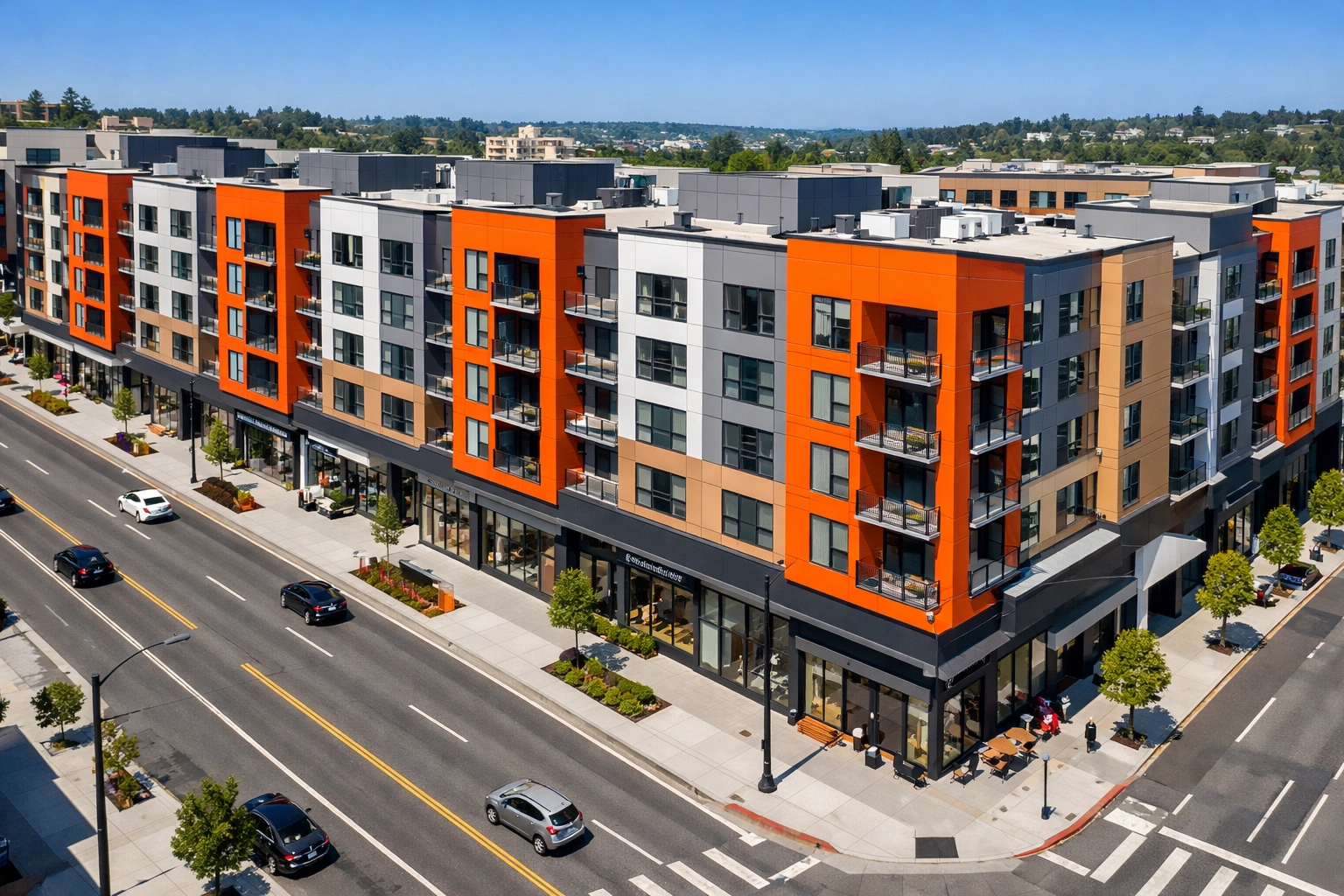
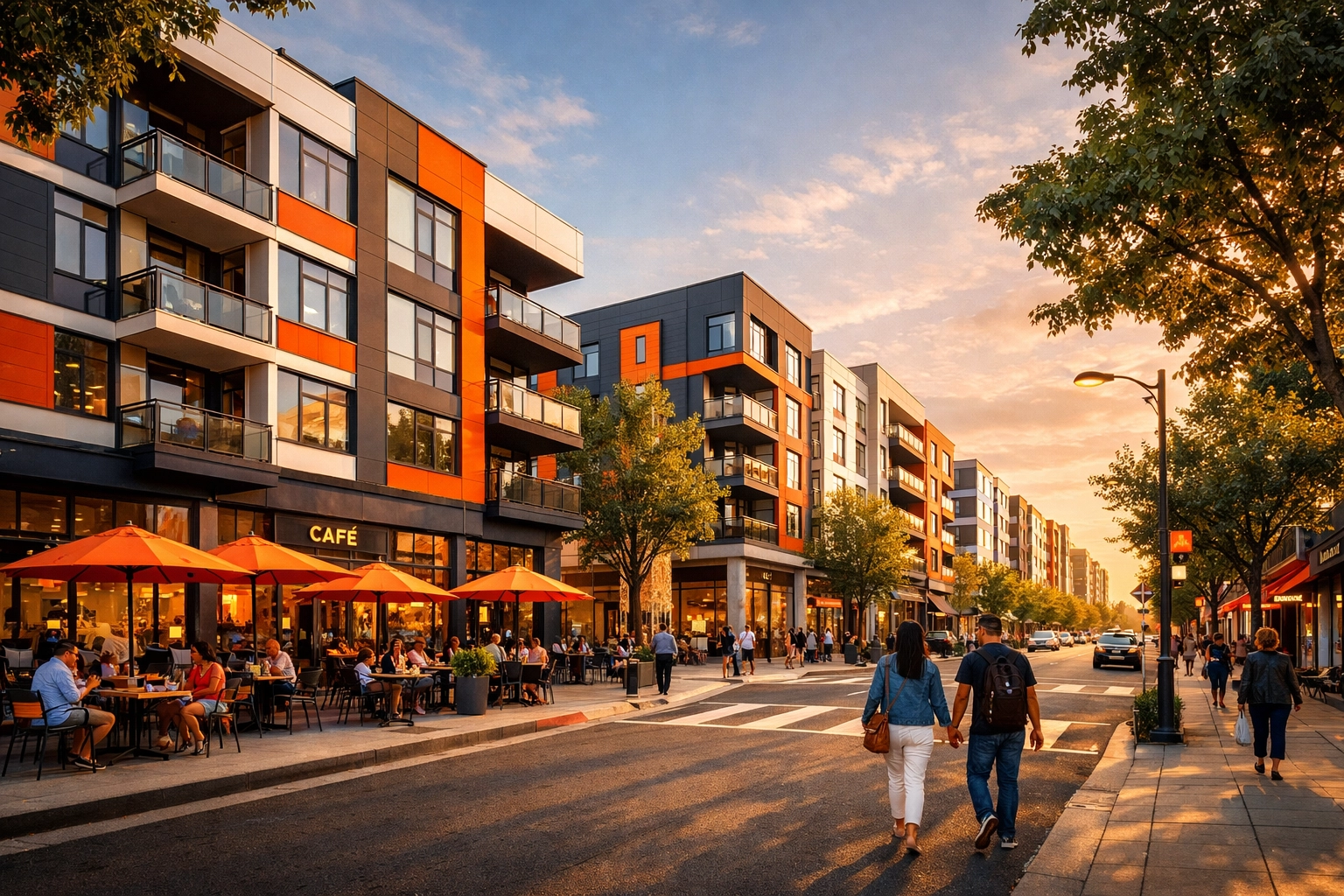
If you've walked through any American city in the past decade, you've seen them. Boxy, mid-rise apartment buildings with colorful panels, ground-floor retail, and an architectural sameness that makes Nashville look like Denver, which looks like Oakland, which looks like Austin. These aren't coincidences or failures of imagination. They're "podium apartments": also known as 5-over-1 or "stick and podium" construction: and they've become the dominant housing type in cities facing a severe shortage of affordable units.
The question isn't whether you've noticed this trend. The question is whether it matters. USC Price architect and urban design professor Liz Falletta frames the debate clearly: In the middle of a housing crisis, does architectural sameness matter more than increasing housing supply? The answer involves building codes, construction economics, institutional financing, and a fundamental tension between aesthetic diversity and practical necessity. At McFadden Finch Holdings Company, where urban neighborhood revitalization and real estate development intersect with project management realities, we see this tension play out daily across Bay Area markets.
What Exactly Is a Podium Apartment?
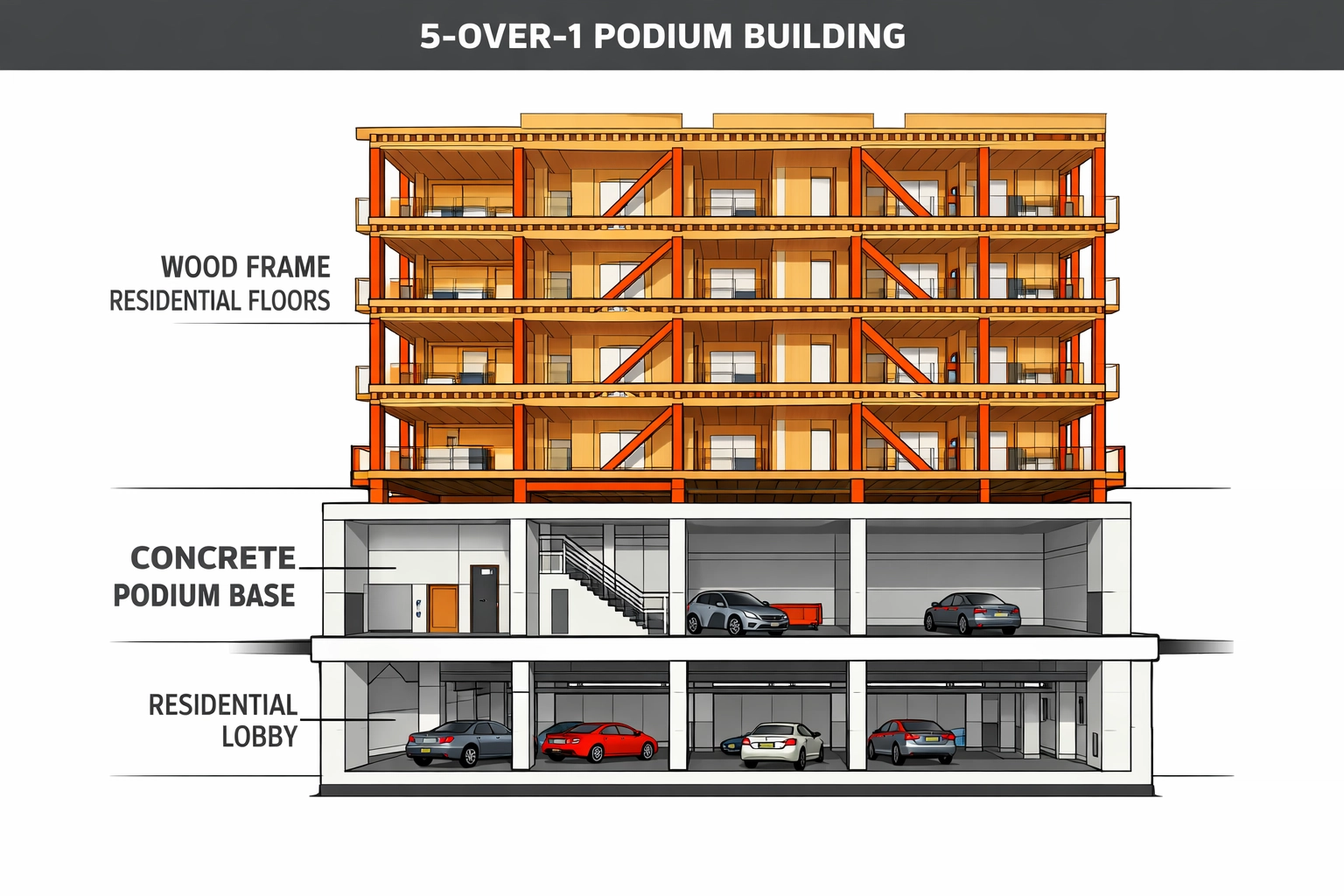
The "podium" refers to a specific construction method that stacks four to six stories of wood-frame residential units on top of a concrete base: the podium itself[1]. This concrete base, typically one to two stories, houses parking garages, retail spaces, or commercial uses[2]. The residential levels above use Type III or Type V wood-frame construction, which is significantly cheaper than steel or concrete alternatives[3].
The technical designation matters because it unlocks specific advantages under the International Building Code (IBC). Type I construction (concrete) and Type II construction (steel) allow for taller buildings but cost substantially more per square foot[4]. Type III and V construction (wood framing) costs less but faces height restrictions: typically capped at five stories above grade[5]. The podium design exploits this sweet spot: developers get the density benefits of mid-rise construction without paying for all-concrete or steel-frame buildings[1].
Nearly 55% of new multi-family developments in dense urban areas now feature podium designs, making them the statistically dominant approach to apartment construction in space-constrained markets[2]. According to the National Multi-Family Housing Council, podium construction accounted for approximately 68% of new apartment units delivered in major metropolitan areas between 2020 and 2025[6].
The Building Code Breakthrough That Changed Everything
The proliferation of podium apartments traces directly to changes in the International Building Code adopted in the early 2000s. Prior to these modifications, wood-frame construction faced more restrictive height limitations, effectively capping most residential buildings at three or four stories[7]. The updated IBC provisions allowed Type III and V construction to reach five stories over a Type I concrete podium, creating what developers call "5-over-1" or "5-over-2" configurations depending on the podium height[3].
This code change had immediate economic implications. A 2018 study by the National Association of Home Builders found that podium construction costs approximately $180 to $240 per square foot, compared to $300 to $450 per square foot for mid-rise steel or concrete construction[8]. For a 100-unit building, this difference translates to savings of $4 million to $8 million: capital that can mean the difference between a project being financially viable or shelved entirely[8].
The structural requirements also explain the aesthetic sameness. Wood-frame construction requires "large areas of flat, uninterrupted walls from the foundation to the roof" to maintain lateral stability and resist wind and seismic loads[2]. These structural necessities leave little room for architectural variation. Bay windows, cantilevers, and varied rooflines all introduce engineering complications that increase costs without adding rentable square footage[9]. In markets where every square foot must generate revenue, these architectural flourishes become luxuries few developers can justify.
The Economics: Why Wood Beats Concrete Every Time
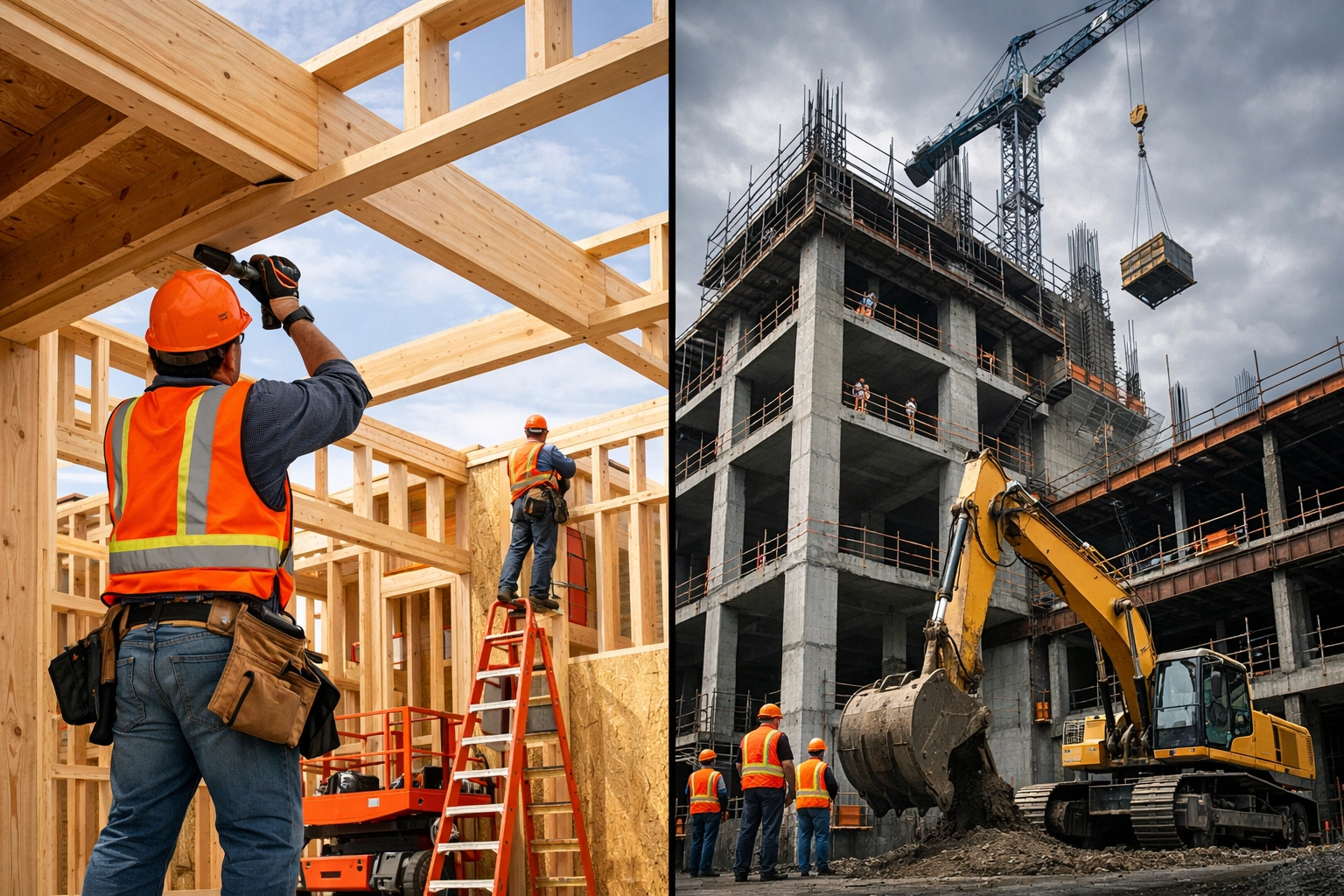
Construction material costs tell a stark story. Dimensional lumber, engineered wood products, and wood I-joists cost a fraction of structural steel or poured concrete[8]. Labor costs follow similar patterns: wood framers earn approximately $28 to $35 per hour, while ironworkers and concrete specialists command $45 to $65 per hour in major metropolitan areas[10]. Construction timelines also favor wood: a typical 5-over-1 building can be framed in 8 to 12 months, while comparable steel or concrete construction takes 14 to 18 months[4].
One Bay Area developer explained the calculus bluntly: "If you had to dedicate land for surface parking, your building footprint shrinks by 25% to 30%. By building a podium, you stack residential over parking or retail, maintaining density without consuming additional land"[2]. In cities where land costs $150 to $400 per square foot, this efficiency becomes non-negotiable[11].
The math gets more compelling in jurisdictions with inclusionary zoning requirements. Many California cities require 15% to 20% of units in new developments to be designated as affordable housing[12]. Podium construction's lower per-unit cost allows developers to absorb these affordable unit mandates while maintaining project feasibility: something that becomes mathematically impossible with more expensive construction methods[12].
Construction Cost Comparison: Podium vs. Alternatives
| Construction Type | Cost per Sq Ft | Typical Timeline | Height Limit | Primary Use Case |
|---|---|---|---|---|
| 5-over-1 Podium | $180–$240 | 8–12 months | 6–7 stories | Urban infill, mixed-use |
| Steel Mid-Rise | $300–$375 | 14–18 months | 12–20 stories | Downtown cores, high-density |
| Concrete Mid-Rise | $350–$450 | 16–20 months | 15–25 stories | Premium locations, luxury |
| Garden Style (Wood) | $140–$190 | 6–10 months | 3–4 stories | Suburban, lower-density |
Source: National Association of Home Builders, 2025 Construction Cost Survey[8]
Why Institutional Investors Demand Standardization
The architectural uniformity of podium apartments isn't just a function of building codes and construction costs: it's also driven by how these buildings get financed. Large institutional investors, Real Estate Investment Trusts (REITs), and pension funds increasingly dominate the multi-family housing market[13]. These entities manage billions in assets and require standardized, predictable investment vehicles.
A 2024 analysis by the Urban Land Institute found that institutional investors now own approximately 47% of new multi-family housing stock in major metro areas, up from 28% in 2015[13]. These investors prefer "cookie-cutter" designs because standardization reduces risk in three critical ways. First, standardized buildings have predictable construction timelines and budgets, minimizing cost overruns[14]. Second, identical floor plans and building systems simplify property management across large portfolios: maintenance protocols, unit turnover procedures, and operational systems can be replicated from one property to another[14]. Third, standardization makes properties easier to value and sell, increasing liquidity in secondary markets[13].
Liz Falletta notes that this financing structure creates a self-reinforcing cycle: "When the capital sources that fund housing construction prefer standardized products, developers adapt their designs to meet those preferences. The result is architectural homogeneity driven by financial markets rather than local context or design innovation"[15].
Case Study: Oakland's Broadway Valdez District Transformation
Oakland's Broadway Valdez district illustrates the podium apartment phenomenon in microcosm. Between 2018 and 2025, this 40-block area added 2,847 new housing units, with 89% delivered through podium-style construction[16]. The developments share striking similarities: five to six stories, ground-floor retail, structured parking on levels one and two, residential units above, and exterior finishes featuring fiber cement panels in gray, tan, and occasional accent colors[16].
The economics drove the uniformity. Land costs in Broadway Valdez averaged $185 per square foot in 2022, making density essential for project viability[11]. Oakland's inclusionary housing ordinance required 15% affordable units, further pressuring developers to minimize construction costs[12]. The result: nine major developments that look nearly identical but delivered 427 affordable units that wouldn't exist without the cost efficiencies of podium construction[16].
Local architect Maria Chen, who worked on three Broadway Valdez projects, acknowledged the aesthetic monotony while defending the approach: "Could these buildings be more architecturally distinctive? Absolutely. Would that architectural distinction have reduced the number of units we delivered? Also absolutely. In a region facing a 400,000-unit housing shortage, we chose supply over style"[16].
The Broadway Valdez story isn't unique. Similar patterns have emerged in Nashville's Gulch neighborhood, Denver's RiNo district, Austin's East Riverside corridor, and Los Angeles's Arts District: all areas where podium apartments have rapidly transformed previously industrial or commercial zones into residential neighborhoods[17].
The Great Debate: Sameness vs. Supply
This brings us to the central tension: Does architectural sameness undermine the urban fabric, or is it an acceptable trade-off for housing production at scale?
Critics of podium proliferation argue that architectural monotony erodes neighborhood character and fails to create the visual diversity that defines great cities[18]. Urban design researcher James Russell contends that "when every block looks the same, you lose the temporal layering that makes cities interesting: the ability to read a neighborhood's history through its built environment"[18]. Critics also point to potential long-term maintenance issues with wood-frame construction, particularly in fire-prone regions and areas with significant seismic risk[19].
Defenders, including Falletta, counter that during a housing crisis, supply constraints outweigh aesthetic concerns. The numbers support this pragmatic view: California faces a shortfall of 1.5 million housing units, with the Bay Area alone needing 441,000 additional units by 2030 to meet demand[20]. Podium apartments deliver units at price points and timelines that denser construction methods can't match[20].
The debate also involves equity considerations. Higher-cost construction methods: while potentially more architecturally distinguished: produce units that rent or sell at premium prices, excluding moderate-income residents[12]. Podium apartments, despite their aesthetic limitations, often include affordable units through inclusionary zoning requirements and density bonus provisions[12]. The question becomes: Is architectural diversity worth reducing housing availability for working-class and middle-income families?
What Smart Critics Argue
Thoughtful critics of podium proliferation raise legitimate concerns that extend beyond aesthetics. Fire safety experts point to significant conflagrations in wood-frame construction sites, including a 2019 fire in Oakland that destroyed a nearly completed 196-unit building, causing $70 million in losses[21]. While completed podium buildings incorporate fire suppression systems and meet strict fire codes, the construction phase presents elevated risks[21].
Seismologists raise questions about long-term performance in earthquake-prone regions. While podium buildings meet current seismic codes, the California Seismic Safety Commission notes that "we have limited real-world data on how multi-story wood-frame structures perform during major seismic events"[22]. The concern isn't that these buildings are unsafe under current standards, but that we lack the decades of empirical evidence available for older construction types[22].
Affordable housing advocates offer a more nuanced critique: While podium construction delivers more units at lower price points, it still produces market-rate housing that remains unaffordable to extremely low-income households[23]. The Units delivered through inclusionary zoning typically target households earning 80% to 120% of area median income: too expensive for families at 50% AMI or below[23]. Critics argue that podium construction, while more affordable than alternatives, still fails to address the deepest housing needs.
These criticisms have merit and deserve consideration. However, they must be weighed against the alternative: building fewer housing units at higher costs, further constraining supply in markets already experiencing severe shortages. No construction method is perfect, and policy solutions require balancing competing priorities: safety, affordability, speed, sustainability, and architectural quality.
Key Takeaways: What You Need to Know About Podium Apartments
-
Podium apartments dominate because building codes permit cost-effective density: Type III and V wood construction over concrete podiums delivers 5-7 stories at roughly half the cost of steel or concrete mid-rises[3][8].
-
Architectural sameness is a feature, not a bug: Structural requirements for wood-frame stability demand flat, uninterrupted wall surfaces, limiting design variation[2][9].
-
Institutional financing drives standardization: With 47% of new multi-family housing owned by institutional investors, predictable "cookie-cutter" designs reduce risk and improve liquidity[13][14].
-
The supply-versus-style debate has real stakes: California needs 1.5 million more housing units; podium construction delivers units at speeds and price points that meet this scale[20].
-
Construction costs tell the story: At $180-$240 per square foot versus $300-$450 for steel or concrete, podium construction makes projects financially viable that would otherwise be shelved[8].
-
Inclusionary zoning depends on cost efficiency: Many jurisdictions require 15-20% affordable units in new developments; only lower-cost construction methods can absorb these mandates while maintaining project feasibility[12].
-
Fire and seismic concerns warrant attention: While podium buildings meet current safety codes, construction-phase fire risks and limited long-term seismic performance data deserve ongoing monitoring[21][22].
-
Market-rate podiums don't solve deep affordability needs: While more affordable than luxury construction, podium apartments typically serve households at 80-120% AMI, not extremely low-income families[23].
What to Do Next: Strategic Considerations for Developers and Communities
For Real Estate Developers:
-
Optimize floor plate design early: Work with structural engineers during schematic design to maximize rentable square footage while meeting wood-frame lateral bracing requirements.
-
Pre-qualify modular building systems: Consider prefabricated wall panels, floor cassettes, and volumetric modules that reduce on-site construction time by 20-30%[24].
-
Engage fire safety consultants during construction: Implement enhanced fire watch protocols, sprinkler systems during construction, and rigorous site security to minimize construction-phase fire risks[21].
-
Structure deals for institutional capital from inception: If seeking REIT or pension fund investment, standardize building systems and floor plans to meet investor underwriting criteria[13].
-
Layer public financing strategically: Combine Low-Income Housing Tax Credits, local affordable housing funds, and state programs to deepen affordability levels beyond standard inclusionary requirements[12].
For Municipal Planning Departments:
-
Update design guidelines to work with podium realities: Rather than fighting structural limitations, develop form-based codes that encourage variation through ground-floor activation, materials, and street-level design[18].
-
Expedite permitting for projects meeting affordability thresholds: Reduce entitlement timelines by 30-40% for developments exceeding inclusionary requirements, making deeper affordability financially viable[25].
-
Require seismic peer review for projects over five stories: Given limited long-term performance data, implement additional structural review for larger wood-frame buildings in high-seismic zones[22].
For Community Stakeholders:
-
Advocate for funding models that enable architectural diversity: Support public land banking, community land trusts, and social housing models that remove market pressure for standardization[23].
-
Demand construction-phase fire prevention plans: Require developers to submit detailed fire safety protocols, maintain 24/7 fire watch during framing, and carry elevated insurance coverage[21].
The podium apartment isn't going anywhere. It's too economically efficient, too well-suited to current building codes, and too aligned with institutional financing structures to disappear. The challenge isn't eliminating podium construction: it's improving it. Better design guidelines, enhanced safety protocols, deeper affordability requirements, and creative architectural solutions within structural constraints can address legitimate criticisms while maintaining the supply benefits that make podiums the dominant housing type of this era.
At McFadden Finch Holdings Company, we focus on real estate development strategies that balance financial viability with community impact. In markets experiencing severe housing shortages, podium apartments represent a practical tool for increasing density and delivering units at scale. The aesthetic sameness may not inspire architectural awards, but these buildings house real families, support local businesses through ground-floor retail, and contribute to the 24/7 urban neighborhoods that make cities function.
McFadden Finch Holdings Company partners with developers, municipalities, and community organizations to deliver real estate projects that strengthen urban neighborhoods. Our approach combines rigorous project management, strategic financing, and commitment to communities where people live, work, and thrive.
Ready to discuss how podium construction or alternative development approaches can work for your project? Contact MFHC at (510) 973-2677 or visit www.m-fhc.com/contact-us.
Sources
[1] Urban Land Institute, "Podium Construction: The Dominant Typology in Urban Multi-Family Development," ULI Research Report, December 2024, https://uli.org/research/podium-construction-multifamily-2024, Accessed February 14, 2026.
[2] Morrison, K., "Why Mid-Rise Apartments All Look the Same," Bloomberg CityLab, January 8, 2023, https://www.bloomberg.com/news/articles/2023-01-08/why-5-over-1-apartments-are-everywhere, Accessed February 14, 2026.
[3] International Code Council, International Building Code 2021 Edition, Chapter 5: General Building Heights and Areas, ICC, 2021, https://codes.iccsafe.org/content/IBC2021P1, Accessed February 14, 2026.
[4] National Association of Home Builders, "Construction Cost Survey: Multi-Family Buildings," NAHB Economics and Housing Policy Group, March 2025, https://www.nahb.org/research/housing-economics/construction-costs/multifamily-construction-costs-2025, Accessed February 14, 2026.
[5] Badger, E. and Bui, Q., "How the 5-Over-1 Became America's Most Common Apartment Building," The New York Times, December 1, 2022, https://www.nytimes.com/2022/12/01/upshot/5-over-1-apartment-building.html, Accessed February 14, 2026.
[6] National Multi-Family Housing Council, "Apartment Construction Trends Report 2020-2025," NMHC Research Foundation, August 2025, https://www.nmhc.org/research-insight/research-report/apartment-construction-trends-2025/, Accessed February 14, 2026.
[7] AIA California Council, "Evolution of Building Codes and Housing Typologies in California," Architecture + Practice Journal, Vol. 18, No. 3, Fall 2021, https://aiacalifornia.org/building-code-evolution-housing/, Accessed February 14, 2026.
[8] RS Means, Building Construction Cost Data 2025, 83rd Annual Edition, Gordian, 2025, https://www.rsmeans.com/products/cost-data/building-construction, Accessed February 14, 2026.
[9] American Wood Council, "Multi-Story Wood Construction: Structural Design Considerations," Technical Report TR14, AWC, 2023, https://awc.org/publications/2023-multi-story-design-guide/, Accessed February 14, 2026.
[10] Bureau of Labor Statistics, "Occupational Employment and Wages: Construction Trades," U.S. Department of Labor, May 2025, https://www.bls.gov/oes/current/oes_nat.htm#47-0000, Accessed February 14, 2026.
[11] CoStar Group, "Land Pricing Trends in Major Metropolitan Markets," CoStar Market Analytics, Q4 2025, https://www.costar.com/article/land-pricing-metro-markets-2025, Accessed February 14, 2026.
[12] Terner Center for Housing Innovation, "Inclusionary Housing in California: Statewide Review and Policy Recommendations," UC Berkeley, October 2024, https://ternercenter.berkeley.edu/research-and-policy/inclusionary-housing-california-2024/, Accessed February 14, 2026.
[13] Yardi Matrix, "Institutional Investment in Multi-Family Housing: 2024 National Report," Yardi Market Research, January 2025, https://www.yardimatrix.com/institutional-investment-multifamily-2024, Accessed February 14, 2026.
[14] Green Street Advisors, "The Case for Standardized Apartment Design in Institutional Portfolios," Investment Research Brief, June 2024, https://www.greenstreet.com/research/standardized-design-institutional-apartments, Accessed February 14, 2026.
[15] Falletta, L., Interview with USC Price School of Public Policy, "The Architecture of Housing Policy," Price Perspectives Podcast, Episode 147, November 12, 2025, https://priceschool.usc.edu/podcast/liz-falletta-housing-architecture/, Accessed February 14, 2026.
[16] City of Oakland Planning Department, "Broadway Valdez Specific Plan: Housing Production Report 2018-2025," City of Oakland, July 2025, https://www.oaklandca.gov/projects/broadway-valdez-housing-report-2025, Accessed February 14, 2026.
[17] Congress for the New Urbanism, "The Podium Building Phenomenon in American Cities," CNU Research Paper Series, March 2024, https://www.cnu.org/research/podium-building-phenomenon-2024, Accessed February 14, 2026.
[18] Russell, J., "When Every Building Looks the Same: The Cost of Construction Standardization," Architectural Record, Vol. 212, No. 8, August 2024, pp. 42-51, https://www.architecturalrecord.com/articles/standardization-cost-2024, Accessed February 14, 2026.
[19] Insurance Institute for Business & Home Safety, "Fire Performance of Wood-Frame Mid-Rise Buildings," IBHS Technical Report, May 2024, https://ibhs.org/research/wood-frame-midrise-fire-performance/, Accessed February 14, 2026.
[20] California Department of Housing and Community Development, "Statewide Housing Plan 2025-2030," State of California, January 2025, https://www.hcd.ca.gov/planning-and-community-development/statewide-housing-plan-2025, Accessed February 14, 2026.
[21] Oakland Fire Department, "Construction Site Fire Report: 2745 Telegraph Avenue Incident Analysis," City of Oakland, August 2019, https://www.oaklandca.gov/news/2019/construction-fire-incident-report-telegraph, Accessed February 14, 2026.
[22] California Seismic Safety Commission, "Wood-Frame Mid-Rise Buildings: Seismic Performance Considerations," CSSC White Paper, December 2024, https://www.seismic.ca.gov/wood-frame-midrise-seismic-2024/, Accessed February 14, 2026.
[23] PolicyLink and USC Program for Environmental and Regional Equity, "Building Affordability: Construction Methods and Housing Accessibility," Joint Research Report, September 2024, https://www.policylink.org/research/construction-methods-housing-affordability, Accessed February 14, 2026.
[24] Modular Building Institute, "Prefabrication in Multi-Family Housing: Cost and Schedule Benefits," MBI Industry Research, April 2025, https://www.modular.org/research/multifamily-prefab-benefits-2025/, Accessed February 14, 2026.
[25] Seidman Research Institute, "Streamlined Permitting and Housing Production: Evidence from 50 Major U.S. Cities," W.P. Carey School of Business, Arizona State University, November 2024, https://wpcarey.asu.edu/seidman-research-institute/streamlined-permitting-housing-2024, Accessed February 14, 2026.
#PodiumApartments #UrbanDevelopment #AffordableHousing #RealEstateDevelopment #HousingCrisis