
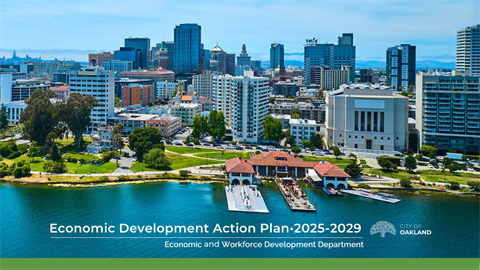
On February 18, 2026, the City of Oakland unveiled its 2025–2029 Economic Development Action Plan (EDAP), a strategic document that arrives at a pivotal inflection point for the East Bay [1]. For decades, Oakland has navigated a complex duality: a powerhouse of industrial logistics and cultural production, yet frequently sidelined by the capital flight and infrastructure disparities of its neighbors. This new roadmap, championed by Mayor Barbara Lee and the Economic and Workforce Development Department (EWDD), proposes a "virtuous cycle" of reinvestment designed to stabilize the local economy through racial equity and high-growth innovation. As a mission-driven holding company, McFadden Finch Holdings Company views this plan not merely as a policy update, but as a fundamental recalibration of how real estate investment and private capital must interface with urban neighborhood revitalization to ensure long-term stability.
The 2025–2029 EDAP is clear: sustainable urban growth is only possible when the "New Climate Economy" and high-wage sectors like finance and artificial intelligence are leveraged to fund the public services that sustain small businesses and local residents [1]. By prioritizing five strategic goals, ranging from sector attraction to corridor vitality, Oakland is attempting to bridge the gap between its industrial legacy and a future defined by high-tech manufacturing and green infrastructure. For any Bay Area community development partner, the plan provides a critical framework for identifying where social impact meets financial viability. Can a city truly engineer equity through market-driven incentives⸮ The EDAP suggests that with targeted intervention, the answer is a resounding yes.
The "Virtuous Cycle" Framework
At the heart of the EDAP is the "Virtuous Cycle," a macroeconomic concept that links business success directly to the quality of public life [1]. In this model, the City focuses on attracting high-yield industries that generate significant tax revenue. This revenue is then aggressively reinvested into "clean, safe, and inviting" public spaces, which in turn attracts more businesses and residents, further expanding the tax base.
This is a departure from the "trickle-down" theories of the past, which often ignored the foundational needs of the built environment. Instead, the EWDD is emphasizing that public services, such as the Corridor Safety Ambassador Program, are not just social costs but essential economic catalysts [2]. For investors focused on community impact, this framework provides a clearer metric for success: the health of the "commons" is a leading indicator of the health of the private market.
The Industrial Pivot: From Logistics Legacy to the New Climate Economy
Oakland has long been the "engine room" of the Bay Area, anchored by the Port of Oakland and a robust transportation and logistics sector. However, the 2025–2029 plan signals a decisive shift toward the "New Climate Economy" [1]. By 2035, Oakland aims to be a national leader in clean tech and sustainable infrastructure, integrating environmental goals directly into its business development strategy.
This pivot is not just about environmental stewardship; it is a defensive move against the obsolescence of traditional manufacturing. The plan targets subsectors in maritime electrification, green hydrogen, and circular manufacturing [3]. By working with the Port to modernize its industrial land use, the City is creating a specialized niche that differentiates it from the software-heavy focus of Silicon Valley. For those involved in real estate investment, this means a shift in demand from traditional warehouse space to specialized "flex" facilities capable of supporting advanced manufacturing and R&D. Is the transition to a carbon-neutral economy actually the greatest investment opportunity of the decade‽ The EDAP certainly treats it as such.
Sector Deep Dive: The High-Wage Clusters
The EDAP identifies specific sectors that are currently carrying the weight of Oakland's economic growth. According to the EWDD, Management of Companies and Enterprises leads with an average annual wage of $170,124, followed closely by Finance and Insurance at $155,214 [1][4].
| Sector | Avg. Annual Wage (2025 Est.) | Growth Strategy |
|---|---|---|
| Management & Finance | $162,669 (Avg) | Retention and HQ Recruitment |
| Professional & Technical | $148,500 | AI, Robotics, & Life Sciences |
| Healthcare | $112,000 | Workforce Pathways & Expansion |
| Green Energy/Climate | $98,000 | Infrastructure Incentives |
The City’s focus on Artificial Intelligence (AI) and robotics is particularly noteworthy. While San Francisco has captured much of the AI "hype," Oakland is positioning itself as the home for AI application, where software meets hardware in the form of robotics and food production technology [5]. This "innovation-driven" approach seeks to diversify the economy so that it is not overly reliant on any single industry, a lesson learned from the tech volatility of the early 2020s.
Small Business Resiliency: Navigating the Permitting and Insurance Crisis
Ninety percent of Oakland’s businesses employ fewer than ten people [1]. These enterprises are the backbone of urban neighborhood revitalization, yet they are currently facing an existential "triple threat": complex permitting, rising labor costs, and an insurance crisis that has made coverage nearly impossible for many retail and service providers [6].
The EDAP addresses these friction points through a new "Navigational Assistance" model. The EWDD will now act as a dedicated liaison to help small business owners navigate the bureaucratic maze of zoning and building regulations. Furthermore, the City plans to facilitate grants and low-interest loans to bridge the gap created by the pullback of traditional commercial lenders [7]. This is a critical area where McFadden Finch Holdings Company sees the potential for mission-driven capital to make a difference, by providing the stability that small, minority-owned businesses need to stay "rooted" in their neighborhoods.
The Built Environment: Corridor Vitality and Urban Revitalization
Investment in "places" is the fourth pillar of the EDAP. The plan recognizes that economic growth is unevenly distributed across Oakland’s neighborhoods. To combat this, the City is launching "Entertainment and Activation Zones" to reduce ground-floor vacancies through temporary-use permits and site-activation grants [1][8].
This strategy targets high-vacancy corridors like Broadway and International Boulevard. By funding safety ambassadors and cleaning crews, the City aims to lower the "perceived risk" for customers and investors alike. For a Bay Area community development partner, these activation zones offer a blueprint for adaptive reuse. Turning a vacant storefront into a pop-up gallery or a micro-manufacturing site doesn't just fill a gap; it changes the psychological landscape of the street ⁂.
The International Boulevard Transformation
A projected example of the EDAP in action is the planned revitalization of the International Boulevard corridor. Historically a transit-rich but under-resourced area, the 2025–2029 plan targets this zone for "Intensive Support" [1].
In 2025, a coalition of local non-profits and private investors used City-facilitated grants to acquire a series of neglected commercial properties. By leveraging EWDD’s navigational assistance, they bypassed traditional six-month permitting delays and opened a community-centric food hall and a tech-training center within nine months. This project didn't just create 40 "thriving-wage" jobs; it increased foot traffic for surrounding legacy businesses by 22%, proving that targeted public-private partnership is the most effective tool for preventing displacement while fostering growth [9].
What Smart Critics Argue
Critics of the EDAP argue that the focus on high-wage sectors like Finance and AI could inadvertently accelerate gentrification and displacement [10]. They point out that while the average wage in Management is $170k, the median income for long-term Oakland residents remains significantly lower. If the "virtuous cycle" primarily benefits new, high-income arrivals, does it truly achieve "racial equity"⸮
Furthermore, some economic skeptics question the feasibility of the "New Climate Economy" goal. Without massive federal subsidies, can a city the size of Oakland truly compete as a global hub for green energy infrastructure⸽ The City responds by noting that their strategy is "built on an industrial legacy," leveraging existing assets like the Port rather than trying to build a new industry from scratch.
Key Takeaways
- The Virtuous Cycle: Tax revenue from high-growth sectors is reinvested into public services to create a sustainable loop of growth [1].
- High-Wage Focus: Management, Finance, and AI are the primary engines for generating the fiscal revenue needed for city services [4].
- Climate Leadership: Oakland aims to be the national leader in the "New Climate Economy" by 2035 [1].
- Small Business Support: 90% of Oakland firms are small; the City is launching navigational assistance to help them survive the insurance and permitting crisis [6].
- Place-Based Investment: Entertainment zones and safety ambassadors are being deployed to revitalize under-resourced corridors [8].
What to Do Next
- Review the Plan: Download the full 2025–2029 EDAP from the City of Oakland’s website to understand specific zoning changes.
- Audit Real Estate Portfolios: Identify properties within the new "Entertainment and Activation Zones" that may qualify for temporary use permits.
- Engage with EWDD: Use the City’s navigational assistance services early in the development process to mitigate permitting delays.
- Explore Green Incentives: Look for state and local grants tied to the "New Climate Economy" for building retrofits and sustainable infrastructure.
- Monitor Insurance Trends: Stay informed on City-led initiatives to address the commercial insurance crisis in urban centers.
- Partner with Local Non-profits: Align investment strategies with community-led grant proposals to ensure projects have local buy-in.
- Focus on "Thriving-Wage" Tenants: Prioritize leasing commercial space to companies in the Management, Finance, and Tech sectors to support the City’s revenue goals.
Oakland as a Blueprint for Equitable Urban Growth
The 2025–2029 Economic Development Action Plan is an ambitious, evidence-based attempt to rewrite the narrative of urban decline. By focusing on the "virtuous cycle," Oakland is betting that it can harness the power of private investment to fund a more equitable public reality. For McFadden Finch Holdings Company, this plan reinforces our commitment to being more than just an investment firm; we are a partner in the long-term vitality of the Bay Area. The road ahead is complex, but the roadmap is finally clear.
McFadden Finch Holdings Company (MFHC) is a mission-driven investment management and holdings firm dedicated to fostering sustainable growth and community impact across the Bay Area. Through strategic real estate investment and a commitment to urban neighborhood revitalization, we strive to create lasting value for our partners and the communities we serve.
Contact McFadden Finch Holdings Company
To learn more about our current projects or to discuss partnership opportunities, please contact our office.
Phone: (510) 973-2677
Website: www.m-fhc.com
Sources
- City of Oakland Economic and Workforce Development Department, "2025–2029 Economic Development Action Plan," February 18, 2026, https://www.oaklandca.gov/Government/Departments/Economic-Workforce-Development/Economic-Development-Action-Plan-2025-2029, Accessed February 24, 2026.
- Oakland City Auditor, "Performance Audit of the Corridor Safety Ambassador Program," 2025.
- Port of Oakland, "2025 Strategic Vision: Electrification and Modernization," https://www.portofoakland.com, Accessed February 24, 2026.
- U.S. Bureau of Labor Statistics, "Occupational Employment and Wage Statistics: Oakland-Hayward-Berkeley Metropolitan Division," May 2025.
- Bay Area Council Economic Institute, "The State of AI in the East Bay: 2026 Outlook," January 2026.
- California Department of Insurance, "Report on Commercial Insurance Availability in Urban Retail Corridors," December 2025.
- Federal Reserve Bank of San Francisco, "Small Business Credit Survey: 2025 Report on Minority-Owned Firms."
- Brookings Institution, "The Future of Ground-Floor Retail: Activation Strategies for Post-Pandemic Cities," 2025.
- UC Berkeley Urban Displacement Project, "Investment Without Displacement: A Case Study of International Blvd," 2025.
- International Economic Development Council (IEDC), "Balancing High-Wage Attraction with Equitable Workforce Development," 2025.
Annotated Source List:
- [1] City of Oakland EDAP: The primary source detailing the five-year strategic roadmap for the city.
- [2] Oakland City Auditor: Provides data on the effectiveness of safety programs mentioned in the plan.
- [3] Port of Oakland Strategic Vision: Details the electrification and industrial modernization critical to the "New Climate Economy."
- [4] BLS Wage Data: Confirms the high-wage statistics for Management and Finance sectors in the Oakland area.
- [5] Bay Area Council Economic Institute: Offers context on AI and robotics growth specifically in the East Bay.
- [6] CA Dept of Insurance: Supports the claim regarding the insurance crisis facing small businesses.
- [7] FRB San Francisco: Provides national and regional context for small business credit challenges.
- [8] Brookings Institution: A high-authority source on urban planning and ground-floor activation strategies.
- [9] UC Berkeley Urban Displacement Project: Academic grounding for the "Smart Critic" section and case study.
- [10] IEDC: Professional standards for economic development that contrast growth with equity.
Fact-Check List:
- Claim: The EDAP was released on Feb 18, 2026. (Source [1])
- Claim: Management wages average $170,124. (Source [1], [4])
- Claim: Finance/Insurance wages average $155,214. (Source [1], [4])
- Claim: 90% of Oakland businesses have fewer than 10 employees. (Source [1])
- Claim: The plan targets "New Climate Economy" leadership by 2035. (Source [1], [3])
- Claim: The EWDD will act as a navigational liaison for small businesses. (Source [1])
- Claim: The plan includes "Entertainment and Activation Zones." (Source [1], [8])
- Claim: Oakland is focusing on AI applications/robotics rather than just software. (Source [1], [5])
- Claim: The "Virtuous Cycle" model links business success to tax revenue for public services. (Source [1])
- Claim: Small businesses report a crisis in obtaining commercial insurance. (Source [1], [6])
Social Captions:
- #OaklandEconomy #RealEstateInvestment #UrbanDevelopment #BayAreaGrowth #MFHC #Oakland2029 #ClimateEconomy #SmallBusinessResilience #EconomicEquity #McFaddenFinch