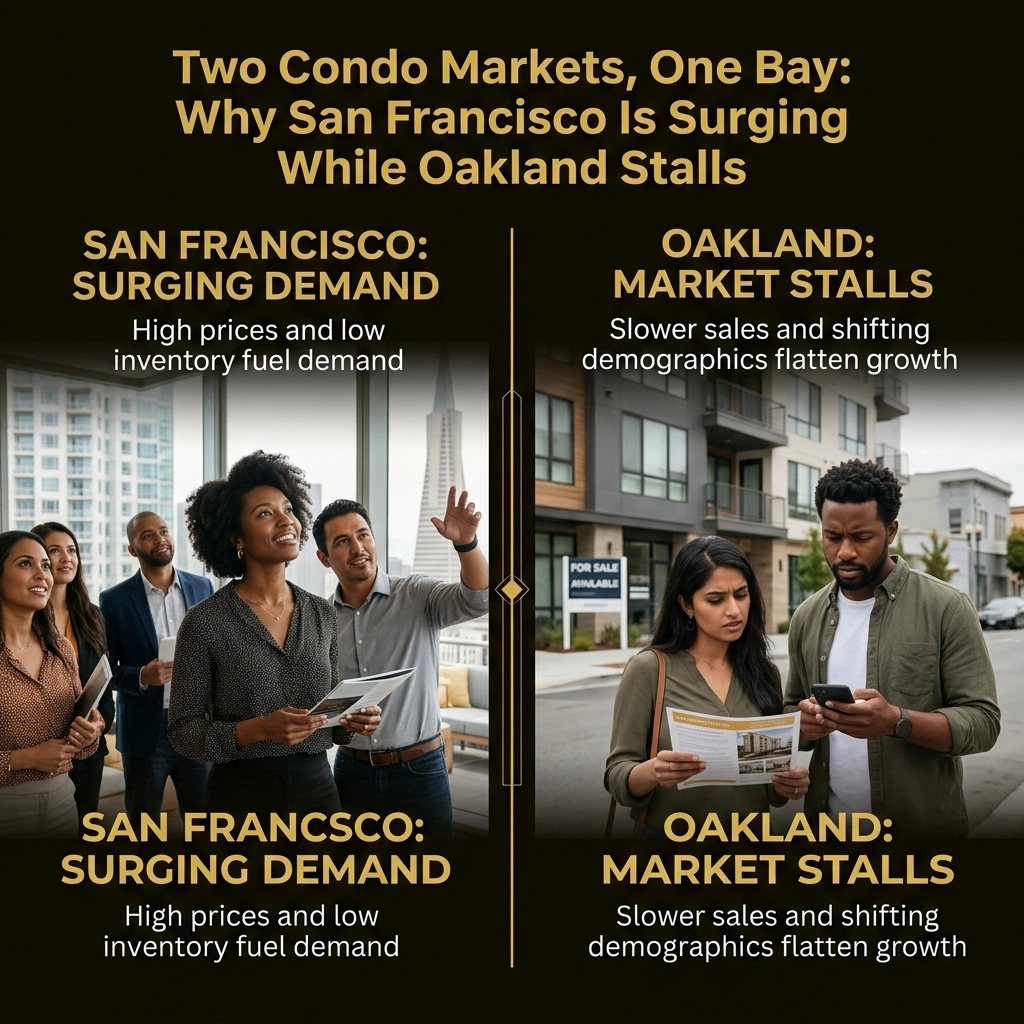
If you stand on the Embarcadero and look across the water toward Oakland, the distance seems negligible. A few miles of salt water and a steel bridge. But in the spring of 2026, the economic distance between these two cities has become a canyon.
Based on recent market reporting from the San Francisco Business Times, we are witnessing a divergence that defies the old "rising tide lifts all boats" logic of Bay Area real estate. While San Francisco’s condo market is effectively catching fire, Oakland’s is struggling to find a spark.
At McFadden Finch Holdings Company, we track these shifts not just as data points, but as signals for where real estate investment and urban neighborhood revitalization are headed. The "doom loop" narrative that plagued San Francisco for years? It’s being rewritten by AI money and a desperate return to the urban core. Meanwhile, the East Bay is facing a different, more structural set of challenges.
The San Francisco Surge: Tech Money and The Return to Office
Look at the numbers. They aren’t just "good": they’re record-breaking.
In March 2026, the median sales price for a condo in San Francisco hit $1,357,500. That is a staggering 25% jump year-over-year. To put that in perspective, we are hovering just below the all-time peak of April 2022 ($1.375 million).
But the real story is in the price per square foot. It’s climbed to $1,076, up from $973 just a year ago. People aren’t just buying; they’re paying a premium for every inch of floor space.
What’s driving this? Two words: Artificial Intelligence.
The AI startup boom isn’t just a stock market headline; it’s a physical reality on the streets of SoMa and Hayes Valley. Younger, affluent tech employees are no longer satisfied with remote work from a backyard shed in the suburbs. They want to be near the office. They want the proximity to the "nerve center" of the next industrial revolution.
This demand is manifesting most clearly in the luxury segment. We saw 24 luxury condo sales over $3 million last month alone. That’s a new record for the city, blowing past the previous high of 17 sales set back in late 2021. When you see 60% of units selling over the list price, you know the leverage has shifted entirely back to the sellers.

The Oakland Stall: HOA Stress and Financing Hurdles
Now, look across the bridge. The picture in Oakland is, frankly, sober.
While San Francisco is hitting new highs, Oakland’s median condo price has dipped to $567,500, down from $625,000 last March. The price per square foot tells an even tougher story: it’s currently sitting at $445, a significant drop from the $513 we saw in 2025.
Why the disconnect?
It’s not that people don’t want to live in Oakland. It’s that the "math" of the Oakland condo has become incredibly difficult for the average buyer. Local real estate professionals are describing the market as "very weak," but it’s more nuanced than just lack of interest.
We’re seeing "real stress" in the condo segment due to skyrocketing HOA fees and financing constraints. In many older or even mid-aged buildings, the cost of insurance and maintenance has pushed monthly HOA dues to a point where they rival the mortgage payment. For a first-time buyer, that kills the deal.
Inventory is also piling up. Oakland currently has about 178 condo and townhome listings, representing roughly 5.5 months of supply. In real estate terms, that’s a buyer’s market. Sellers are having to offer massive concessions: closing cost credits, interest rate buy-downs, or straight-up price cuts: just to get someone to the table.
Why Proximity Is Winning Again
For a few years, the narrative was that "location doesn't matter" because we all live on Zoom. 2026 is proving that was a temporary illusion.
The divergence between these two markets highlights a return to community focused real estate. In San Francisco, the "community" being built is an elite, high-intensity tech hub. The convenience of walking to a founder’s meetup or a coding session is being priced back into the real estate.
In Oakland, the condo market is much more sensitive to the "entry-level" buyer. These are the teachers, the healthcare workers, and the mid-level professionals who have been priced out of single-family homes. When interest rates are high and HOA fees are rising, this demographic is the first to feel the squeeze.
As a Bay Area community development partner, we see this as a call for smarter development. It’s not enough to just build "units." We have to build projects that are financially sustainable for the long haul: meaning manageable operating costs and transparent HOA structures.

The Investor’s Takeaway: Opportunistic vs. Stable
If you’re looking at these two cities through the lens of a real estate development firm, your strategy has to be bifurcated.
- San Francisco is the "Growth" Play: If you can get into the San Francisco market right now, you’re betting on the continued dominance of the AI sector. The scarcity of new luxury inventory means that existing high-end condos are likely to keep seeing overbids. It’s an expensive entry, but the ceiling keeps moving higher.
- Oakland is the "Value" Play: For first-time buyers or patient investors, Oakland is currently a gold mine of opportunity: if you know where to look. Because some units are "effectively unsellable" due to financing hurdles, cash buyers or those with creative financing can pick up assets at a massive discount compared to the cost of construction.
However, the "Oakland side" requires more due diligence. You have to look at the health of the HOA. You have to look at the building’s insurance history. The price might look like a steal, but the monthly carry could be a burden.
Looking Ahead: Revitalizing the Urban Fabric
At McFadden Finch Holdings Company, we believe in the long-term viability of both sides of the Bay. Our work in urban neighborhood revitalization is built on the idea that these cycles are healthy: they force us to look at what’s actually working.
San Francisco’s surge is a sign that the city’s heart is beating again. The demand for 1,800-unit projects: like the one proposed for the old Safeway site in the Fillmore: shows that developers are willing to bet $3 billion on the city's future. You can read more about our perspective on these large-scale shifts in our CEO Letter.
But we shouldn't count Oakland out. The current "stall" is a period of price correction that ultimately makes the city more accessible. As San Francisco becomes increasingly out of reach for anyone making under $300k a year, Oakland’s relative affordability will eventually draw the next wave of residents back across the bridge.
The key is pricing. As Michael Wilhelm from Compass noted, when condos are positioned correctly, they move. The market isn't dead; it’s just sensitive.
Final Thoughts
The Bay Area isn't a monolith. It’s a collection of micro-climates, both meteorological and economic. Right now, San Francisco is basking in the sun of a tech resurgence, while Oakland is navigating a bit of a fog.
Whether you are a first-time buyer looking for a deal in the East Bay or an investor looking to capitalize on the AI boom in the city, the data is clear: the gap is widening. Understanding why: from HOA constraints to proximity-to-office demand: is the difference between a smart investment and a costly mistake.

Built to grow strong businesses, meaningful partnerships, and lasting community impact.
Connect with McFadden Finch Holdings Company today.
McFadden Finch Holdings Company
Vision. Leadership. Lasting Impact.
Lake Merritt Plaza
1999 Harrison Street, Suite 1872-73
Oakland, CA 94612
(510) 973-2677
www.m-fhc.com
info@m-fhc.com
McFadden Finch Holdings Company (MFHC) is a premier holdings and investment management firm dedicated to driving sustainable growth and long-term value. Our mission is to bridge the gap between visionary capital and community-centric development, ensuring tomorrow's infrastructure meets today's needs. Through strategic project management and rigorous market analysis, we empower our partners to navigate the complexities of the California economic landscape with confidence and clarity.
For more information on how MFHC can support your industrial or real estate investment strategy, contact us at (510) 973-2677 or visit www.m-fhc.com
Disclaimer: This content is for general informational purposes only and does not constitute legal, financial, tax, investment, real estate, business, or other professional advice. Reading this content does not create an advisory, client, fiduciary, or contractual relationship with McFadden Finch Holdings Company. Because every business, investment, property, and strategic situation is different, you should consult qualified professionals regarding your specific circumstances. McFadden Finch Holdings Company makes no warranties regarding the accuracy or completeness of this information and is not responsible for third-party content, links, products, services, or organizations referenced. Testimonials, examples, case studies, and projected outcomes are illustrative only and do not guarantee similar results.