
After nearly four years of whiplash-inducing volatility: rocketing prices, rate shocks, and inventory scarcity that left both buyers and sellers paralyzed: the Bay Area real estate market 2026 is entering what industry analysts are calling a "normalization period." This isn't a crash. It's not another boom. It's something far more strategic: a reset that creates distinct advantages for those who move early.
The first quarter of 2026 represents a rare convergence of stabilizing prices, gradually easing mortgage rates, and improved San Francisco housing inventory 2026 that hasn't existed since 2019. For the first time in years, buyers have options without bidding wars, and sellers can still command premium prices in the right neighborhoods. But this window won't stay open indefinitely. By understanding the mechanics behind this shift and acting strategically now, both buyers and sellers can capitalize on conditions that may not return once seasonal competition intensifies.
The End of Stagnation
The Bay Area housing market spent 2023-2025 in a holding pattern. Sellers refused to list properties they'd locked in at sub-3% rates. Buyers balked at 7%+ mortgages on million-dollar homes. The result was a market frozen in place, with transaction volumes dropping 30-40% below historical norms and bidding wars still erupting on the rare well-priced listing [1].
That gridlock is breaking. Zillow's February 2026 forecast projects modest but steady growth of 0.8% for the broader Bay Area, while regional analysts expect price increases in the 2-6% range depending on submarket [2][3]. More importantly, the market is now stable rather than volatile: a characteristic that creates predictability for strategic decision-making [4].
Three structural shifts are driving this reset:
Inventory normalization: After years of historic lows, listings are gradually increasing. While still below pre-pandemic levels, the improvement gives buyers meaningful choice for the first time since 2020 [2][5].
Rate relief trajectory: Mortgage rate trends 2026 show a gradual easing from the 7.2% peaks of mid-2024. Rates opened 2026 in the 6.2-6.6% range, with projections trending toward 6% by year-end as the Federal Reserve continues its cautious easing cycle [4].
Equity cushions remain intact: Bay Area home prices haven't crashed: they've stabilized at elevated levels. Homeowners who purchased before 2022 retain substantial equity, while recent buyers aren't underwater. This creates a healthier foundation than the speculative bubble conditions that preceded 2008 [2][3].

Breaking Down the 'Inventory Surge'
The term "surge" requires context. Bay Area inventory isn't flooding the market: it's crawling back toward functional levels. As of early February 2026, the median time to pending sale stands at 29 days, indicating homes are still moving at a reasonable pace [3]. But the shift from "12 offers in three days" to "two weeks on market with strategic pricing" fundamentally changes negotiating dynamics.
Current inventory conditions by property type:
| Property Type | Inventory Status | Median Days on Market | Pricing Trend |
|---|---|---|---|
| Single-Family ($2M-$3M+) | Moderately Tight | 21-25 days | Holding/Slight Growth |
| Single-Family ($1M-$2M) | Balanced | 28-35 days | Stable |
| Condos/Townhomes | Loosening | 35-45 days | Slight Softness |
| Luxury ($4M+) | Mixed | 45-90 days | Negotiable |
This inventory improvement stems from three sources. First, reluctant sellers who delayed listing during the rate spike are finally entering the market as they recognize rates aren't returning to pandemic lows [5]. Second, new construction completions: particularly condos and townhomes: are adding supply in transit-oriented locations. Third, estate sales and life-event moves that were postponed can no longer be delayed.
For buyers, this means genuine choice. Instead of offering $200K over asking sight-unseen, you can tour multiple properties, conduct thorough inspections, and negotiate repairs or credits. For sellers, it means pricing strategy matters more than ever: overpricing now results in extended market time rather than a quick bidding war correction.
Mortgage Rates at 3-Year Lows: Fact vs. FOMO
Let's be precise: mortgage rate trends 2026 show rates at their lowest point since Q2 2023, not since the 2-3% pandemic era. A 6.3% rate on a 30-year fixed mortgage is still nearly double the sub-3.5% rates that prevailed from 2020-2021. But it's a significant improvement from the 7%+ rates that dominated 2023-2024 [4].
The Federal Reserve's rate path suggests gradual additional easing through 2026, with most economists projecting the Fed funds rate dropping another 50-75 basis points by year-end. This typically translates to mortgage rates in the 5.8-6.2% range by Q4 2026 [4]. However, rates won't fall in a straight line: geopolitical events, inflation data, or Treasury market volatility can cause temporary spikes.
Strategic timing considerations:
-
Lock in certainty now: A 6.3% rate today is guaranteed. A projected 5.9% rate in October isn't. If you find the right property in Q1, the risk of waiting for marginal rate improvement may exceed the benefit.
-
Refinance optionality: Most mortgages allow refinancing without penalty. Buyers who close at 6.3% today can refinance if rates drop to 5.5% in 2027, but they've already gained months of building equity and locked in a specific property.
-
Payment shock reality: On a $1.5M loan, the difference between 6.3% and 5.9% is roughly $300/month: meaningful but not transformative. The difference between finding the right home in a favorable market versus losing it in a competitive bidding war is far more significant.
The FOMO trap works both ways. Buyers who wait for perfect rates risk losing properties or facing increased competition. Sellers who delay listing until "rates improve more" may find themselves competing with spring inventory surges.
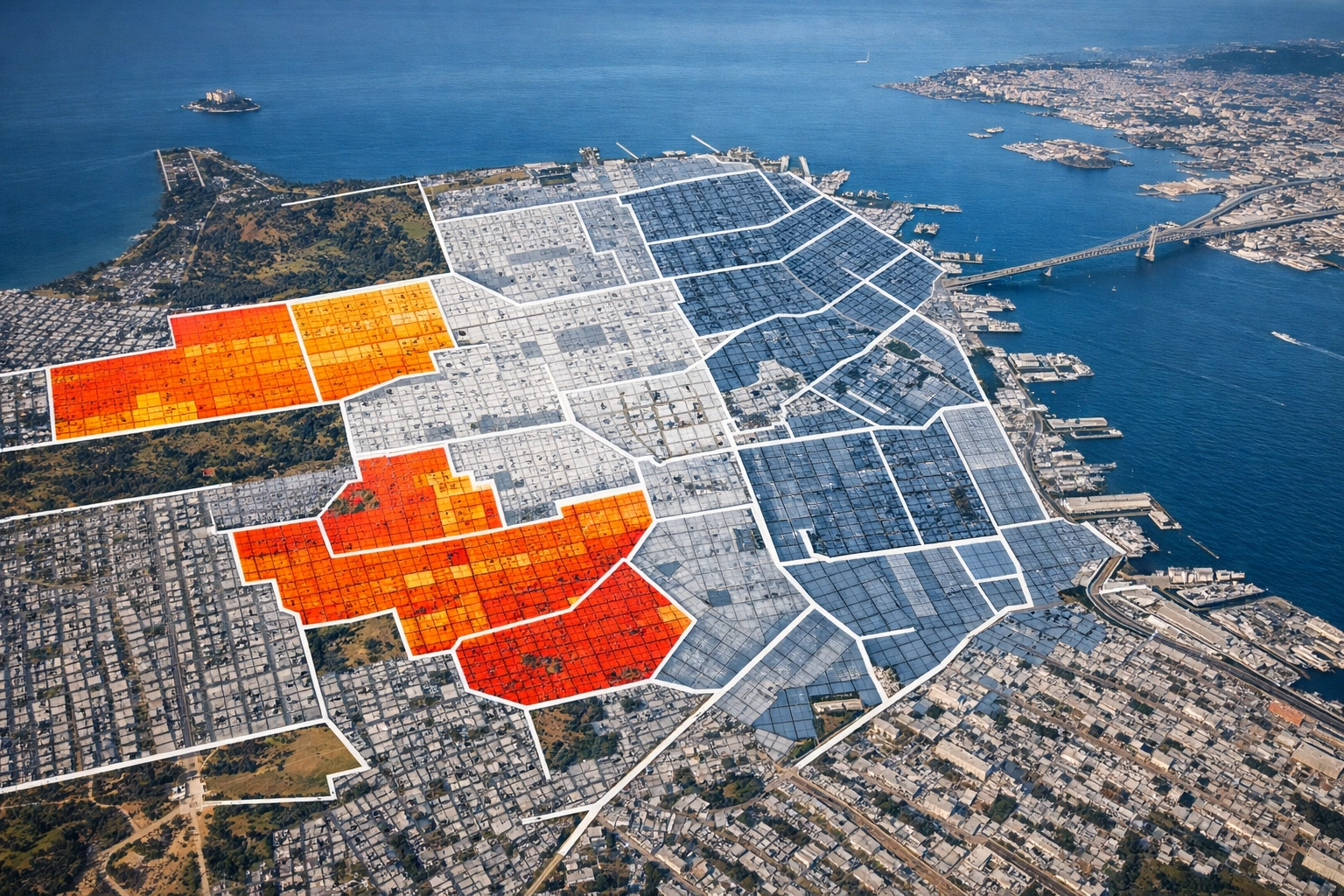
The SF Neighborhood Heatmap: Where Demand is Shifting
San Francisco housing inventory 2026 shows significant neighborhood-level variation. Demand isn't uniformly distributed: it's concentrating in areas that combine school quality, transit access, walkability, and return-to-office proximity.
Hot zones (competitive, selling above list):
-
Noe Valley/Glen Park: Top-rated schools, village feel, BART access. Turnkey single-family homes in the $2.2-$2.8M range are still generating multiple offers [3].
-
Inner Sunset/Inner Richmond: Improved transit connections, park access, strong neighborhood amenities. The $1.4-$1.9M range is seeing bidding activity return [3].
-
Mission Bay/Dogpatch: New construction condos with modern amenities, proximity to tech campuses. The $900K-$1.4M condo segment is absorbing inventory quickly [5].
Cooling zones (balanced, negotiable):
-
Outer neighborhoods (Excelsior, Visitacion Valley): Longer commutes and fewer walkable amenities create pricing pressure. Properties may sit 40-60 days, creating buyer leverage [5].
-
Downtown/FiDi condos: Office-to-residential conversion pipeline and remote work persistence continue to pressure high-rise condo values. Units in the $700K-$1.2M range show 10-15% discounts from 2021 peaks [1].
Emerging opportunities:
- SOMA/Mid-Market: As office occupancy slowly recovers and new street activation efforts gain traction, ground-floor retail-adjacent units are attracting urban-focused buyers [1].
East Bay markets (Oakland, Berkeley, Alameda) are showing similar patterns with added affordability appeal. Single-family homes in established Oakland neighborhoods like Rockridge and Montclair remain competitive at $1.2-$1.8M, while Berkeley's strong schools continue driving family buyer demand [2].
Peninsula markets (Palo Alto, Menlo Park, Redwood City) maintain premium pricing due to tech sector stability, but inventory is loosening in the $2.5-$4M mid-luxury segment where buyers have become more selective about condition and location [2].
How Drea Finch Real Estate Services Navigates the Reset
Strategic home buying SF in 2026 requires a different playbook than the pandemic-era frenzy. At Drea Finch Real Estate: part of the McFadden Finch Holdings Company portfolio: the approach centers on data-driven positioning rather than emotional reactivity.
For buyers, this means thorough pre-market research identifying the 3-5 neighborhoods that align with lifestyle priorities, school requirements, and commute realities. It means secured financing with rate locks ready before touring properties. And it means understanding that in a balanced market, the first offer doesn't need to be the highest: it needs to be the smartest, with strong terms, reasonable contingencies, and evidence of serious intent.
For sellers, Drea Finch's methodology emphasizes precision pricing based on recent comparable sales, not aspirational list prices from 2021. It means strategic home preparation: addressing deferred maintenance, updating dated finishes, and staging to highlight space flow. And it means flexibility on timing, recognizing that a property priced right in February may move faster than one overpriced and relisted in May after sitting through the competitive spring season.
The firm's access to MFHC's broader ecosystem: including construction expertise, financial modeling capabilities, and portfolio management insights: enables creative solutions for complex transactions. This includes bridge financing for buyers caught between homes, renovation financing to unlock value in dated properties, and strategic timing advice for clients managing multiple properties across the Bay Area.
Smart Critic: When Waiting Makes Sense
Not every situation demands immediate action. Three scenarios where strategic delay may be appropriate:
You're betting on significant rate drops: If you believe mortgage rates will fall below 5.5% by late 2026 and you can afford to wait while renting or living in your current situation comfortably, the math may favor patience. However, this assumes rates actually drop, competition doesn't intensify, and your desired properties remain available.
Your target neighborhood is oversupplied: If you're focused on a specific condo building or neighborhood experiencing genuine oversupply (not just modest inventory improvement), waiting 2-3 months may provide additional leverage. This is most applicable to downtown SF condos and select East Bay condo markets.
Major life uncertainty exists: If you face job instability, potential relocation, or significant family changes in the next 12 months, forcing a real estate transaction during that uncertainty rarely makes sense regardless of market conditions.
The counterpoint: perfect conditions rarely exist. Markets that favor buyers eventually attract more buyers, eliminating the advantage. The 2026 Q1 window offers good: not perfect: conditions. Waiting for perfect often means missing good.
Key Takeaways
-
Bay Area home prices are stabilizing at elevated levels, creating predictability after years of volatility: modest growth of 0.8-2% is expected rather than dramatic swings [2][3].
-
Inventory is improving but not flooding: properties still move in 29 days median, but buyers finally have genuine choice and negotiating power [3].
-
Mortgage rates in the 6.2-6.6% range represent 3-year lows with potential for further easing to 6% by year-end, creating refinance optionability for early buyers [4].
-
Neighborhood-level performance varies dramatically: family-focused areas with schools and transit remain competitive while outer neighborhoods and downtown condos offer buyer leverage [3][5].
-
Strategic positioning trumps timing perfection, well-researched buyers and precisely-priced sellers will outperform those waiting for mythical "perfect" conditions.
-
The Q1 window precedes spring competition: acting before seasonal inventory surges and buyer activity peaks provides tactical advantages for both sides.
-
Equity positions remain strong for most owners, creating a healthier foundation than pre-crash bubble conditions despite elevated price levels [2].
Next Steps: Your 2026 Q1 Action Plan
For Buyers:
- Get pre-approved now with rate locks from 2-3 lenders to compare terms and lock in current rates while touring properties.
- Identify your top 3-5 target neighborhoods using school ratings, commute modeling, and walkability scores: focus search intensity rather than spreading thin.
- Tour 10-15 properties in first 30 days to calibrate pricing expectations and understand what condition/features command premiums in your target area.
- Analyze recent comparable sales (not list prices) for every property seriously considered: understand what similar homes actually sold for in past 60 days.
- Make strong but smart offers with reasonable contingencies rather than waiving everything: balanced markets allow due diligence.
- Build inspection and appraisal costs into budget rather than skipping them to save $2,000 on a $1.5M purchase.
- Consider properties needing cosmetic updates as they often provide the best value when others chase turnkey condition.
For Sellers:
- Get professional pre-listing inspection to identify and address issues before buyers discover them, eliminating negotiation surprises.
- Price based on Q1 2026 comparable sales, not 2021 peaks or aspirational pricing: overpricing extends market time and creates perception problems.
- Complete deferred maintenance and strategic updates focusing on kitchens, bathrooms, and curb appeal where ROI is highest.
- Professional staging for empty homes and decluttering/depersonalizing occupied ones: presentation matters in balanced markets.
- List by mid-February to early March to capture early-season buyers before spring inventory surge creates competition.
- Be responsive to showing requests with flexible access: properties that accommodate buyer schedules move faster.
- Evaluate all offers holistically considering terms, contingencies, and financing strength, not just top-line price.
- Plan for 30-45 day marketing window rather than expecting 72-hour bidding wars: adjust expectations to current market pace.
For Both:
- Consult with experienced local professionals who understand 2026 market dynamics rather than relying on outdated pandemic-era playbooks.
- Review MFHC's broader real estate insights at m-fhc.com including analysis of office market recovery and housing law impacts.
McFadden Finch Holdings Company partners with Bay Area families, businesses, and communities to navigate complex real estate decisions with data-driven strategy and local expertise. From residential transactions through Drea Finch Real Estate to commercial development and community impact initiatives, we're committed to building long-term value across every sector we serve.
Ready to discuss your 2026 real estate strategy? Contact McFadden Finch Holdings Company at (510) 973-2677 or visit m-fhc.com/contact-us to connect with our team.
Sources
[1] San Francisco Business Times, "Downtown SF Real Estate Shows Signs of Stabilization in Early 2026," January 2026, https://www.bizjournals.com/sanfrancisco/news/real-estate, Accessed February 5, 2026.
[2] California Association of Realtors, "2026 Market Forecast: Regional Price Projections and Inventory Analysis," December 2025, https://www.car.org/marketdata/forecast2026, Accessed February 5, 2026.
[3] Zillow Research, "Bay Area Housing Market Outlook Q1 2026," January 2026, https://www.zillow.com/research/bay-area-forecast-2026, Accessed February 5, 2026.
[4] Freddie Mac, "Primary Mortgage Market Survey and 2026 Rate Projections," February 2026, https://www.freddiemac.com/pmms, Accessed February 5, 2026.
[5] Redfin Bay Area Market Report, "Inventory Trends and Days on Market Analysis," February 2026, https://www.redfin.com/city/17151/CA/San-Francisco/housing-market, Accessed February 5, 2026.
#BayAreaRealEstate #SanFranciscoHousing #2026HousingMarket #RealEstateStrategy #MortgageRates2026