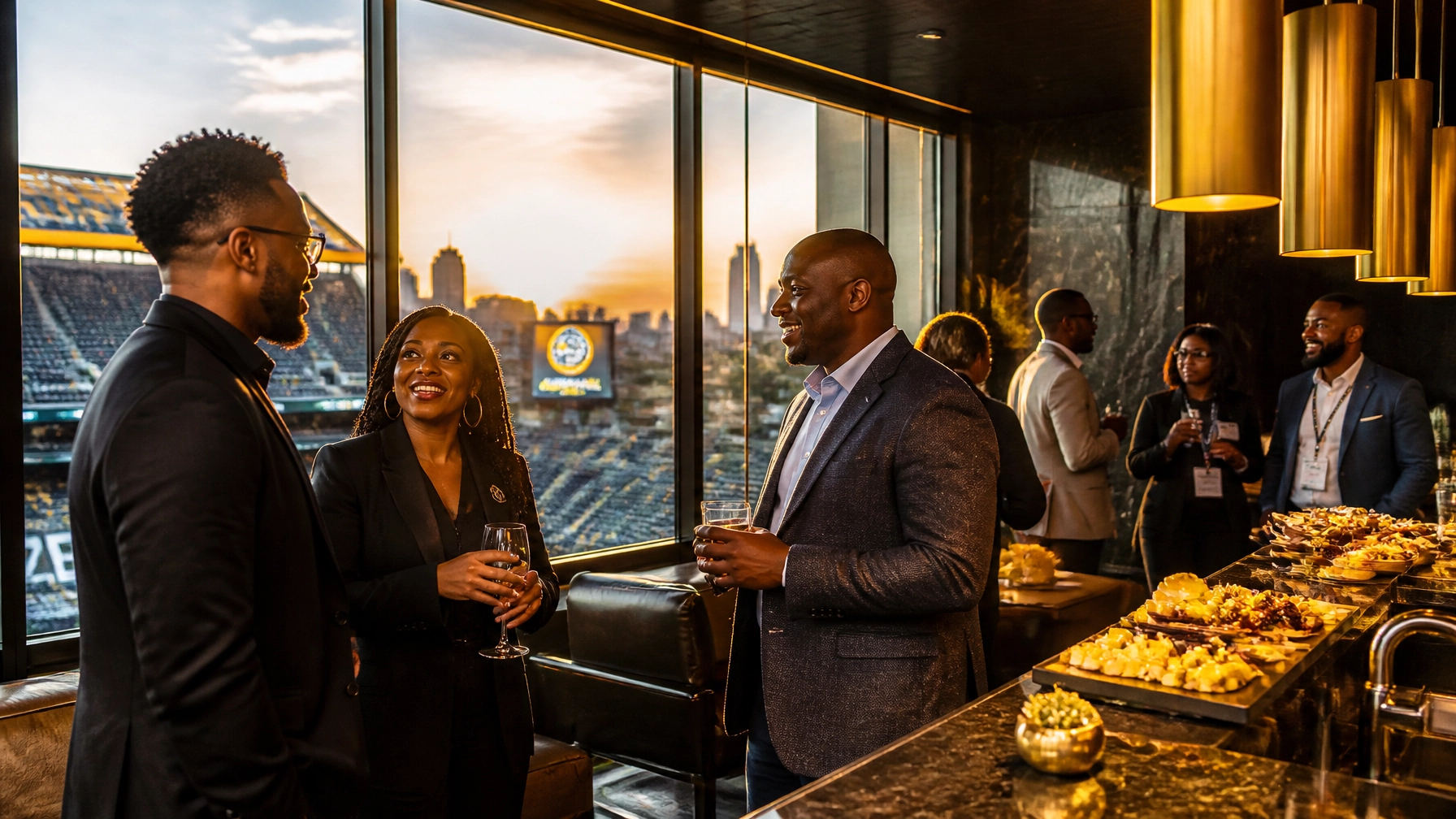
When the final whistle blew at Levi’s Stadium for Super Bowl LX, the scoreboard told one story. But for those of us watching the regional economy from the executive suites and the boardroom tables of Oakland and San Francisco, the real tally was only beginning. We knew the event would be big. We knew the eyes of the world were on the Bay. What we didn’t fully grasp until the data started rolling in was just how profoundly this single weekend would redefine our economic trajectory.
The numbers are out, and they are staggering. A post-event report from the Boston Consulting Group (BCG) has confirmed that Super Bowl 60 generated an estimated $720 million in total economic activity across the Bay Area. To put that in perspective, the pre-event projections: which were already ambitious: hovered between $370 million and $630 million. We didn’t just meet the high end of the goal. We shattered it.
At McFadden Finch Holdings Company (MFHC), we view these milestones through a specific lens: business development as a vehicle for community impact. A $720 million windfall isn't just a win for the NFL or the host committee. It is a testament to the Bay Area's world-class infrastructure, our resilient hospitality sector, and the sheer operational excellence that defines our regional business ecosystem. This wasn't a lucky break. It was the result of years of strategic planning, heavy lifting in construction, and a hospitality industry that knows how to perform on the global stage.
Shattering the Ceiling: The $720 Million Surge
Let's talk about that $720 million figure for a moment. In the world of economic forecasting, hitting the "high end" is usually cause for a press release. Beating the high end by nearly $100 million? That is a market signal. It tells us that the Bay Area isn't just "back": it’s operating at a level of efficiency and appeal that few other global hubs can match.
This surge didn't happen in a vacuum. It was driven by a massive influx of visitor spending on lodging, elite-level dining, transportation, and retail. But it’s the ripple effect that matters most. That initial $720 million represents "economic output," a fancy way of saying money that actually moved through the hands of local businesses and workers. When a visitor spends $500 on a dinner in San Francisco, that money doesn't just sit in a register. It pays the sous-chef. It pays the laundry service. It pays the local produce supplier.
For a firm like ours, which operates across restaurant consulting and real estate, this is exactly the kind of sustainable growth we champion. It proves that when we build the right infrastructure and support the right industries, the dividends are shared.
The Tale of Two Counties (and Every Square Mile in Between)
The geographic breakdown of the impact tells a compelling story of regional collaboration. San Francisco County, as expected, captured the lion's share, bringing in approximately $425 million. Santa Clara County, home to the stadium itself, received about $195 million. The remaining $100 million or so was distributed across the rest of the nine-county region, including our home base in Oakland and the East Bay.
This distribution is critical. In the past, there’s been a tendency to view these events as "San Francisco events" or "Santa Clara events." But Super Bowl 60 felt different. There was a deliberate effort by the Bay Area Host Committee to ensure the benefits were felt across the entire region. We saw it in the hotel bookings in Oakland and the increased foot traffic in Berkeley and the Peninsula.
From a construction and project management standpoint, this reinforces why regional thinking is the only way forward. Whether we are talking about transit corridors or mixed-use developments, the Bay Area is one interconnected organism. When one part of the region thrives, the pulse is felt everywhere. We’ve seen this in our work with Drea Finch Real Estate Services, where Bay Area expertise isn't just about knowing a neighborhood: it’s about understanding the macro-economic forces that drive value across county lines.

Hospitality: The Front Line of the Economic Engine
If you want to see where the $720 million really lived, look at the restaurants. The hospitality sector was the hero of Super Bowl weekend. The report indicates that the bulk of the economic activity came from food, beverage, and lodging. This isn't surprising to anyone in our McFadden-Finch Restaurant Consulting Group. We’ve always said that hospitality is the front line of community engagement and economic health.
Operating a high-end restaurant or a casual eatery during a global event like this is a logistical masterclass. It requires precision in staffing, supply chain management, and guest experience that most businesses never have to face. The success of Super Bowl 60 proves that the Bay Area culinary scene: one of the most diverse and innovative in the world: is ready for anything.
But here’s the thing: the impact didn't stop when the visitors left. The $20 million in local government revenue generated by this spending is now flowing back into our communities. That’s money for parks, for schools, and for the very infrastructure that makes the Bay Area a premier destination. When we consult with hospitality businesses, we don’t just look at the menu. We look at the legacy. We look at how that business anchors a street, a neighborhood, and a city.
Infrastructure as Destiny: Building for the Next Decade
You can’t host a $720 million weekend on a broken foundation. The success of Super Bowl LX was a direct result of the Bay Area’s "world-class infrastructure," as Host Committee President Zaileen Janmohamed rightly noted. But infrastructure isn't static. It’s something we have to build, maintain, and innovate constantly.
At Atlas Premier Services & Consultants, we spend a lot of time thinking about the construction and project management side of these large-scale regional successes. Whether it's residential projects that house our workforce or commercial spaces that host these global activations, the quality of our built environment dictates our economic ceiling.
Think about the 4,000 jobs supported by this event. Those aren't just temp roles. They are positions in logistics, security, event management, and construction that require a skilled, local workforce. When we invest in sustainable growth, we are investing in the people who do the work. The Super Bowl was a proof of concept for what happens when visionary capital meets rigorous project management.

4,000 Reasons for Optimism: The Human Element of Growth
Numbers are easy to report, but people are the point. The 4,000 jobs supported by Super Bowl 60 represent 4,000 households that saw a direct benefit from this event. The BCG report notes that approximately $330 million was generated in labor income. That is a massive infusion of capital into the pockets of Bay Area residents.
This is where the MFHC worldview really comes into play. We are "Philanthropreneurs." We believe that business growth must serve community impact. Through our philanthropic arms, like the McFadden Finch Foundation for Community Enrichment, we work to ensure that the "Bay Area success story" includes everyone.
When we see $720 million in activity, we don't just see a bigger GDP. We see a stronger Oakland. We see a more resilient San Francisco. We see a region that is capable of generating massive wealth and: hopefully: distributing that opportunity more equitably. The success of Super Bowl 60 is a template. It shows us what we can achieve when the public and private sectors align around a common goal.
The Strategy of Success: Lessons for the Future
So, what do we take away from this? Honestly, the biggest lesson is that the Bay Area’s "premium" status is alive and well. There have been plenty of headlines over the last few years questioning our future. The Super Bowl 60 data is a definitive answer to those questions.
But success like this doesn't happen by accident. It requires:
- Visionary Leadership: The ability to see the potential of an event years before it happens.
- Operational Excellence: The "concept to completion" mindset that we bring to every MFHC venture.
- Community Integration: Ensuring that a global event feels local and benefits the people who live here year-round.
We’ve seen this play out in our other sectors too. From Mission Cats In-Home Care providing trusted services to a traveling workforce to Nucleus Holdings investing in the next generation of tech and healthcare, the thread is the same: quality matters. Trust matters.

Sustaining the Momentum: What’s Next for MFHC?
The Super Bowl is gone, but the $720 million impact is still working its way through our economy. At MFHC, we aren't waiting for the next big game to drive growth. We are doing it every day through our diverse portfolio of professional services.
Whether we are consulting for the next great Bay Area restaurant or managing a multi-million dollar construction project, we carry the same momentum. We are building businesses that build communities. We are turning bold ideas into thriving enterprises.
The $720 million victory was a game-changer because it reminded the world: and maybe a few of us here at home: of what we are capable of. It’s time to take that same energy and apply it to our everyday business challenges. Let’s keep building. Let’s keep innovating. And let’s make sure the next big win for the Bay Area is even more impactful than the last.

Built to grow strong businesses, meaningful partnerships, and lasting community impact. Connect with McFadden Finch Holdings Company today.
McFadden Finch Holdings Company
Vision. Leadership. Lasting Impact.
Lake Merritt Plaza
1999 Harrison Street, Suite 1872-73
Oakland, CA 94612
(510) 973-2677
www.m-fhc.com
info@m-fhc.com
McFadden Finch Holdings Company (MFHC) is a premier holdings and investment management firm dedicated to driving sustainable growth and long-term value. Our mission is to bridge the gap between visionary capital and community-centric development, ensuring tomorrow’s infrastructure meets today’s needs. Through strategic project management and rigorous market analysis, we empower our partners to navigate the complexities of the California economic landscape with confidence and clarity.
For more information on how MFHC can support your industrial or real estate investment strategy, contact us at (510) 973-2677 or visit www.m-fhc.com.
Disclaimer: This content is for general informational purposes only and does not constitute legal, financial, tax, investment, real estate, business, or other professional advice. Reading this content does not create an advisory, client, fiduciary, or contractual relationship with McFadden Finch Holdings Company. Because every business, investment, property, and strategic situation is different, you should consult qualified professionals regarding your specific circumstances. McFadden Finch Holdings Company makes no warranties regarding the accuracy or completeness of this information and is not responsible for third-party content, links, products, services, or organizations referenced. Testimonials, examples, case studies, and projected outcomes are illustrative only and do not guarantee similar results.