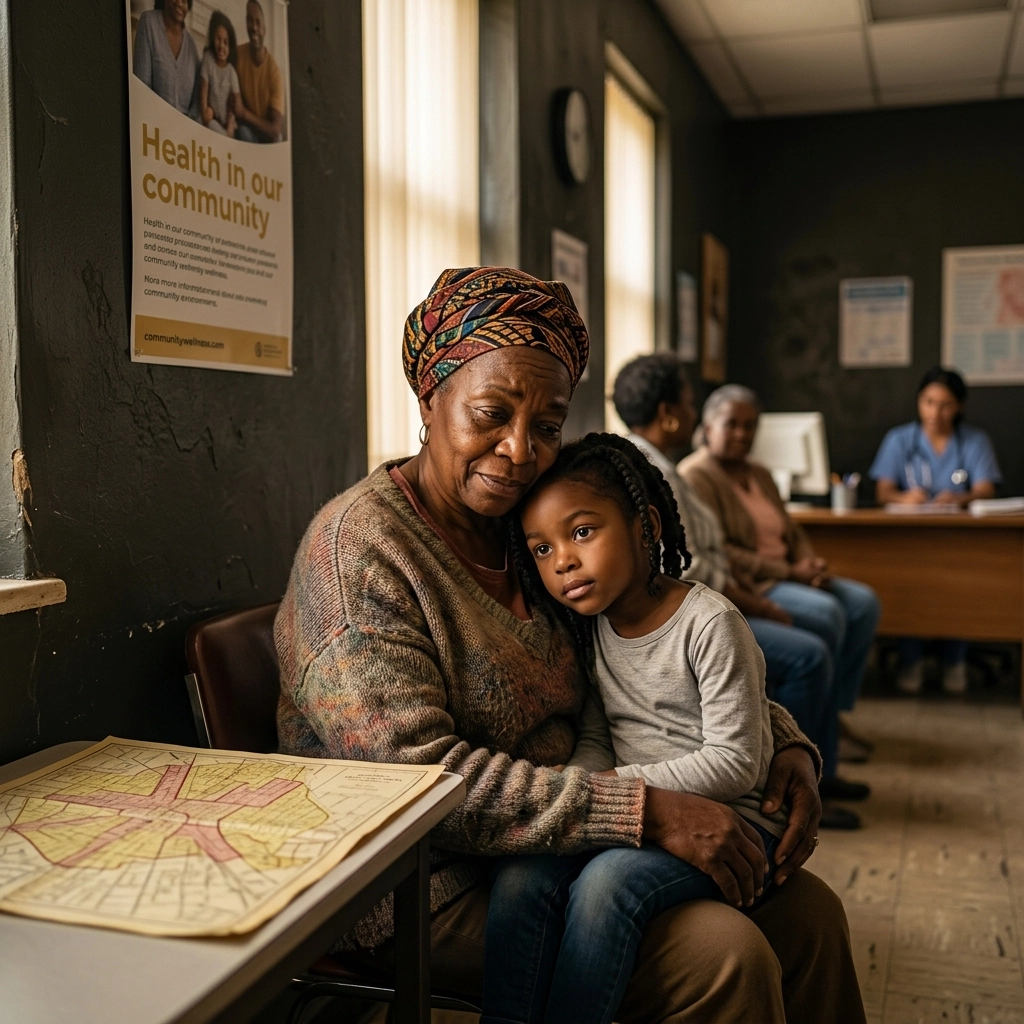
Look at a map of Oakland, San Francisco, or any major American city from 1937. You’ll see neighborhoods shaded in green, blue, yellow, and: most infamously: red. These Home Owners' Loan Corporation (HOLC) maps were designed to tell banks where it was "safe" to lend. Red meant "hazardous." In practice, it meant "this is where Black and brown people live."
We’re told redlining is history. A relic of a pre-Civil Rights era that we’ve moved past. But here’s the reality: those red lines haven't faded. They’ve just become invisible. They aren't just lines on a dusty map; they are the blueprint for where the heat is trapped, where the air is toxic, and why children in certain zip codes are labeled "troubled" before they even hit middle school.
At McFadden Finch Holdings Company, our work in urban neighborhood revitalization has shown us that you cannot talk about real estate or community impact without talking about environmental justice. If we want to build lasting value, we have to understand the toxic legacy that’s still poisoning the soil and the air in our most vulnerable communities.
The Toxic Legacy of the "D" Grade
When a neighborhood was graded "D" (redlined) eighty years ago, it didn't just lose out on mortgages. It lost out on trees. It lost out on parks. It gained freeways, bus depots, and industrial sites.
Today, these neighborhoods are literal heat islands. Because they have more asphalt and fewer trees, redlined areas can be up to 13 degrees hotter than greenlined neighborhoods in the same city. Heat isn't just uncomfortable: it’s a health crisis. It exacerbates cardiovascular issues and increases cortisol levels.
But it’s not just the heat. Research shows that residents in formerly redlined areas are nearly twice as likely to live near oil and gas wells. They breathe in higher levels of PM2.5: fine particulate matter that enters the bloodstream and wreaks havoc on the body. This isn't a coincidence. It’s the result of decades of placing industrial hazards in the paths of least political resistance.

Shifting the Narrative: From "Bad Kids" to "Exposed Kids"
There is a persistent, damaging narrative in this country. We see kids in low-income, historically redlined neighborhoods struggling with focus, exhibiting "behavioral issues," or being diagnosed with ADHD at staggering rates. Too often, the "expert" response is to blame the parents, the culture, or the kids themselves. They are labeled "bad" or "behind."
We need to stop blaming the outcome and start looking at the cause.
Environmental exposure is a massive, often overlooked driver of neurodevelopmental conditions. Lead is the most famous culprit. Even low levels of lead exposure in early childhood are linked to lower IQs, increased impulsivity, and aggression. Despite lead paint being banned decades ago, it remains a ghost in the walls of older, neglected housing stock in redlined districts.
Then there’s the air. New studies are linking high levels of air pollution to inflammation in the brain. When a child spends their first five years breathing in nitrogen dioxide from a nearby freeway: a freeway that was intentionally routed through a redlined neighborhood: their brain development is literally being altered.
When we talk about community impact, we have to realize that these kids aren't "bad." They are reacting to a toxic environment that their bodies were never meant to handle. It is a physiological response to a structural injustice.
The Mental Health Desert
The impact of redlining extends into the very systems designed to help. Recent research from George Washington University found a direct correlation between historic redlining and the current shortage of behavioral health clinicians.
In formerly redlined areas, there are fewer therapists, fewer psychiatrists, and fewer clinics. This creates a "behavioral health desert." Even if a parent recognizes that their child is struggling with the effects of environmental stress, finding a professional who takes their insurance and is located within a ten-mile radius is often impossible.
This is where the cycle tightens. A child is exposed to toxins that trigger behavioral issues, they live in a neighborhood that lacks the green space to mitigate that stress, and when they need help, there’s no doctor to see them. This isn't a failure of the individual; it’s a failure of the infrastructure.

Why Social Impact Investment Firm Strategies Matter
If you’re wondering why a social impact investment firm like MFHC is talking about neurodevelopment and PM2.5 levels, the answer is simple: you cannot have a thriving economy without healthy people.
Urban neighborhood revitalization isn't just about putting a fresh coat of paint on a building or opening a trendy coffee shop. That’s superficial. Real revitalization: the kind that creates community wealth building strategies: starts with the environment.
It means investing in "green" infrastructure that actually lowers the temperature of a neighborhood. It means supporting developers who prioritize high-grade air filtration and lead remediation. It means advocating for the removal of industrial hazards from residential zones.
We see our role as more than just managers of capital. We are connectors. We look at the data: the 1.7-year life expectancy gap for every grade drop on the HOLC scale: and we realize that our investment strategies must be a form of corrective justice.
Digital Redlining: The New Frontier
We also have to acknowledge that redlining has gone digital. In 2026, access to high-speed internet is a social determinant of health. Digital redlining: where fiber optic cables and high-speed infrastructure bypass lower-income neighborhoods: limits access to telehealth, educational resources, and job opportunities.
If a kid in a formerly redlined neighborhood can’t jump on a stable video call with a tutor or a therapist, they are being redlined all over again. It’s the same old blueprint, just with different materials.

What Can We Do Right Now?
Awareness is the first step, but accountability is what actually changes the map. Whether you are a resident, an investor, or a policymaker, there are tangible steps to combat the environmental legacy of redlining:
- Test Your Environment: If you live in an older home, test for lead in the water and soil. Use high-quality air purifiers (HEPA filters) to mitigate the impact of nearby traffic or industrial sites.
- Improve Ventilation: Simple fixes like better window seals and updated HVAC filters can dramatically reduce a child's exposure to neurotoxins.
- Advocate for Green Space: Support local initiatives that plant trees and create parks in "concrete jungle" areas. Trees aren't just pretty; they are air scrubbers and temperature regulators.
- Support Environmental Justice: Back policies that hold polluters accountable and prevent new industrial sites from being placed in already overburdened communities.
- Invest in Community Wealth: Support community wealth building strategies that keep the value generated by revitalization within the neighborhood, rather than displacing the very people who have endured these toxic conditions for decades.
The Bottom Line
The red lines of the 1930s were drawn with a pen, but they were built with brick, mortar, and exhaust pipes. We are still living inside that blueprint.
At McFadden Finch Holdings Company, we believe that the next chapter of urban development must be about erasure. Not erasing the history: we need to remember that: but erasing the disparities that history created.
Once we understand the cause: the air, the heat, the toxins, the systemic neglect: we can finally stop blaming the outcome. We can stop calling kids "bad" and start calling the environments "unacceptable." That is how we move toward real, lasting community impact.
Built to grow strong businesses, meaningful partnerships, and lasting community impact.
Connect with McFadden Finch Holdings Company today.
McFadden Finch Holdings Company
Vision. Leadership. Lasting Impact.
Lake Merritt Plaza
1999 Harrison Street, Suite 1872-73
Oakland, CA 94612
(510) 973-2677
www.m-fhc.com
info@m-fhc.com
McFadden Finch Holdings Company (MFHC) is a premier holdings and investment management firm dedicated to driving sustainable growth and long-term value. Our mission is to bridge the gap between visionary capital and community-centric development, ensuring tomorrow's infrastructure meets today's needs. Through strategic project management and rigorous market analysis, we empower our partners to navigate the complexities of the California economic landscape with confidence and clarity.
For more information on how MFHC can support your industrial or real estate investment strategy, contact us at (510) 973-2677 or visit www.m-fhc.com
Disclaimer: This content is for general informational purposes only and does not constitute legal, financial, tax, investment, real estate, business, or other professional advice. Reading this content does not create an advisory, client, fiduciary, or contractual relationship with McFadden Finch Holdings Company. Because every business, investment, property, and strategic situation is different, you should consult qualified professionals regarding your specific circumstances. McFadden Finch Holdings Company makes no warranties regarding the accuracy or completeness of this information and is not responsible for third-party content, links, products, services, or organizations referenced. Testimonials, examples, case studies, and projected outcomes are illustrative only and do not guarantee similar results.