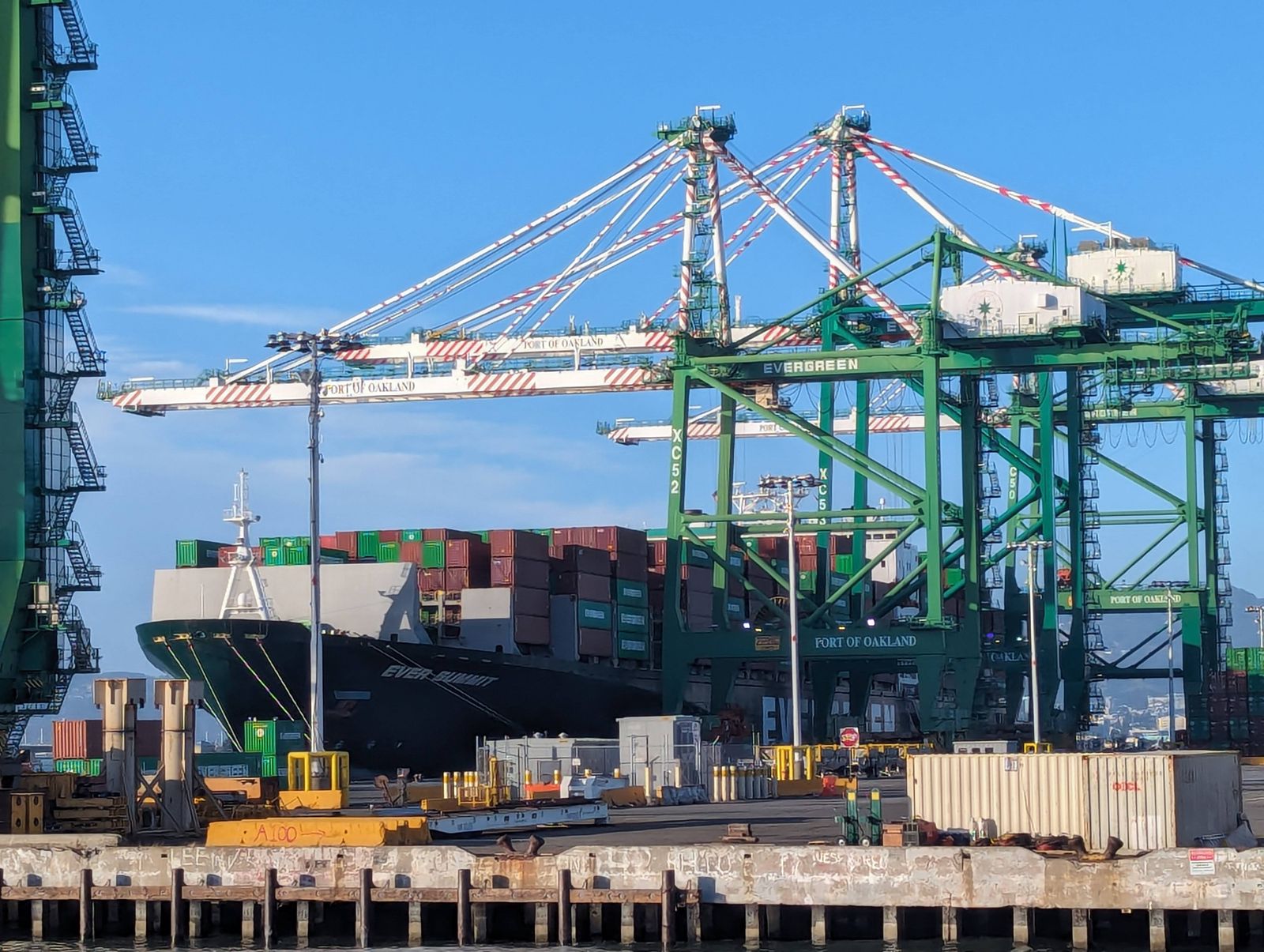
The Port of Oakland has started construction on infrastructure improvements across the Oakland Seaport that will enable its Matson Terminal to transition to a 100 percent zero-emission cargo-handling equipment fleet. Once complete, expected in 2028, Matson Terminal will be the first marine terminal at the Port of Oakland to reach that milestone. The project is supported by $119 million in funding from the California State Transportation Agency through the Port and Freight Infrastructure Program.
The announcement matters well beyond the seaport. Large infrastructure projects shape who gets hired, which firms win contracts, and whether longtime residents near the waterfront share in the gains. Oakland's experience shows how hiring rules, training programs, and small-business certifications decide whether a modernization budget becomes community benefit.
What Is Being Built
The Matson Terminal is operated by SSA Terminals, a joint venture between SSA Marine and Matson. Construction began in late October 2026 on new charging and electrical infrastructure that will allow the terminal to run its cargo-handling fleet entirely on zero-emission equipment. The Port announced the start of construction on October 27, 2026, alongside California Transportation Secretary Toks Omishakin, and expects completion in 2028.
The project is part of a broader shift in how California funds freight modernization. The Port and Freight Infrastructure Program, administered by the California State Transportation Agency, invests in projects that modernize the state's goods-movement network, reduce emissions, and relieve supply chain congestion. Electrifying cargo-handling equipment at a major container terminal is a leading example of that approach: replace diesel-powered machines with electric ones, and build the power infrastructure to support them.
The timeline deserves precise language. Construction is underway; the zero-emission fleet milestone is not yet achieved. The Port describes the first-in-fleet status as something the terminal will reach once the work is complete. Businesses planning around this project should treat 2028 as a projected completion date, not a finished result.
Why the Employment Rules Around a Project Matter as Much as the Budget
The Port of Oakland supports more than 98,000 regional jobs and about $174 billion in annual economic activity, according to figures the Port itself publishes. Those totals describe the seaport, Oakland San Francisco Bay Airport, and commercial real estate operations combined. A single terminal electrification project is a small fraction of that activity, but it is governed by the same employment framework the Port applies to its construction contracts.
That framework is the Maritime and Aviation Project Labor Agreement, known as MAPLA. In place since 2000, it requires Port contractors working on projects above $150,000 to pay into the Social Justice Trust Fund, currently $0.30 per work hour. Contractors also operate under hiring goals aimed at the Port's Local Impact Area: Oakland, Alameda, San Leandro, and Emeryville, the communities most likely to experience the benefits and the adverse effects of Port operations.
The Port's own published outcomes show both what the rules aim for and how difficult the targets are. In its most recent reporting period, 2023 through 2025, Port contractors achieved 29.08 percent Local Impact Area resident hiring against a 50 percent goal, while combined Local Impact Area and Local Business Area hiring reached 60.30 percent against the same 50 percent goal. Apprenticeship outcomes were stronger: Local Impact Area apprentices reached 62.33 percent, and new-hire apprentices numbered 20 in the 2023 to 2025 period, nearly double the 11 recorded in the prior period.
The lesson for any organization planning a large capital project is straightforward. Structural hiring goals create accountability, but they do not guarantee outcomes on their own. The gap between the 50 percent local-resident goal and the roughly 29 percent achieved comes down to execution: recruitment pipelines, apprenticeship access, and how early in the project contractors engage the local labor pool. The Social Justice Trust Fund exists partly to address that gap, with more than $800,000 awarded to community-based training programs since 2000.
Where Local Workers Enter the Pipeline
The Port describes its long-term workforce role as an intermediary: connecting new and incumbent workers to career pathways in maritime, aviation, and the transportation, distribution, and logistics sectors. In practice, that connects employers and unions with community-based training organizations. Several of the Port's named workforce partners are based in or near the neighborhoods closest to the seaport.
Two examples illustrate the pathway structure. Cypress Mandela Training Center in Oakland runs a 16-week pre-apprenticeship program in building and construction trades with a green construction and workforce development model. The West Oakland Job Resource Center, located adjacent to the Port, operates as a nonprofit workforce intermediary linking residents to port-related employment. The Port also works with the Building and Construction Trades Council of Alameda County, which represents 28 affiliated unions across the construction trades.
For workers, the practical takeaway is that electrification projects favor skills that did not exist in the same form a decade ago. Installing and maintaining charging infrastructure, servicing electric cargo-handling equipment, and building electrical distribution systems all draw on electrical and mechanical trades. Pre-apprenticeship training is a documented entry point: Cypress Mandela's 16-week program, for example, prepares participants for building and construction trades work. MAPLA itself sets a 50 percent goal for hiring Local Impact Area residents, an explicit recruitment commitment covering Oakland, Alameda, San Leandro, and Emeryville.

How Small Businesses Position for Port Contracts
The Port maintains a certification program designed to route contracting dollars to local firms. Its Non-Discrimination and Small Local Business Utilization Policy applies to Port public works, goods, and services contracts, and provides preference points for local, small, and very small businesses that bid on them. The Small Business Enterprise designation covers firms with average gross revenue up to $36 million over the prior three years; the Very Small Business Enterprise designation covers firms up to $5 million.

Eligibility goes beyond geography: a business must be economically independent, perform a commercially useful function, and have had a fixed commercial or residential location in Alameda County or Contra Costa County for the preceding 12 months to apply. The Port and its partner agencies in the East Bay Interagency Alliance offer a collaborative common application designed to streamline the certification process. The Port also runs workshops and events that teach firms how to pursue and perform Port contracts, and maintains a public certification database where firms can list and buyers can search.
For a small construction, electrical, logistics, or professional services firm in the East Bay, the sequence is concrete. Confirm eligibility based on location and revenue. Apply through the Port's Social Responsibility Certification Application. Watch the Port's bids and requests for proposals, and attend the Port's outreach events before bidding cycles open. The certification itself does not award work; it positions a firm for the preference points and small-business set-asides the policy provides when Port contracts are available.
A Practical Framework for Reading Any Infrastructure Announcement
Terminal electrification is one project, but the pattern behind it is reusable. When a major public or private investment lands in a community, the same four questions determine who benefits.
First, what does the funding require? State and federal programs often carry hiring, prevailing-wage, or small-business participation conditions. The Port and Freight Infrastructure Program is an example of public money arriving with public expectations attached.
Second, which rules bind the contractors? Project labor agreements, local-hire goals, apprenticeship ratios, and trust-fund contributions are the documented mechanisms. They apply to the contractor, not to casual observers, which means their effect depends on enforcement and early participation.
Third, where is the on-ramp for residents? Pre-apprenticeship programs, workforce boards, and intermediary organizations translate project budgets into individual careers. The existence of an on-ramp matters more than its marketing.
Fourth, how do local firms get certified before the work starts? Preference programs reward firms that completed certification and relationship-building before bids were issued. Businesses that wait for the contract posting usually start late.
Applied to Oakland, those questions point to a project whose community framework is unusually well documented. The hiring goals, achieved outcomes, training partners, and certification pathways are all published, which lets residents, workers, and small businesses engage with evidence rather than rumor. That transparency is itself a community benefit, and a standard worth holding other projects to.
What to Watch Next
The project runs through 2028, and the community outcomes worth tracking are the ones the Port already measures. Future MAPLA reporting will show whether local-resident hiring improves as electrification construction scales up. The Port's board meetings and its Social Responsibility events calendar are the public venues where contracting opportunities and workforce programs are announced. For workers and small businesses, the useful move is engagement now, while construction spending is ramping rather than after the contracts are let.
MFHC publishes weekly perspectives on business, leadership, portfolio industries, and community development, with a focus on practical insight, responsible growth, and long-term value.
McFadden Finch Holdings Company
Vision. Leadership. Lasting Impact.
Lake Merritt Plaza
1999 Harrison Street, 18th Floor
Oakland, CA 94612
Main: (800) 994-9028
Office: (510) 973-2677
Fax: (800) 210-5252
Website: https://www.m-fhc.com
Email: info@m-fhc.com
Sources
Port of Oakland: Port of Oakland Begins Construction to Electrify Matson Terminal's Cargo Handling Fleet (October 27, 2026): https://www.portofoakland.com/port-of-oakland-begins-construction-to-electrify-matson-terminals-cargo-handling-fleet
Port of Oakland: Workforce Development: https://www.portofoakland.com/community/workforce-development
Port of Oakland: Local, Small, and Diverse Business Programs: https://www.portofoakland.com/business/small-local-business
Disclaimer: MFHC does not provide tax or legal advice. This article provides general information and education, without individualized financial, investment, accounting, securities, lending, real estate, architectural, engineering, construction, employment, veterinary, medical, nonprofit, philanthropic, public-policy, or other professional advice. Business conditions, regulations, services, programs, costs, funding, investment criteria, and availability change. Readers should verify current information and seek qualified professional guidance appropriate to their circumstances. References to MFHC, portfolio organizations, affiliated nonprofits, outside organizations, products, services, or resources do not guarantee engagement, funding, investment, approval, availability, endorsement, partnership, or results. Reading this article or contacting MFHC does not, by itself, create an advisory, fiduciary, client, funding, investment, or other professional relationship.